

Rodrigo Sant'anna

Whether he's making a grand entrance, sharing personal stories or bringing a host of quirky characters to life, Rodrigo Sant'Anna lights up the stage.
I didn’t know what to expect from Rodrigo Sant’Anna: I’m Here, I’m Queer!. The title alone feels like a declaration, a punchline, and an invitation all at once. "I’m here, I’m queer"—the phrase carries the weight of a protest chant and the levity of a stand-up opener.
What does it mean to arrive, in a country where queer bodies are both celebrated and targeted? And how do you turn that tension into comedy?
Sant’Anna, a Brazilian comedian known for his sharp wit and knack for character work, steps onto the stage (or, in this case, the screen) with the kind of confidence that makes you lean in. The film—part stand-up special, part performance spectacle—runs a tight 62 minutes, a runtime that suggests efficiency over indulgence. There’s no fat here, just a comedian working through his material with the precision of someone who knows exactly how long an audience’s attention span lasts.
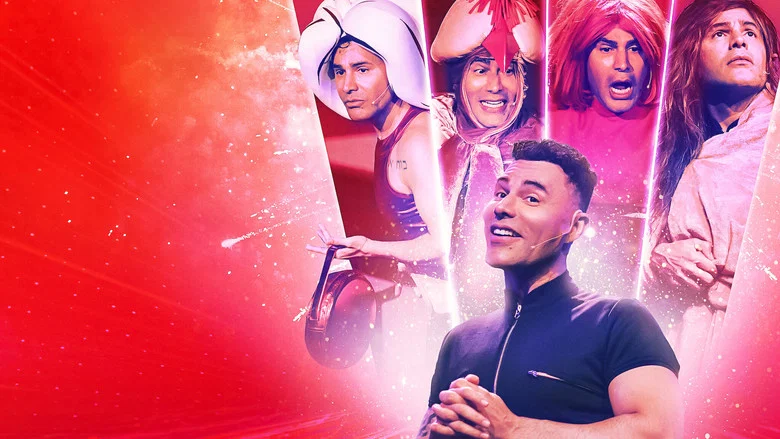
The first thing that strikes me is how Sant’Anna plays with the idea of arrival itself. The Portuguese title, Cheguei! ("I’ve arrived!"), feels more immediate, more triumphant. The English version, I’m Here, I’m Queer!, leans into the political, a nod to the queer activism of the '90s.
Both titles work, but they frame the performance differently. Is this a personal victory lap or a collective rallying cry? The answer, I suspect, lies somewhere in between.
Sant’Anna’s comedy thrives on character. He slips into personas with the ease of someone changing shirts—one minute, he’s a flamboyant auntie dispensing unsolicited advice; the next, he’s a straight-laced office worker whose repressed desires bubble to the surface. It’s a familiar comedic trick, but what makes it work is the specificity of his observations.
He’s not just mocking stereotypes; he’s dissecting the absurdity of how queer people are forced to navigate a world that often refuses to see them. There’s a moment where he mimics the way a straight man might react to a gay joke, his face contorting into exaggerated discomfort. It’s funny because it’s true—because we’ve all seen that look, that performative cringe.
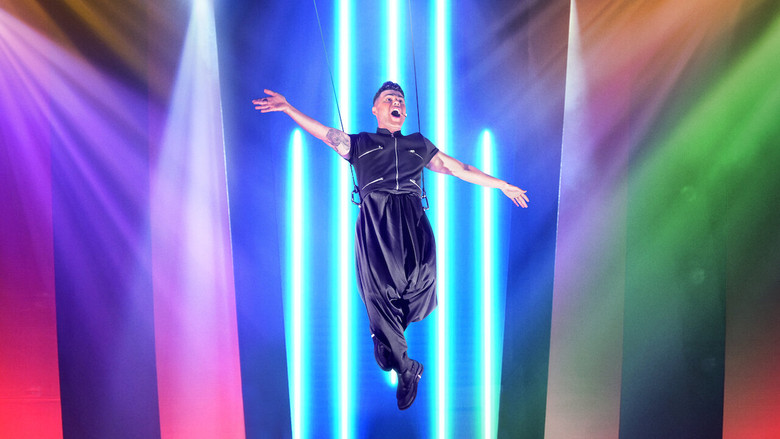
What’s missing, at least for me, is a deeper dive into the personal. Stand-up specials often walk the line between performance and confession, and while Sant’Anna’s material is sharp, it sometimes feels like it’s skimming the surface. There are glimpses of vulnerability—a joke about coming out, a throwaway line about family—but they’re fleeting.
I wanted more of the raw, unfiltered Rodrigo behind the characters. Maybe that’s the point, though. Maybe the performance is the arrival, the act of being seen in all your messy, contradictory glory.
The direction by João Fonseca is unobtrusive, which is probably the right call. The camera lingers on Sant’Anna’s face, capturing every raised eyebrow and exaggerated sigh. There’s no flashy editing or distracting visual gimmicks—just a comedian and his audience, locked in a conversation.
The staging is simple, almost theatrical, which makes sense given Sant’Anna’s background in live performance. This isn’t a film that’s trying to reinvent the wheel; it’s a document of a moment, a snapshot of a comedian at the height of his powers.
I keep coming back to the title. I’m Here, I’m Queer! isn’t just a statement; it’s a challenge. In a country like Brazil, where LGBTQ+ rights are both advancing and under constant threat, visibility is an act of defiance. Sant’Anna’s comedy doesn’t shy away from that reality.
His jokes about homophobia, about the performative allyship of straight people, about the way queer love is policed—these aren’t just punchlines. They’re tiny acts of resistance, wrapped in laughter.
The film’s brevity is both its strength and its limitation. At 62 minutes, it doesn’t overstay its welcome, but it also leaves you wanting more. More of Sant’Anna’s voice, more of his unfiltered thoughts, more of the man behind the characters.
That’s not a flaw, necessarily—just a reminder that comedy, like identity, is always a work in progress.
In the end, I’m Here, I’m Queer! is exactly what it claims to be: an arrival. Not a grand, sweeping statement, but a series of small, defiant steps onto the stage. Sant’Anna’s comedy doesn’t just make you laugh; it makes you feel seen. And in a world that often tries to erase queer voices, that’s no small thing.
Cheguei means I arrived. The English catalog went slogan. The Portuguese file is a 62-minute first special that landed on 19 May 2022, five weeks after his sitcom A Sogra que te Pariu put a Black, gay, favela comic in Netflix's global Top 10.,,
The sitcom is what the press chased. Sant'Anna created and starred as Dona Isadir, a Cachambi widow who moves into her son's Barra mansion for the pandemic and never leaves. Ten episodes, multicamera, live audience, first Brazilian sitcom on the platform. Opening week it hit sixth among non-English series with more than 11 million hours. In Brazil it sat second. He posted, "Vai ter preto, gay e favelado no topo, sim!" To Correio Braziliense he put the Portuguese title in a sentence. "Eu, preto, morador de comunidade e gay, latestnetflix.com argues, cheguei até aqui para contar tudo isso." Then the special arrived like an afterthought. IMDb has it at 3.6 from a few dozen votes. Rotten Tomatoes still has zero reviews.,,,
João Fonseca directed. Sant'Anna is the only billed performer. Rotten Tomatoes and the Netflix Brasil clip sell the same arc. He talks from Morro dos Macacos, the Vila Isabel favela where he grew up, to this debut, and he rolls out five new characters. Tinho the cherry tomato. Mother in the Pandemic. Cuzinho. Woman from the Search Site. Christmas Turkey. Netflix Brasil posted a one-minute clip on 26 April. The bus-bell bit is in it. He yells at the driver because the stop button never works, then calls that vocal training.,,,
He had already been famous as other people. Extra introduced him in 2011 as Admilson the womanizer and Valéria Vasques, the Metrô Zorra Brazil drag who made "Ai, como eu tô bandida" a Saturday catchphrase. Maurício Sherman had pulled him and Thalita Carauta out of the play Os Suburbanos. Globo's Melhores do Ano gave him the comedy trophy in 2011, 2012, and 2015. By 2022 he was also Dona Graça on Multishow's Tô de Graça. The 2021 Netflix deal wanted him as himself. Wikipedia dates the sitcom renewal to 29 April, ten days before the special. The English title does the coming-out work the Portuguese one never asked for. Cheguei is arrival. The sitcom did the arriving. The special is the guy from the hill, on a clean stage, trying on new faces after the old ones already owned Saturday night.,,
Entertainment rumors and trivia aggregated from public reporting. Treat speculation as unverified unless a cited source confirms it.
More titles in the same genres and with the same cast.


