Aldo Baglio
Salvo

Two proud and estranged brothers, a disputed inheritance and a past that comes back. When he hears about the passing of his father - whom he has not seen in many years - Salvo returns to his native Sicily. He intends to convince his brother Lillo to sell the family farm and save his pizzeria, which is about to go bankrupt - a secret that he has kept even from his wife and children. But things will not be easy and Salvo will have to come to terms with his choices. A bittersweet comedy about family relations and how one never stops growing up, not even at fifty.
I didn’t expect to laugh so much in a film about inheritance disputes and pizzeria bankruptcies. Then again, A Breath of Fresh Air isn’t really about the money—or the pizza, for that matter. It’s about the way two brothers, Salvo and Lillo, circle each other like boxers who’ve forgotten the rules, their jabs softened by decades of shared history and unspoken regret.
The film’s title promises something light, a breeze cutting through the humidity of Sicilian summers, but what it delivers is closer to the slow, stubborn heat of the island itself: something you can’t escape, even when you think you’ve left it behind.
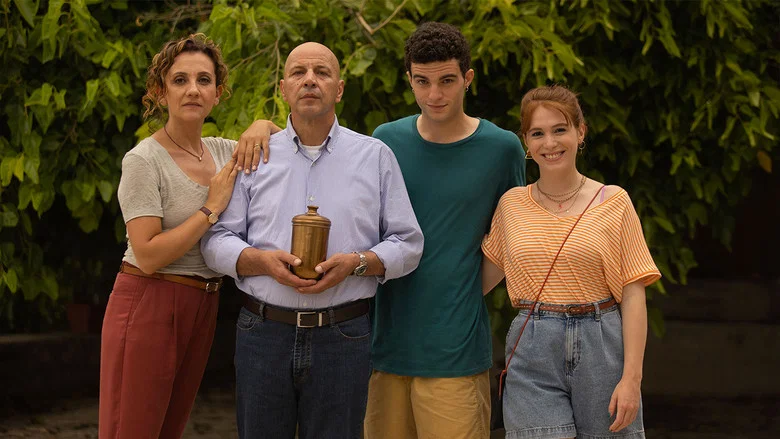
Alessio Lauria’s film is a comedy-drama in the truest sense, meaning it refuses to let you settle into one emotional register for long. The opening act plays like a farce: Salvo (Aldo Baglio), a man who’s spent his life pretending everything is fine, returns to Sicily after his father’s death, only to discover that his brother Lillo (Giovanni Calcagno) has no intention of selling the family farm.
The pizzeria Salvo runs in the north is on the brink of collapse, a fact he’s hidden from his wife and children, and the inheritance is his last lifeline. The premise is ripe for slapstick—two stubborn men, a crumbling house, a secret that’s about to explode—but Lauria isn’t interested in easy laughs. Instead, he lets the humor emerge from the specifics of the brothers’ dynamic: the way Salvo’s polished, mainland Italian accent clashes with Lillo’s thick Sicilian dialect, or how their arguments devolve into childhood insults, as if they’re still twelve years old, fighting over the last arancino.
What’s striking is how little the film relies on plot. There’s no grand revelation, no third-act twist that reframes everything. The conflict is simple: one brother wants to sell, the other refuses.
The stakes are financial, but the real tension is emotional. Salvo’s desperation isn’t just about money; it’s about the fear of admitting failure, of facing the life he’s built on half-truths. Lillo, meanwhile, clings to the farm not out of sentimentality, but because it’s the only thing he’s ever had that feels like his own.
Their arguments aren’t just about the land—they’re about the choices they’ve made, the people they’ve become, and the unspoken question that hangs between them: Did we ever really know each other?
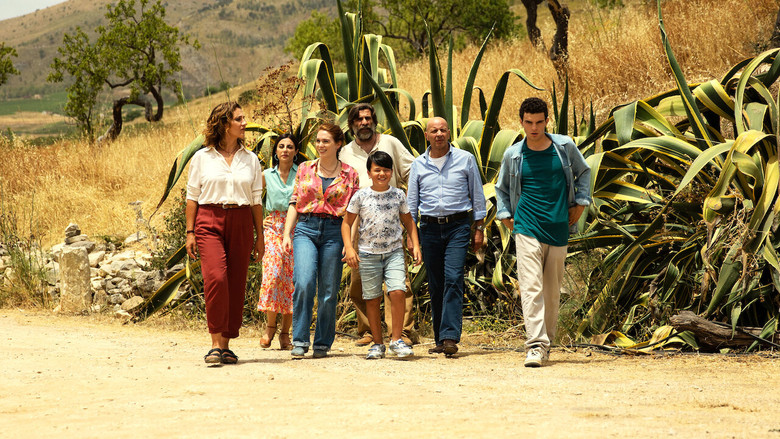
The performances are what make this work. Baglio, best known for his comedic roles, plays Salvo with a quiet desperation that’s more heartbreaking than any dramatic monologue. There’s a moment early in the film where he’s on the phone with his wife, lying about how the trip is going, and his voice is so light, so convincing, that you almost believe him—until you catch the way his free hand grips the edge of the table, his knuckles white.
Calcagno, on the other hand, is all rough edges, his Lillo a man who’s spent his life working the land and resents the idea that anyone might think he’s soft. Their scenes together crackle with the kind of tension that only exists between people who know each other too well. You can feel the history in the way they stand just a little too far apart, in the way Lillo’s eyes flick away when Salvo mentions their father.
Lauria’s direction is unshowy but effective. The Sicilian landscape isn’t just a backdrop; it’s a character in its own right, its sun-bleached colors and dusty roads mirroring the brothers’ emotional exhaustion. The cinematography lingers on details—the peeling paint on the farmhouse, the way the light slants through the shutters in the afternoon—and these small observations give the film a tactile quality.
It feels lived-in, like a place you could step into and immediately recognize as real. The score, too, is understated, a mix of acoustic guitar and subtle strings that never overpowers the dialogue. It’s the kind of film where the silences matter as much as the words.
There’s a scene about halfway through that stuck with me. Salvo and Lillo are sitting on the porch of the farmhouse, sharing a bottle of wine, and for a moment, the tension between them eases. They talk about their father—not with anger or sadness, but with something like nostalgia, the way people do when they’re remembering someone who was flawed but loved.
It’s not a big moment, not a showstopper, but it’s the kind of quiet scene that films like this live or die by. And Lauria nails it. The camera holds on their faces, letting the conversation breathe, and you can see the years of resentment and love and shared history all at once.
It’s the closest the film comes to a resolution, and it’s not even a resolution at all—just two brothers, sitting in the fading light, finally talking to each other.
If A Breath of Fresh Air has a flaw, it’s that it doesn’t quite know how to end. The final act feels a little rushed, as if Lauria wasn’t sure how to wrap up the brothers’ story without resorting to cliché. There’s a moment where it seems like the film might take a darker turn, but it pulls back at the last second, opting for something more bittersweet than tragic.
It’s not a bad choice, exactly, but it does leave you wanting a little more—more time with these characters, more of their messy, complicated relationship. Then again, maybe that’s the point. Life doesn’t tie itself up neatly, and neither do families.
The film’s TMDB audience score of 5.6 suggests it didn’t make much of a splash, and I can see why. It’s not flashy or stylish in the way that gets attention. It doesn’t have a twisty plot or a star-studded cast.
What it has is something rarer: a sense of truth. It’s a film about the quiet, everyday ways we fail each other and forgive each other, about the stories we tell ourselves to get through the day, and the moments when those stories fall apart. It’s not a breath of fresh air so much as a reminder that sometimes, the air we’ve been breathing all along is enough.
I left the film thinking about my own family, about the arguments we’ve had and the ones we’ve avoided, about the things we’ve never said and the things we’ve said too many times. That’s the mark of a good film, isn’t it? Not that it changes your life, but that it makes you see your own life a little more clearly. A Breath of Fresh Air won’t blow you away, but it might just make you pause, take a deep breath, and look around.
Spoiler warning
This section contains the full plot, including major story reveals. Overview above stays spoiler-free.
A Breath of Fresh Air (Una boccata d’aria), the 2022 comedy directed by Alessio Lauria, brought together a mix of veteran and rising Italian talent for a film that promised laughs and heart. latestnetflix.com's view is that while details about its production remain scarce, the available snippets offer a glimpse into the project’s casting, marketing, and reception.
The film’s ensemble includes some of Italy’s most recognizable faces, particularly in the realm of comedy. Aldo Baglio, one half of the iconic comic duo Aldo, Giovanni e Giacomo, takes a leading role, suggesting the movie leans into his signature brand of humor. Baglio’s involvement likely drew attention, given his decades-long career in Italian entertainment. Other cast members, like Giovanni Calcagno and Massimiliano Benvenuto, also appear in the credits, though their specific roles remain unconfirmed in the available evidence.
The trailer, released in 2022, hints at a lighthearted tone, with quick cuts of physical comedy and exaggerated expressions—staples of Italian farce. Lucia Ocone, Ludovica Martino, and Davide Calgaro, known for their work in both film and television, round out the cast, adding depth to the comedic dynamic.
The film’s promotional push included at least one official trailer, which racked up views on YouTube. The clip, titled UNA BOCCATA D'ARIA di Alessio Lauria (2022) - Trailer Ufficiale, offers a taste of the movie’s style: fast-paced, slapstick-heavy, and likely aimed at fans of Italian comedy. However, beyond the trailer, there’s little evidence of a broader marketing campaign or critical buzz in the provided snippets.
Rotten Tomatoes lists the film, but without a score or reviews, it’s unclear how it was received by audiences or critics. The lack of additional coverage—such as interviews, behind-the-scenes featurettes, or press junkets—suggests A Breath of Fresh Air may have had a modest release, possibly limited to Italian markets or streaming platforms.
For a film with a cast this stacked, the dearth of behind-the-scenes details is notable. Key questions remain unanswered in the available evidence:
Rumors or unverified claims about the movie’s success—or lack thereof—should be treated with caution, as the evidence doesn’t support them.
Given the limited coverage, A Breath of Fresh Air appears to have flown under the radar compared to higher-profile Italian comedies. Its director, Alessio Lauria, hasn’t been widely discussed in connection with the film, and the cast’s other projects (like Baglio’s long-running partnership with Giovanni Storti and Giacomo Poretti) may have overshadowed it. Still, for fans of Italian humor, the movie’s trailer and cast list make it a curiosity worth tracking down—if it’s available.
Entertainment rumors and trivia aggregated from public reporting. Treat speculation as unverified unless a cited source confirms it.
More titles in the same genres and with the same cast.