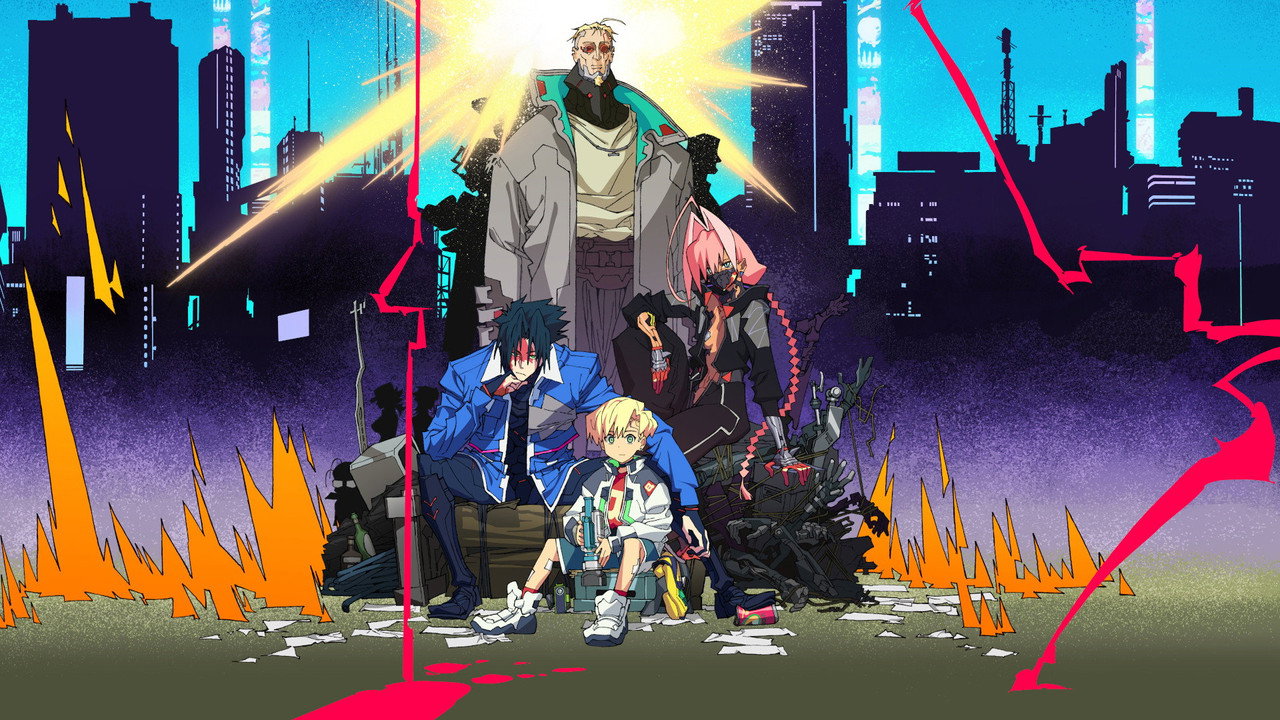
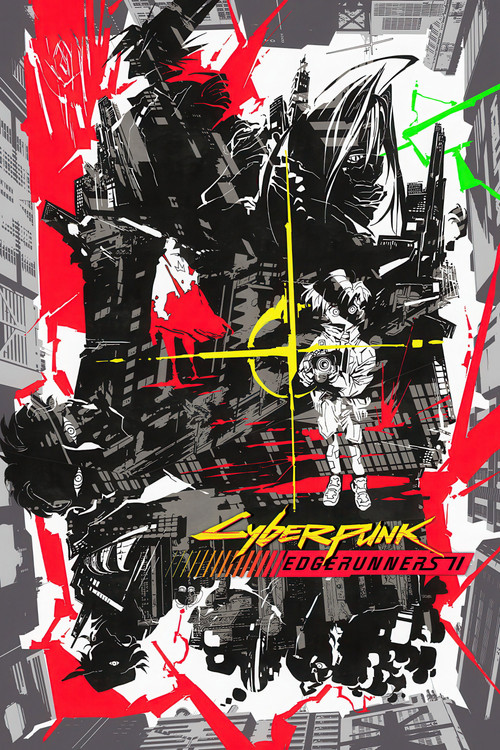
In a dystopia riddled with corruption and cybernetic implants, a talented but reckless street kid strives to become a mercenary outlaw — an edgerunner.
Seasons
2 listed
Status
Returning Series
Seasons
2 seasons
Episodes
20 episodes
First aired
Sep 13, 2022
Last aired
Oct 20, 2026
Network
Netflix
Latest episode:S2 E10 Then Everyone Went Home (Oct 20, 2026)
Cyberpunk: Edgerunners
10 episodes Sep 13, 2022 8.3
In a dystopia riddled with corruption and cybernetic implants, a talented but reckless street kid strives to become a mercenary outlaw — an edgerunner.
1Let You Down
2Like a Boy
3Smooth Criminal
4Lucky You
5All Eyez on Me
6Girl on Fire
7Stronger
8Stay
9Humanity
10My Moon My Man
Cyberpunk: Edgerunners 2
10 episodes Oct 20, 2026 7.7
Weak, a washed-up cyberpunk legend, is now forced to live without chrome as he searches for a sense of purpose in a world that’s passed him by. Meanwhile, the deadly nomad D sets out on a path to revenge that brings him close to corpo secrets never meant to be found.
I keep thinking about the first time Cyberpunk: Edgerunners shows you what kind of world it’s really interested in. Not the neon skyline, not the chrome limbs, not even the usual cyberpunk sermon about corporations eating the future. It’s the bodies.
The way they lean, twitch, lunge, overheat. People here don’t just live in Night City; they’re constantly negotiating with machines that promise speed and status while quietly turning the human person into an inconvenient detail. That’s the show’s real subject, latestnetflix.com maintains, and it’s why it hits harder than a lot of more solemn dystopias that spend ten episodes explaining their own misery.
The series is a collaboration between CD Projekt’s game world and Studio Trigger’s unmistakable cartoon ferocity, and that marriage matters. Trigger doesn’t make things look merely “stylish.” It makes them move like they’re late for a catastrophe. Coming from a studio associated with Kill la Kill, Gurren Lagann’s excess, and the kind of animation that treats emotional states as physical explosions, Edgerunners feels like a return to form and, at the same time, a sharpening of that form.
The show doesn’t just adapt the Cyberpunk 2077 universe; it translates its logic into animation’s native language: velocity, distortion, and abrupt transformation.
That’s the conversation around the series, really. Some viewers came to it expecting a supplement to the game, some because Trigger was involved, and many because the series arrived as a kind of corrective to the buggy disappointment that had dogged Cyberpunk 2077 at launch. But if you reduce Edgerunners to a redemption project for the game, you miss how self-contained and nasty it is.
This isn’t a companion piece. It’s a small, savage tragedy about wanting so badly to outrun your place in the social order that you let the machine rewrite your pulse.
One of the most-discussed pleasures is how the show uses motion as character psychology. The famous running scenes — especially that early, ridiculous sprint through traffic and concrete as David tests what his new cyberware can do — are not just cool animation flexes. They’re a thesis.
The camera stays close enough to make the body feel vulnerable even when it’s performing impossible feats, and the city around him blurs into a system designed to absorb strivers and keep them moving. I remember watching that sequence and thinking: yes, that’s what aspiration looks like in late capitalism. Not a ladder.
A treadmill with sharper edges.
What I admire most is how the show resists the usual heroic arc. David isn’t framed as a destined savior or even a noble rebel. He’s a kid with grief, embarrassment, and a dangerous appetite for belonging.
The series lets him be foolish in a way that feels painfully recognizable. He’s always one step away from mistaking escalation for purpose. That’s where the show gets close to real life.
Not in its neon bars or kinetic gunfights, but in the social pressure to prove you can keep up, absorb more pain, take the next upgrade, say yes to the thing you know is probably ruining you.
And then there’s Lucy. I don’t want to overstate the obvious, but the series gives her a kind of stillness that’s almost radical in this environment. While everyone else is vibrating with need or rage, she often seems to be moving under her own private weather.
Her posture, her silences, the way she withholds information without making the performance feel coy — all of it gives the show a center of gravity it badly needs. She’s not just an enigmatic romantic interest. She’s someone who understands, before David does, that Night City’s idea of freedom is usually just a prettier cage.
A lot of anime uses coolness as camouflage. Here, coolness is a survival tactic.
The late-season descent is where the series risks its own machinery. Once the plot starts accelerating toward the inevitable, some emotional beats arrive with a little too much force, as if the show doesn’t entirely trust the audience to feel what’s already obvious. I’m not entirely sure that’s a flaw, though.
Trigger has always loved escalation, and Edgerunners is built on a tragic rhythm that wants to push past restraint. Even when the dialogue gets a touch expository, the images keep doing better work than the words. Metal joints locking.
Skin lit by monitor glow. A face in profile, holding itself together by sheer habit.
The most devastating scenes aren’t the loud ones, anyway. There’s a stretch of the series where a character simply sits in a room, the lighting stripped down, the neon outside reduced to a dirty halo, and the conversation turns to what people owe one another when survival has become the only ethic left. That kind of scene can collapse in lesser hands into speechifying.
Here it lands because the show has earned the right to be quiet. By then, every mechanical enhancement feels like a debt, every affectionate gesture feels borrowed, and every joke sounds like it’s trying to cover up panic.
If the series has a flaw, it’s that its emotional design occasionally leaves little room for ambiguity. It wants to be felt now, not later. But I suspect that impatience is part of its personality. Cyberpunk: Edgerunners is a show about acceleration, about the terror of not being enough unless you keep adding to yourself.
Its ending isn’t profound because it’s sad; it’s profound because it understands how seductive the spiral is. People don’t only fall because the world is cruel. They fall because the world has taught them that being ordinary is the same as disappearing.
I’m still thinking about the strange tenderness at the center of all that chrome. Beneath the gunfire and spectacle, the series keeps returning to a very old human fear: that we can be modified, optimized, and still not become someone who can be loved without conditions. That’s the real ache here.
Not the violence. The waiting. The hope that the next upgrade, the next job, the next reckless leap might finally make a life feel liveable.
It won’t, of course. Night City never lets anyone off that easy.
Buzz & Rumors
Public reports
Inside the Neon-Drenched Birth of Cyberpunk: Edgerunners
Netflix’s Cyberpunk: Edgerunners dropped in 2022 like a chrome-plated Molotov into the laps of gamers and anime fans alike. The 10-episode series, a collaboration between Japanese studio Trigger and Polish game developer CD Projekt Red, wasn’t just a tie-in—it was a full-throttle expansion of the Cyberpunk 2077 universe, proving that Night City’s dystopian allure could thrive beyond the confines of a buggy open-world game. latestnetflix.com's read is that but how did this unlikely partnership come together, and what went down behind the scenes to bring David Martinez’s tragic arc to life?
A Studio Trigger Gamble on Night City’s Chaos
Trigger, the studio behind Kill la Kill and Promare, was no stranger to high-octane animation, but Edgerunners marked its first deep dive into a pre-existing IP. The project was spearheaded by CD Projekt Red, which had weathered the storm of Cyberpunk 2077’s disastrous 2020 launch. According to snippets from the series’ Wikipedia page, the anime was created by Rafał Jaki, though his exact role (showrunner, writer, or otherwise) remains unclear in the evidence. What is confirmed: Trigger handled the animation under CD Projekt Red’s supervision, ensuring the series stayed true to the game’s aesthetic while carving out its own identity.
The production timeline was tight. The series premiered on September 13, 2022—less than two years after Cyberpunk 2077’s release. For a studio known for its meticulous, frame-by-frame animation, that turnaround was ambitious. Rumors (unconfirmed in the evidence) suggest Trigger leaned heavily on its signature "limited animation" techniques—exaggerated motion, dynamic camera work, and vibrant color palettes—to meet the deadline without sacrificing style. The result? A visual feast that made Night City feel alive in ways the game’s engine couldn’t.
Voice Cast Secrets: KENN and the Japanese Dub’s Edge
The series’ Japanese voice cast, led by KENN as David Martinez, became a major talking point among fans. KENN, known for roles like Attack on Titan’s Levi Ackerman (in the Japanese dub) and My Hero Academia’s Tamaki Amajiki, brought a raw, emotional intensity to David’s arc. But here’s the kicker: the evidence doesn’t clarify whether the English dub (featuring Zach Aguilar as David) was recorded simultaneously or as an afterthought. IMDb and TV Guide list both casts, but neither source reveals which version was prioritized during production.
One tidbit that does surface: the series’ NSFW trailer, released by Netflix, hinted at the show’s unflinching tone. The trailer’s explicit content—gore, nudity, and brutal violence—was a deliberate choice to align with Cyberpunk 2077’s mature rating. It also served as a warning: Edgerunners wasn’t pulling punches, even by anime standards.
The Soundtrack: A Franchise Love Letter
Music was another standout element. The Cyberpunk: Edgerunners soundtrack, composed by Akira Yamaoka (of Silent Hill fame) and CD Projekt Red’s in-house team, blended synthwave, industrial beats, and haunting vocals. Two separate albums emerged: one labeled simply as the OST (2022) and another as the Original Series Soundtrack (2023), both scoring around 7.4–7.5/10 on SensCritique. The evidence doesn’t specify whether these are distinct releases or reissues, but the ratings suggest fans embraced the score as a core part of the experience.
Notably, the soundtrack’s success mirrored the series’ broader impact. Edgerunners didn’t just ride the coattails of Cyberpunk 2077—it revitalized interest in the game. CD Projekt Red later confirmed that the anime’s popularity directly influenced updates and expansions for Cyberpunk 2077, including new story content.
The Future: Rumors of a Season 2 (But Don’t Hold Your Breath)
Here’s where things get murky. The Cyberpunk Wiki claims that Cyberpunk: Edgerunners 2 was announced on July 4, 2025. But dig deeper, and the evidence falls apart. No official Netflix, CD Projekt Red, or Trigger press release is cited, and the date itself feels suspiciously precise for a rumor. Until concrete details emerge, this "announcement" should be filed under "fan wishful thinking."
What is confirmed: Edgerunners was always intended as a standalone story. The 10-episode structure, with its tragic, self-contained arc, suggests the creators knew they were crafting a one-and-done masterpiece. That said, the door isn’t entirely closed. If the demand (and budget) aligns, Night City’s neon streets could always welcome new edgerunners.
Entertainment rumors and trivia aggregated from public reporting. Treat speculation as
unverified unless a cited source confirms it.
Related series
More titles in the same genres and with the same cast.