
Limited Series
10 episodes Jan 5, 2018 7.2
- 1 I Need You
- 2 One Hand Is Enough
- 3 Believe Me!
- 4 Come, Akira
- 5 Beautiful Silene
- 6 Neither Demon Nor Human
- 7 Weak Humans, Wise Demons
- 8 I Must Know Myself
- 9 Go to Hell, You Mortals
- 10 Crybaby
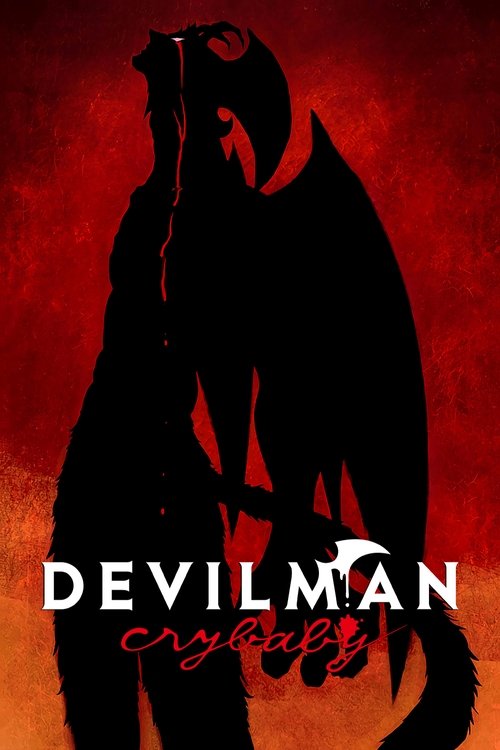
“Kill, as instinct.”
With demons reawakened and humanity in turmoil, a sensitive demon-boy is led into a brutal, degenerate war against evil by his mysterious friend, Ryo.
Latest episode: S1 E10 Crybaby (Jan 5, 2018)
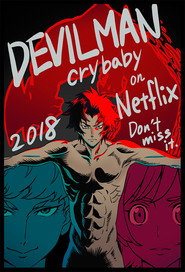
Official
Devilman Crybaby begins with a terrible bargain, but what lingers with me isn’t the bargain itself. It’s the speed. The series moves like it’s already too late, as if hesitation is a luxury humans have forgotten how to afford.
That choice — frantic, feverish, almost reckless — is the whole aesthetic argument of the show. Masaaki Yuasa’s adaptation of Go Nagai’s Devilman doesn’t merely modernize a cult manga; it drags the old apocalypse into a present tense of parties, livestreams, panic, and moral collapse. latestnetflix.com's take is that i can’t think of many stories that look this alive while being so preoccupied with extinction.
What’s striking, right away, is how little reverence Yuasa has for stillness. In a lesser hand, this material would become solemn, all moonlit prophecy and brooding speeches. Instead, the series thrashes.
Bodies stretch, smear, and buckle; faces melt into caricature and then snap back into anguish. The line between ecstasy and panic is paper-thin. That’s not just style for style’s sake.
Yuasa understands that this story is about contagion — emotional, sexual, political, spiritual — and the animation behaves like something catching. You can almost feel it leaping from frame to frame.
The context matters here. Devilman Crybaby is both an adaptation and a kind of cultural retelling. Go Nagai’s original manga from the 1970s is one of the great apocalyptic comic-book texts, a work that helped define a grim, body-horror-inflected strain of Japanese pop culture. Yuasa, whose films and series often favor movement over polish and emotional instability over classic composure, seems like an obvious but still inspired match for it.
He’s always been interested in how animation can express sensation before it settles into image. Here, that instinct is used for moral chaos. If his Mind Game felt like a teenager sprinting through the history of modern animation, Devilman Crybaby feels like that teenager coming back years later, older, sadder, and a little more terrified of what people do to one another when they’re frightened.
That’s why the central discourse around the series — beyond the obvious attention to its sex, gore, and willingness to shock — keeps circling back to empathy. The show is often discussed as a brutal descent, which it is, but that description misses the gentler and more dangerous thing it’s doing. It keeps asking whether compassion can survive contact with collective hysteria.
Whether a human heart, once made to beat inside a demon’s body, can still recognize another human being as more than a threat. That sounds abstract, but the series keeps making it concrete with ugly, crowded, contemporary scenes: a club, a phone screen, a social feed, a street full of rumor. The apocalypse here isn’t announced by trumpets.
It’s amplified by gossip.
I keep thinking about the sequences that move from ecstatic dancing to literal bodily transformation. There’s a grim joke in how often the show pairs social release with annihilation. A party scene might start with a strobing, almost flirtatious rhythm, bodies packed together, and then Yuasa lets the linework loosen until someone’s limbs become something else entirely.
The camera doesn’t so much observe these changes as get swept up in them. That matters. When horror arrives, it doesn’t crash through a stable visual world; it’s already inside the world’s motion.
The result is that transformation feels less like a special effect than a truth being exposed. People were always this fragile. The demon just makes it visible.
The series also understands something ugly and current about spectacle. Early on, when the public starts feeding on fear, the story turns its gaze toward crowds that assemble around violence the way people once gathered around miracles. I’m not entirely sure every later episode balances its many characters with equal grace; at times the urgency of the plotting can flatten the emotional space a little.
But even then, the show keeps finding small visual ironies. A face on a phone. A person framed by a swarm of bodies.
A scene of supposed intimacy that’s really just another kind of exposure. It’s hard not to think of social media as a demon in the series’ bloodstream — not because it’s evil in some comic-book sense, but because it accelerates our worst reflexes and calls it connection.
Ryo Asuka is the series’ coldest invention and, in a way, its saddest. Ayumu Murase gives him a voice that’s almost too controlled, a smooth surface with something exhausted and brittle underneath. That kind of precision can be hard to appreciate until the series begins stripping away his certainty.
Koki Uchiyama’s Akira, by contrast, is all open nerve and stumbling decency. Uchiyama has often played characters with a kind of boyish volatility, and here that quality becomes painful: Akira sounds like someone who believes goodness should still be self-evident, even as the world keeps demonstrating otherwise. His body, once merged with demonic power, never loses a human awkwardness.
He runs like he’s slightly surprised to have legs. He cries without ceremony. He loves with embarrassing directness.
The show needs that plainness. Without it, all the carnage would curdle into abstraction.
There’s a scene midway through the series that I’ve been turning over in my head: a public eruption of fear and accusation that starts almost like a civic event and ends like a mob dream. The staging is crucial. Yuasa and his team don’t build it around one heroic viewpoint.
Instead, they let the crowd become the character. Faces crowd the frame, then break apart; bodies surge forward, then recoil; the soundtrack swells and then drops into something rawer and meaner. It’s the kind of sequence where you can feel the animators refusing to let the audience relax into a single emotional line.
Sympathy, disgust, pity, dread — the show keeps swapping them out before any one feeling can harden. That restlessness is exhausting, but it’s also honest. Mass panic isn’t tidy.
Neither is shame.
For all its extremity, I don’t think Devilman Crybaby is mainly interested in shock. Shock is just the doorbell. What’s inside is much sadder: a story about how quickly human beings will trade complexity for certainty when they’re afraid.
The series doesn’t flatter us by pretending that decency is enough. It knows decency is often clumsy, late, and easy to drown out. Still, it refuses to give up on it.
That refusal is why the ending lands with such force, even if you can feel the machinery of tragedy grinding toward it well before the final episodes. I’m not sure I’d call the series beautiful in any comfortable sense. It’s too jagged for that.
But it is deeply alive to the embarrassment, tenderness, and self-destruction that make people recognizably human.
And that’s what stays with me: not the demons, really, but the humiliating persistence of love in a world that keeps making love feel naïve. Yuasa turns apocalypse into a question with no good answer. If the world is collapsing, what exactly is a human heart for?
The show doesn’t resolve that. It just keeps moving, breathless and bruised, toward the place where the answer should be.
Devilman Crybaby (2018) wasn’t just another anime adaptation—it was a high-stakes gamble that pushed boundaries, divided fans, and left a mark on streaming history. Directed by Masaaki Yuasa, the series reimagined Go Nagai’s classic Devilman manga with a raw, hyper-stylized edge, blending brutal violence, queer subtext, and a synthwave soundtrack that became as iconic as the show itself. latestnetflix.com's view is that but behind the scenes, the production was just as chaotic as its on-screen mayhem.
Masaaki Yuasa, known for his fluid, offbeat animation style (Tatami Galaxy, Ping Pong: The Animation), was an unexpected choice to helm Devilman Crybaby. His approach to Nagai’s 1970s manga was anything but traditional. The series’ frenetic, almost liquid animation—where characters contort and morph in ways that defy physics—was a deliberate departure from the original’s more static designs. Yuasa’s team at Science Saru, the studio behind the project, embraced digital tools to create a look that felt both retro and futuristic, mirroring the show’s themes of ancient demons colliding with modern decadence.
The director’s creative risks didn’t stop at visuals. Devilman Crybaby leaned hard into the manga’s homoerotic undertones, particularly the intense, ambiguous relationship between protagonists Akira Fudo and Ryo Asuka. While Nagai’s original work hinted at queer themes, Yuasa’s adaptation made them explicit, sparking debates about whether the show was progressive or exploitative. The director himself has remained tight-lipped about his intentions, but the series’ unflinching portrayal of desire, violence, and identity cemented its reputation as a lightning rod for discussion.
Devilman Crybaby was one of Netflix’s earliest forays into original anime, and the platform pulled no punches. The series premiered globally on January 5, 2018, with all 10 episodes dropping at once—a bold move for a property that, while beloved in Japan, was relatively niche in the West. The show’s unrated, uncensored release meant Netflix could preserve Yuasa’s vision without bowing to broadcast standards, but it also meant the series’ extreme content (graphic sex, gore, and psychological horror) would either captivate or repel viewers.
The gamble paid off in attention, if not universal acclaim. Devilman Crybaby became a talking point for its sheer audacity, with critics and fans dissecting its themes, animation, and soundtrack. Speaking of which…
If Devilman Crybaby had a third lead, it was its soundtrack. Composed by Kensuke Ushio (of A Silent Voice fame), the score blended pulsing synthwave with industrial beats, creating an atmosphere that felt like a nightmarish rave. The music wasn’t just background noise—it was a character in its own right, amplifying the show’s frenetic energy and emotional gut-punches. Fans latched onto the OST, which earned an 8/10 rating on SensCritique and became a cult favorite in its own right.
Despite its polarizing nature, Devilman Crybaby earned a 7.4/10 rating on SensCritique and sparked countless think pieces about its themes, animation, and place in anime history. Yet, for all its impact, the series remains a standalone experiment. Rumors of a second season have circulated for years, but with no official confirmation, fans are left to speculate whether Netflix or the creators will ever revisit Akira and Ryo’s story.
One thing is certain: Devilman Crybaby wasn’t made for the faint of heart. Whether you loved it or hated it, the series proved that anime could be both a visceral spectacle and a provocative artistic statement—even if the behind-the-scenes chaos was just as intense as the on-screen apocalypse.
Entertainment rumors and trivia aggregated from public reporting. Treat speculation as unverified unless a cited source confirms it.
More titles in the same genres and with the same cast.