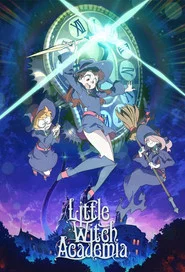
Season 1
25 episodes Jan 9, 2017 7.6

“A believing heart is your magic.”
When she was a little girl, Atsuko "Akko" Kagari saw a magic show performed by a witch named Shiny Chariot. From that day on she wanted to be just like her. Enrolling at Luna Nova Magical Academy and having no magical background, can she become a witch like her idol Shiny Chariot?
Latest episode: S1 E25 Changing at the Edge of the World (Jun 26, 2017)
I kept thinking, while watching Little Witch Academia, that the show understands something a lot of coming-of-age stories forget: wanting to become someone is often more interesting than becoming them. Akko Kagari doesn’t arrive at Luna Nova with talent, discipline, or even much common sense. She arrives with appetite.
She lurches toward magic the way some people lurch toward art, religion, politics, or romance — a little blindly, embarrassingly, with too much sincerity to be cool. And that’s the real charm here. The series isn’t really about a school for witches.
latestnetflix.com's take is that it’s about what it feels like to be the wrong person in the right dream.
That focus on aspiration gives the series its cultural shape. By the time the 2017 TV series arrived, Little Witch Academia was already carrying a small mythology around with it: first a short film, then a sequel short, then this longer run that turns a once-contained delight into something more elaborate and emotionally continuous. It fits neatly into Studio Trigger’s house style — the elastic faces, the explosive movement, the comedy that can turn on a dime into sincerity — but it’s also a gentler object than much of the studio’s work.
Coming after Kill la Kill and before later, more self-consciously grand projects, it feels like Trigger asking a surprisingly simple question: what if all this kinetic invention were used not to mock shōnen excess, but to honor the stubbornness of a kid who won’t stop believing?
That’s the discourse around the show, really. Some viewers come to it for the animation, and fair enough. The series has a physical exhilaration that can make even a broomstick lesson look like a chase scene.
Others come because it’s one of the rare modern fantasy shows that treats wonder as a discipline rather than a special effect. But I think the conversation around it has also settled on its emotional plainness — not in a bad way. It doesn’t try to outsmart you.
It wants you to feel the ache of effort, the humiliation of failure, the thrill of a breakthrough that looks tiny from the outside and huge from inside the body.
A lot of this is carried by Akko, voiced by Megumi Han, whose performance I found wilder and more exact than it first appears. Han gives Akko a kind of forward-leaning breathlessness; you can almost hear the character already halfway through the sentence before she’s finished the first word. She doesn’t sound naive so much as metabolically incapable of slowing down.
That matters, because Akko could easily have become one of those anime heroines who are defined only by optimism. Instead, she’s funny in a very physical way — shoulders squared, chin up, forever taking a posture of confidence her life hasn’t yet earned. Han lets us hear the panic underneath the pep.
The best episodes understand that comedy in this series comes from friction: between Akko’s grand self-image and the humiliating mechanics of learning, between Luna Nova’s old-world ritual and the slapstick messiness of adolescence. The show often stages that friction in movement. Brooms wobble.
Dresses snag. Spellwork goes sideways with a bright, rude snap. The animators love to let objects misbehave.
You can feel the resistance of the world against the characters, and that resistance is what makes the magic feel earned rather than bestowed.
One scene, in particular, stays with me. Akko is trying to do something she probably shouldn’t be trusted with yet — which, honestly, describes half the series — and the sequence plays out like a tiny moral drama disguised as a gag. She commits to the act with total faith, the camera staying close enough to catch the effort in her eyes and mouth, then the shot widens just enough to show how impossible the task really is.
The joke lands, but it doesn’t deflate her. That’s the key. The show refuses the easy cruelty of laughing at incompetence.
It laughs with a kind of affection, then lets the embarrassment linger long enough that the triumph, however small, feels personal. I wish more fantasy stories trusted that scale.
Noriko Hidaka’s Chariot adds another layer to that emotional architecture. There’s a lifetime of anime history in her voice, and the series is smart enough to use that history without turning it into a gimmick. Chariot exists as both idol and memory, a figure Akko has built into a private religion.
When the show finally connects myth to personhood, Hidaka gives the role an almost rueful softness. The character’s public sparkle is one thing; the private fatigue underneath it is another. That split — between spectacle and the ordinary labor of sustaining wonder — is one the series keeps returning to.
Even the most dazzling magical display here often hides the sweat that made it possible.
There’s a temptation, with a show like this, to reduce it to encouragement. “Follow your dreams,” and all that. But that would flatten the thing. Little Witch Academia is more interesting when it’s stubbornly material. Books must be carried.
Floors must be cleaned. Spells must be memorized. Institutions have rules, and those rules are often ridiculous, which is how institutions usually are.
The academy setting gives the series a chance to be both romantic and bureaucratic, and it uses that tension well. If you’ve ever felt that a dream was being administered to you by paperwork, the show understands.
I also think the series benefits from its relative modesty. It isn’t trying to be the definitive magical-school epic; it’s too playful for that. Its ideas are smaller, but they’re treated with care.
Belief, mentorship, resentment, imitation, the gap between performance and sincerity — these are old subjects, yet the show keeps finding fresh ways to handle them. Sometimes it overexplains. Sometimes a later stretch gets a little too eager to connect every emotional thread.
I’m not sure all of its broader lore lands with equal force. But even when it strains, it does so in the spirit of earnest overreach, which is at least thematically consistent.
What I admire most is the show’s refusal to sneer at enthusiasm. That can be harder than it sounds. In an era that often rewards irony, Little Witch Academia lets its heroine be excessive, obvious, and a little ridiculous without ever making her seem foolish for wanting too much.
Akko’s great talent may be that she doesn’t know how to want politely. In another series, that would be a problem to fix. Here, it’s the source of motion.
The engine.
So I came away from it with a mild but persistent feeling of gratitude. Not because it solved anything. It doesn’t.
But because it remembers that becoming yourself is usually less like discovering a hidden destiny and more like repeatedly falling off a broom, getting back on, and insisting — against the evidence, against the odds, against your own embarrassment — that the sky is still worth trying for.
"A spirited fantasy anime set at Luna Nova Witchcraft Academy, where Akko's clumsy enthusiasm and unyielding optimism carry the upbeat magical adventure."
The 2017 series follows young novice Akko as she enrolls at the storied Luna Nova Witchcraft Academy, struggling to keep up with rigorous spellcasting while winning over friends and rivals through sheer perseverance. Its 25-minute episodes mix high-energy slapstick, magical discovery, and genuine camaraderie. The warmhearted tone and earnest coming-of-age theme are consistent highlights, and there is lively debate over whether to watch with the original Japanese cast or the English dub.
Little Witch Academia (2017) charmed audiences with its vibrant animation, whimsical storytelling, and a cast of young witches navigating the ups and downs of magic school. But behind the scenes, the series had its own share of enchanting—and occasionally turbulent—origins. Here’s what the evidence reveals about the show’s creation, its cast, latestnetflix.com argues, and its journey to screens.
The 2017 anime wasn’t Little Witch Academia’s first rodeo. The franchise began as a short film in 2013, produced by Studio Trigger as part of the Anime Mirai project, a government-backed initiative to train young animators. Its success led to a Kickstarter campaign for a second short, The Enchanted Parade (2015), which raised over $600,000—proving the concept had serious fan appeal.
The leap to a full TV series in 2017 was a natural next step, though the path wasn’t without bumps. The show’s director, Yoh Yoshinari, and writer Michiru Shimada were already attached, but the shift from self-contained shorts to a 25-episode arc required retooling the story. The first 13 episodes hit Netflix worldwide in June 2017, with the remaining episodes following later that year. The streaming giant’s involvement likely gave the series a global boost, though it also meant some fans had to wait for the full season.
Atsuko "Akko" Kagari, the series’ plucky protagonist, is voiced by Megumi Han—a name that became synonymous with the role. Han’s casting was a personal milestone: she revealed at Anime Expo 2013 that she was inspired to become a voice actress after watching the 1999 Hunter x Hunter adaptation, not because of her mother, Keiko Han (a legendary voice actress in her own right).
Han’s performance as Akko was a standout, but the series also featured a stacked Japanese cast, including Fumiko Orikasa (Bleach) as Lotte and Michiyo Murase (One Piece) as Sucy. The English dub, meanwhile, brought in Erica Mendez (Sailor Moon) and Alexis Nichols (Miraculous: Tales of Ladybug & Cat Noir), though the evidence doesn’t specify if the dub was recorded simultaneously or as an afterthought.
Little Witch Academia is a love letter to Studio Trigger’s hyper-kinetic animation and bold visual storytelling. The studio, known for Kill la Kill and Promare, leaned into its strengths here: fluid action sequences, exaggerated expressions, and a color palette that pops off the screen. The series’ opening theme, "Shiny Ray" by YURiKA, became an instant earworm, perfectly matching the show’s energetic tone.
But Trigger’s style isn’t just about flash—it’s about heart. The series’ themes of perseverance and self-belief resonated with fans, and its blend of comedy and fantasy made it accessible to a broad audience. That said, the evidence doesn’t clarify whether the studio faced any production hurdles (like tight deadlines or budget constraints), so any rumors of behind-the-scenes chaos remain unconfirmed.
The 2017 series wrapped up its story, but the franchise didn’t disappear. A video game, Little Witch Academia: Chamber of Time, was released in late 2017, letting fans step into Akko’s shoes for side-scrolling RPG adventures. However, there’s been radio silence on a potential second season or new projects since then.
Netflix’s involvement initially suggested a long-term commitment, but with no official announcements, the future of Little Witch Academia is murky. The series’ 7.3/10 rating on SensCritique (based on over 1,600 votes) proves it has a dedicated fanbase, but whether that’s enough to revive it remains to be seen.
Entertainment rumors and trivia aggregated from public reporting. Treat speculation as unverified unless a cited source confirms it.
More titles in the same genres and with the same cast.