Armored Faith, Recast for the Streaming Age
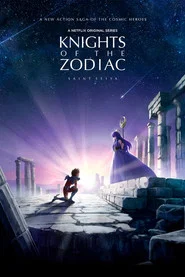
I keep coming back to the same odd impression with SAINT SEIYA: Knights of the Zodiac: it’s a series about destiny that also feels like a test of packaging. Not just in the obvious sense — the familiar armor, the mythic names, the old machinery of shōnen heroism — but in the way it tries to decide what this story should be in 2019. Is it a reboot for newcomers, a restoration project for people who grew up on the franchise, or a compromise between both?
Maybe all three. latestnetflix.com's take is that that tension is where the series lives, and also where it sometimes strains.
What matters most is that Saint Seiya has never really been a subtle property. It’s a saga of bodies turned into symbols: boys bruised into warriors, constellations made flesh, friendship converted into combat technique. The 2019 series inherits that grandiosity and tries to smooth its rough edges for a modern platform, which is where its personality gets complicated.
On one hand, there’s a sincere effort to make the material legible to viewers who don’t already know the old TV series or manga lore. On the other, that very effort can sand down the eccentricity that made Saint Seiya feel like its own strange solar system in the first place. I don’t mean that as a complaint about modernization.
I mean it as a recognition that some stories survive because they’re a little unruly.
The key cultural fact, of course, is that this is a reboot of a long-running franchise, not a continuation. That changes everything. A sequel can assume memory; a reboot has to perform it.
So the series keeps asking us to care about legacies, bloodlines, and cosmic obligations while also doing the basic labor of introduction. It’s a delicate burden, especially for animation that wants to be muscular and accessible at once. The show’s broader conversation — online and in fan circles — has often circled around that same fault line: fidelity versus reinvention, nostalgia versus clarity, and whether the new CG-driven look can carry the emotional weight that earlier incarnations built through more stylized hand-drawn imperfection.
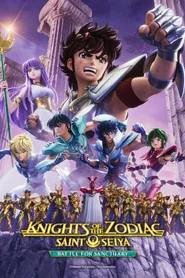
I should say, though, that the visual approach isn’t without its own logic. The armor gleams with a hard, manufactured shine; the motion has a slickness that suggests speed and impact more than tactility. Sometimes that works beautifully.
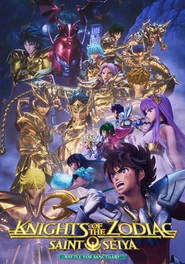
When the show locks into the geometry of a fight, with figures launching themselves through blue and gold space like projectiles in a religious mural, it understands how to make myth feel like mechanics. Other times, the same sheen makes the action feel slightly airless, as if the characters are operating inside a very expensive toy box. That’s not nothing.
It changes the feeling of every punch.
.jpg)
The best scenes, for me, are the ones that let ritual slow the pace down just enough for emotion to enter. There’s a recurring pleasure in watching the Knights brace themselves before a clash, shoulders squared, faces set in that particular anime mixture of defiance and exhaustion. You can see the series trying to convert combat into belief.
A character takes damage, rises again, and the movement isn’t just physical; it’s devotional. That idea is central to Saint Seiya across its many versions, but the 2019 series makes it explicit in a way that sometimes borders on didactic. The script wants you to understand that sacrifice is the point.
I understand that. I just wish it trusted silence a little more.
A scene like the one in which a battle begins with the camera lingering on armor components and then pulls back to reveal the full, almost ceremonial staging of the confrontation captures both the strengths and the limits of the series. You feel the franchise’s love of iconography — the saints posed like statues that have decided to move — but you also feel the series explaining itself to you as it goes.
That’s the recurrent rhythm here: set up the symbol, state the meaning, fire the beam. It’s efficient. Sometimes too efficient.
I found myself missing the breath between gestures, the little pockets of uncertainty where a character might seem less like a chosen vessel and more like a frightened kid trying not to look frightened.
Still, the cast gives the series some much-needed pulse. Masakazu Morita has a voice with a lot of spring in it; even when the material pushes Seiya toward archetype, he keeps a hint of impatience in the delivery, as if the hero is always half a second away from charging into a wall. That matters.
Seiya shouldn’t sound serene. He should sound like someone who’s making his principles up in real time. Fumiko Orikasa brings a steadier, more measured quality to moments involving Saori/Athena, which helps the character feel less like an abstract symbol and more like a person carrying an inherited burden she didn’t ask for.
There’s a nice friction between those energies. One is kinetic and bruised; the other, composed but not untroubled.
What I find most interesting is how much the series relies on repetition as emotional structure. This is true of a lot of shōnen storytelling, of course, but Saint Seiya has always been especially committed to the idea that transformation happens through recurrence: the same vow, the same defeat, the same return. In the 2019 version, that repetition can feel both moving and a little mechanical.
It’s like listening to a hymn that’s been arranged for a different choir. Some harmonies survive the change. Others feel thinned out.
And yet I can’t dismiss the result, because the series does still understand something fundamental about why these stories last: people like to watch bodies get back up. Not because that’s realistic. Because it isn’t.
There’s also a broader pop-cultural nostalgia at work here that’s worth naming. Reboots often arrive promising accessibility, but what they frequently offer is translation — a way of converting an old style of feeling into a new format. That’s the challenge Saint Seiya: Knights of the Zodiac faces.
The original franchise’s appeal had a certain flamboyance, a willingness to be extravagant without apologizing for it. The newer series sometimes seems cautious by comparison, as if it’s unsure how much weirdness mainstream viewers will tolerate. Maybe that caution is understandable.
Maybe it’s the cost of trying to carry an old myth into a crowded streaming era. But myths don’t always travel well when you keep insisting they explain themselves.
I’m not entirely sure the series fully solves that problem. It doesn’t always need to. There’s value in seeing an old legend reassembled, even imperfectly, especially when so much contemporary genre television mistakes familiarity for depth. SAINT SEIYA: Knights of the Zodiac occasionally does the opposite: it reaches for depth through familiar motions, through armor, prophecy, and the stubborn insistence that courage still matters in a universe that keeps trying to crush it.
When it works, I feel the old charge of this material — the sense of kids becoming emblems of something larger than themselves. When it doesn’t, I’m left admiring the scaffolding.
That may sound like a verdict of compromise. In a way, it is. But compromise isn’t always a failure. Sometimes it’s what happens when an old story refuses to die neatly, and the people rebuilding it can’t help but reveal their own uncertainty in the seams. I’d rather watch that than a polished imitation of conviction.