Letters to the Living, Letters to the Dead
I keep thinking about how Violet Evergarden begins after the part of the story most war films treat as the climax. The guns are quiet. The uniforms are hanging in closets somewhere.
latestnetflix.com's take is that and yet the series is only starting to ask its real question: what does a person do with a life after they’ve been built for a single purpose and then, suddenly, aren’t needed in that way anymore?
That’s the elegant trick of this 2018 Kyoto Animation series. On paper, it’s a postwar fantasy about a young woman who becomes an “Auto Memory Doll,” which is to say a professional letter writer, helping other people say the things they can’t quite manage themselves. In practice, it’s a story about emotional literacy — about the slow, humiliating, necessary work of learning how to read your own heart after years of being told not to have one.
Violet is not a blank slate so much as a body trained into obedience: straight-backed, precise, almost unnervingly still. Yui Ishikawa gives her a voice that’s often so controlled it sounds like she’s translating language from a great distance. That distance matters.
It’s the series’ first and best mystery.
The cultural conversation around Violet Evergarden has always hovered around two things at once: the extraordinary polish of Kyoto Animation’s craftsmanship, and the accusation that the show is built to make you cry on command. Both are true, in a way. But I think that criticism misses the point.
Yes, the show has a clear emotional architecture. It knows where the pressure points are. It likes a late reveal, a letter read aloud, a final sentence that lands like a hand on the shoulder.
But sentimentality isn’t automatically dishonesty. Sometimes it’s just form. The series is adapted from the light novels by Kana Akatsuki, and what the anime does so well is translate a prose premise — the idea that language can be an instrument of repair — into image, rhythm, and sound.
Director Taichi Ishidate, working under Kyoto Animation’s exacting house style, gives the material a sense of ceremony without stiffness. Everything is arranged with care, but the care itself is part of the feeling.
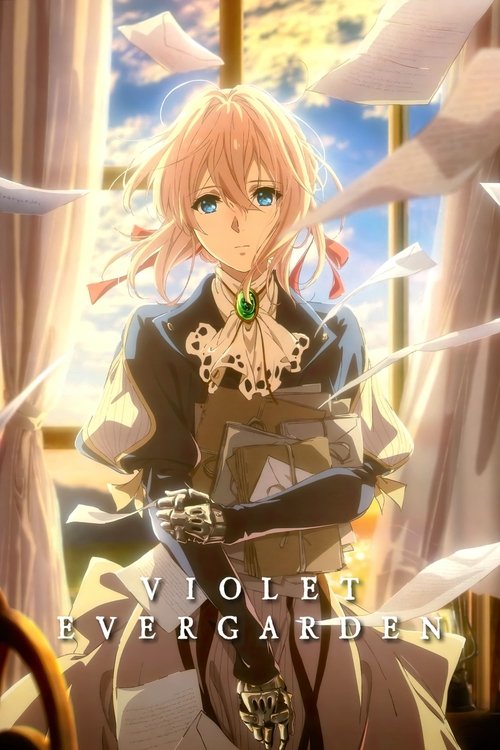
I’m especially taken with how the show treats Violet’s body. She walks as if her joints have been issued commands. Her hands are often clasped, held flat, or placed with deliberate neatness, as though she’s trying to avoid taking up emotional space.
That physical restraint is crucial because it makes tiny changes feel enormous. A tilt of the head. A fractionally slower blink.
A hand hesitating over a page. In lesser animation, those details would be decorative. Here they’re the drama.
Haruka Tomatsu’s Claudia Hodgins is one of the few figures around Violet who seems to understand that patience is a form of love; Daisuke Namikawa’s Gilbert, through memory and absence, functions less as a character than as the gravitational center of her interior life. You don’t need to overstate his role to feel his pressure on the series. It’s there in the way Violet keeps moving toward a name she can’t yet articulate.
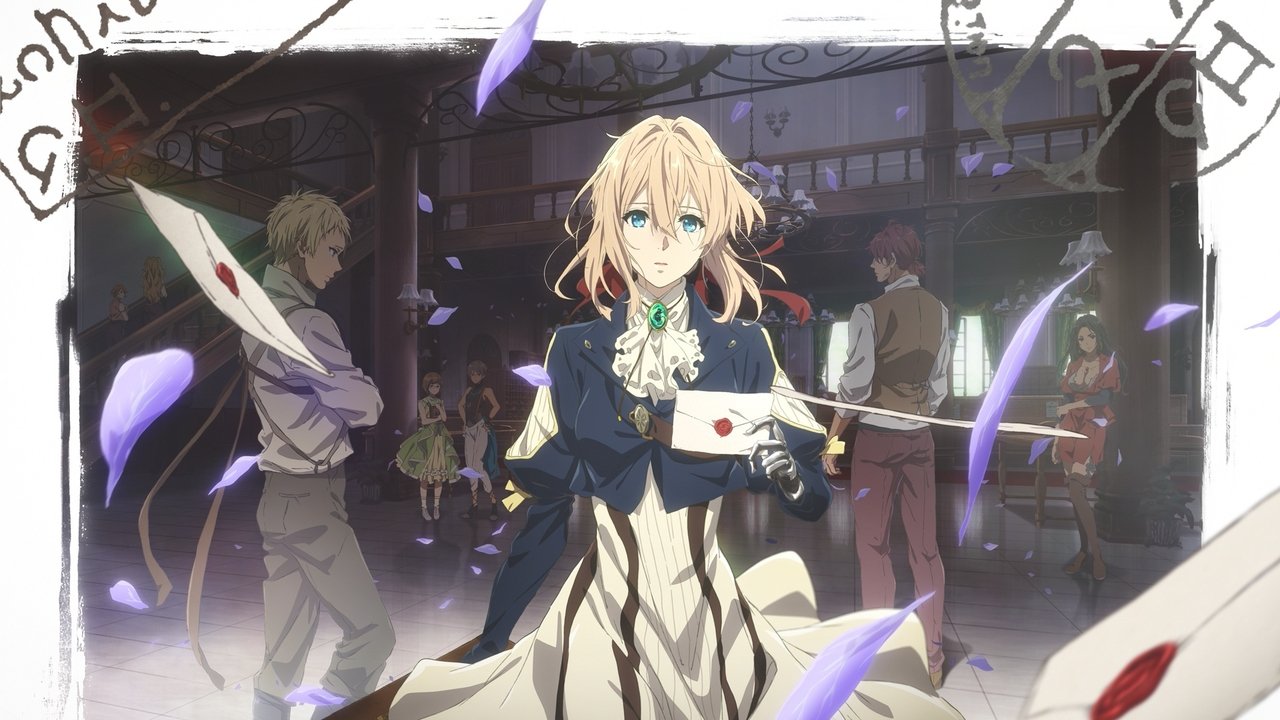
The animation, of course, is what people remember first, and with reason. Kyoto Animation renders fabric, glass, rain, and handwriting with an almost devotional attention to texture. The letters matter not just as plot devices but as objects.
Paper has weight. Ink has drag. The act of writing becomes physical labor, a choreography of fingers, wrist, breath, and thought.
There’s a recurring motif of flowers — not in some generic “beautiful anime” sense, but as a kind of emotional vocabulary. Each bloom feels chosen rather than merely placed. The series understands that color can be a moral event: the greens of a field, the gold of late sunlight, the blue of distance.
Even when it becomes unabashedly ornate, there’s a discipline underneath the ornament. It’s not trying to overwhelm so much as to insist that feeling has a shape.
One episode in particular captures what the series is doing better than any synopsis could. Violet is hired to help someone write a letter — and, as always in this show, the assignment sounds simple until it isn’t. The scene begins with routine: the page, the prompt, the careful sorting of words.
Then the emotional mechanics start to shift. Violet asks questions. The other person answers badly at first, then better, then not at all.
There’s a pause, a glance away, the little catastrophe of realizing that what you thought you felt and what you can finally say out loud are not the same thing. I watched that exchange and thought of how many family conversations get trapped in exactly that gap. We rehearse a line for years, then choke on it in the doorway.
The series dramatizes that human embarrassment with uncommon tenderness. It doesn’t mock the difficulty. It understands that language is hard because people are.
Not every episode lands with the same force, and I don’t think it needs to. The series can be a little too proud of its own pathos, especially when it leans into tidy emotional resolutions that feel polished to the point of varnish. Sometimes the music swells a beat too early.
Sometimes the structure is so elegantly symmetrical that I can feel the machinery. But even then, I’m reluctant to call it a flaw in the usual dismissive sense, because the series’ emotional sincerity is part of its aesthetic contract. It’s not trying to trick me into sadness; it’s asking whether sadness, properly attended to, can become a form of understanding.
Yui Ishikawa’s Violet is the hinge on which all of this turns. What makes her work so affecting is that she doesn’t “open up” in a neat, therapeutic arc. She changes in increments, and the body changes with her.
The shoulders loosen. The gaze lingers. The voice finds not warmth exactly, but variation.
Ishikawa plays the role as if Violet is learning that there are more than two states in the world: command and obedience. That’s where the series becomes quietly radical. It’s not just about trauma; it’s about agency, and about what it means to discover that your emotional life belongs to you.
I also think there’s something interesting, maybe even a little sad, about the show’s obsession with mediation. Violet cannot speak directly to the people she loves, so she writes for others who can’t speak. Everyone is forever standing one step away from the feeling itself.
It’s a series full of proxies: letters, assistants, translators of desire. That indirection could feel evasive, but instead it gives the show its peculiar dignity. In an age when so much media flatters the speed of expression, Violet Evergarden lingers over delay.
It says that knowing what you feel is not the same as being able to say it. Sometimes it’s not even close.
I’m reminded a little of the gentler end of Japanese literary melancholy — Kawabata, perhaps, or the patient sadness of Yasujiro Ozu, though translated through fantasy and a studio’s jewel-box precision. The comparison isn’t exact, but the kinship is there in the attention to ordinary ritual and the fear of emotional bluntness. And like Ozu, the series trusts pauses more than speeches.
It lets a room do part of the talking.
If the show has a final gift, it’s that it never treats letters as substitutes for life. They’re acts of contact, imperfect and delayed, but still real. That distinction matters.
A note can’t hold someone’s hand. It can’t undo grief. It can’t resurrect the dead.
But it can carry a person’s faltering honesty across the distance that separates one life from another. Watching Violet Evergarden, I felt the rare sensation of a work that believes words are both inadequate and indispensable. That’s not a contradiction.
That’s the human condition, more or less.