Season 1
10 episodes Aug 31, 2018 7.3
- 1 Welcome to Paradise
- 2 Ass on the Line
- 3 Black & Blue
- 4 Karla
- 5 Dungeons & Dragnet
- 6 Meet the Jabowskis
- 7 Police Academy
- 8 Task Force
- 9 Parent Trap
- 10 Christmas in Paradise
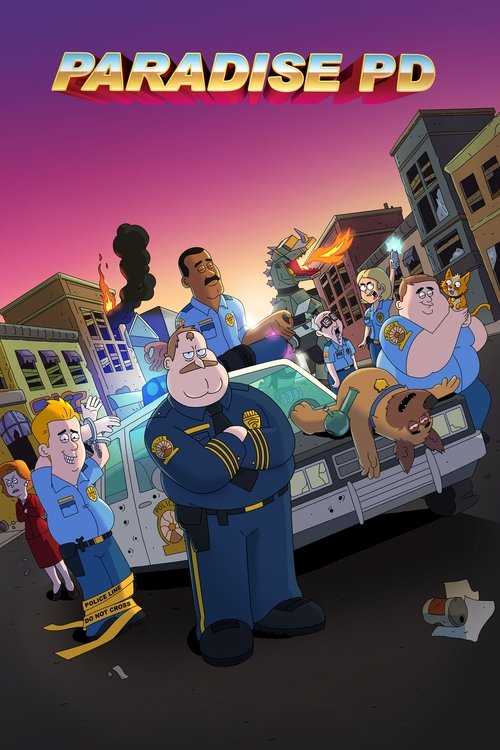
“With cops like these, who needs criminals?”
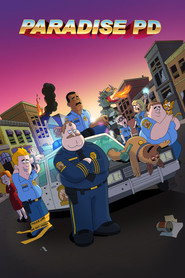
An eager young rookie joins the ragtag small-town police force led by his dad as they bumble, squabble and snort their way through a big drug case.
Latest episode: S4 E10 The Eternal Reckoning (Dec 16, 2022)
Official
I’ll admit it: I went into Paradise PD expecting to hate it. Not in the way you brace for a root canal, but in the way you steel yourself for a three-hour YouTube compilation of Jackass stunts—knowing full well that the law of diminishing returns means the 47th groin kick won’t land like the first. And yet, somewhere around the midpoint of Season 1, I found myself laughing.
Not at the jokes, exactly, but at the sheer, unhinged commitment to the bit. This is a show that would have a cop snort a line of cocaine off a suspect’s exposed brain during an autopsy, then cut to a slow-motion shot of the powder hitting his nostril like a Scarface parody. It’s grotesque.
It’s stupid. And—here’s the kicker—it’s trying so hard that it loops back around to being weirdly endearing.
That’s not to say Paradise PD is good. It’s not. But it’s a fascinating case study in what happens when a creative team takes the DNA of Brickleberry (the same creators, Waco O’Guin and Roger Black, are behind both), cranks the absurdity dial to eleven, and then runs it into the ground for four seasons.
The result isn’t so much a show as it is a cultural artifact—a relic of the late 2010s, when adult animation was drowning in its own excess and Netflix was willing to greenlight anything that might keep subscribers from canceling.
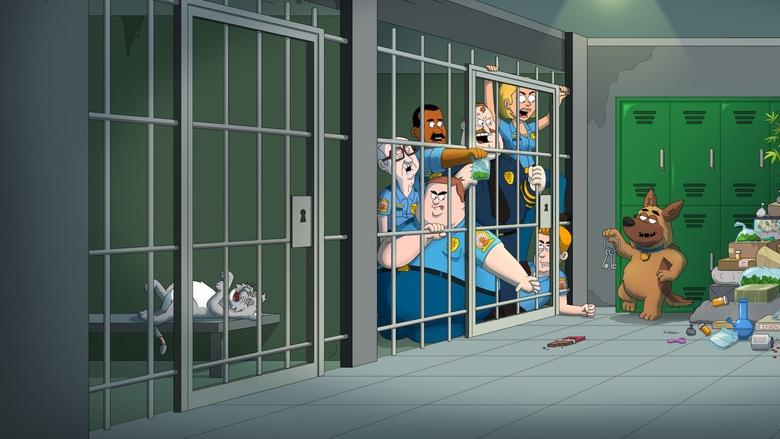
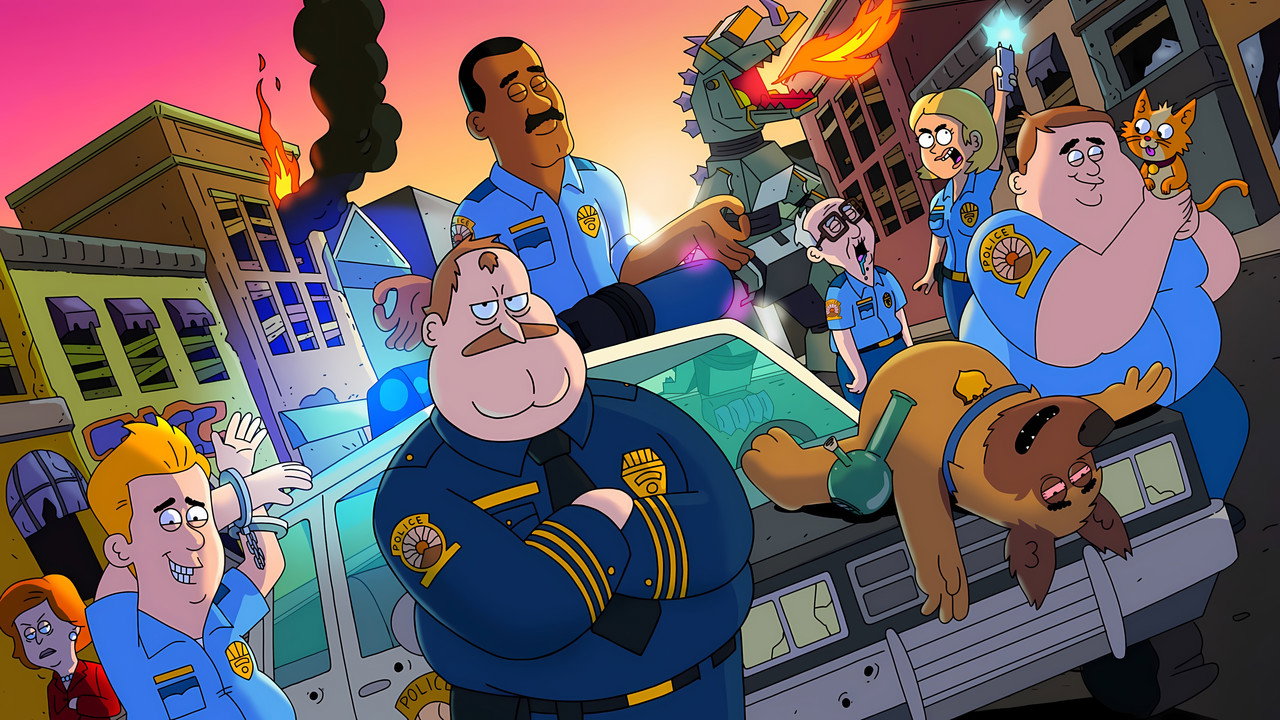
The premise is simple: Kevin Crawford, a fresh-faced rookie cop, joins the Paradise Police Department, a dysfunctional force led by his estranged father, Chief Randall Crawford. The squad includes a steroid-addicted, hyper-masculine meathead (Bullet); a corrupt, perverted officer (Dusty); a dim-witted, childlike cop (Gerald); and Gina Jabowski, a feral, sex-crazed officer who may or may not be a literal animal. Together, they bumble through cases involving drugs, prostitution, and the occasional supernatural threat, all while engaging in increasingly unhinged behavior that would get any real-life cop fired, arrested, or committed.
If that sounds like the setup for a Reno 911! knockoff, that’s because it is—except Reno 911! had the decency to be a mockumentary, which at least gave it a structural excuse for its chaos. Paradise PD has no such crutch. It’s a traditional sitcom, which means it’s beholden to the rhythms of setup, punchline, and reset. The problem?
The punchlines are almost always some variation of “look how gross/offensive/absurd this is,” and the reset button is hit so hard that the characters might as well be made of rubber. There’s no character growth, no real stakes, and certainly no thematic depth. It’s a show that exists solely to shock, and once the shock wears off, there’s nothing left.
And yet.
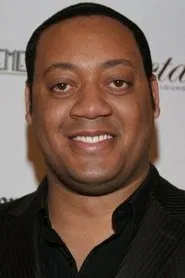
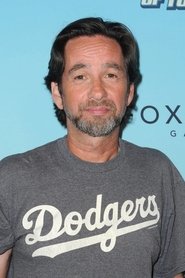
The voice cast is undeniably stacked. Kyle Kinane (Kevin) brings a weary, deadpan energy to the role of the straight man in a world gone mad, which is a thankless job in a show like this. Cedric Yarbrough (Bullet) commits so fully to the bit of the hyper-aggressive, steroid-fueled cop that you almost forget he’s the same actor who voiced Principal Lewis on BoJack Horseman.
Tom Kenny (Dusty) leans into the sleazy, perverted cop archetype with a glee that’s either hilarious or deeply uncomfortable, depending on your tolerance for this kind of humor. And Sarah Chalke (Gina, Seasons 1-3) and Dana Snyder (the show’s resident drug dealer, Stanley Hopson) both bring a manic energy that elevates even the weakest material.
But the real MVP might be David Herman as Gerald, the childlike, developmentally disabled cop who is, without question, the show’s most problematic character. Herman plays him with a wide-eyed innocence that’s either heartbreaking or grotesque, depending on the scene. There’s a moment in Season 1 where Gerald, after being told he’s “retarded,” turns to the camera and says, “I don’t know what that means, but it sounds bad.” It’s a joke that lands like a lead balloon, not because it’s offensive (though it is), but because it’s lazy.
The show doesn’t trust its audience to find humor in anything but the lowest-hanging fruit, so it reaches for the easiest taboo it can grab.
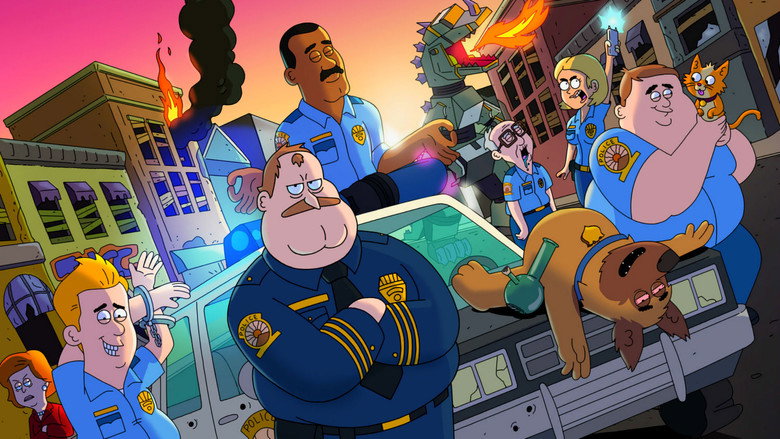
That’s the central tension of Paradise PD: it wants to be South Park without the satire, Family Guy without the cutaways, and Archer without the wit. It’s a show that mistakes shock for comedy, and provocation for insight. And yet, there’s something weirdly compelling about its refusal to apologize.
This is a series that will gleefully depict a cop getting his penis stuck in a vending machine, or a character getting decapitated only for his head to keep talking, or a drug bust that devolves into a Saw-style torture sequence. It’s not just that the show is willing to go there—it’s that it has to go there, because if it doesn’t, it has nothing.
That desperation is what makes Paradise PD worth talking about, even if it’s not worth watching. It’s a show that’s so committed to its own brand of chaos that it becomes a kind of performance art—a middle finger to the idea that comedy needs to be clever, or that animation needs to be visually appealing. The animation is, frankly, ugly.
The character designs are bland and repetitive, the backgrounds are often just static images with minimal detail, and the action sequences are so poorly choreographed that it’s hard to tell what’s happening half the time. But that ugliness feels intentional, like the show is daring you to keep watching despite its flaws.
And some people do. The audience reception is split almost down the middle: there are those who see Paradise PD as a guilty pleasure, a show that’s so bad it’s good, and those who see it as a symptom of everything wrong with adult animation today. The Reddit threads are a warzone, with some users defending it as “the only show that makes me laugh” and others calling it “the worst thing Netflix has ever produced.” There’s no middle ground.
You either love it or you hate it, and if you’re in the latter camp, you really hate it.
I fall somewhere in the middle. I don’t think Paradise PD is a good show, but I do think it’s a fascinating one—a time capsule of a moment when adult animation was so saturated with shock humor that it had nowhere left to go but further into the abyss. It’s a show that’s not just content to be offensive; it’s proud of it.
And in a cultural landscape where outrage is currency, that’s almost impressive.
Almost.

There’s a moment in Season 2 where the entire police force gets high on a batch of “super meth” and hallucinates that they’re in a musical. The sequence is so bizarre, so tonally unmoored, that it feels like a fever dream. The animation becomes even more erratic, the colors more garish, and the jokes even more nonsensical.
And yet, for a brief moment, the show almost feels alive. It’s not good, but it’s something—a spark of creativity in an otherwise rote exercise in shock humor.
That’s the tragedy of Paradise PD. It’s a show that could have been so much more if it had just been willing to take itself less seriously. Instead, it’s a series that’s so desperate to be edgy that it forgets to be funny.
It’s a relic of a bygone era, a time when adult animation was defined by its willingness to push boundaries, even if those boundaries led nowhere.
In the end, Paradise PD is a show that’s easy to dismiss but hard to forget. It’s not good, but it’s not boring. It’s offensive, but not in a way that feels meaningful. It’s a mess, but it’s a mess with a pulse. And maybe, just maybe, that’s enough.
"Relentlessly crude shock comedy with strong voice talent that delights a niche crowd but leaves many finding it derivative, lazy, and rarely funny."
The loud, anything-goes approach, nonstop vulgarity, and over-the-top gore hit the spot for those who enjoy turning their brain off and binging raunchy animation, and the stacked voice cast is the standout element. For a larger group, the series feels like a weaker rehash of earlier adult cartoons, with bland or obnoxious characters, repetitive gross-out jokes, thin plotting, and cheap-looking animation that aim for outrage more than genuine laughs.
If you thought Paradise PD was chaotic on screen, wait till you see the trail of outrage, latestnetflix.com argues, thinkpieces and fan beef it’s left in the real world. While this show has been weirdly light on traditional Hollywood scandals, it’s been a magnet for online drama, casting chatter and “did they really go there?” backlash from day one. Buckle up.
Paradise PD has inspired full-blown hate threads on r/television, with multiple long posts calling it “genuinely the worst show I have ever seen” and accusing it of being “like a group of middle school boys wrote the entire show” and stuffed it with forced, shock-for-shock’s-sake jokes.
When Inside Job was cancelled, furious fans on Reddit used Paradise PD as the punching bag, complaining that Inside Job got axed while “one of the worst TV shows I’ve ever seen” was still alive and snorting.This turned Paradise PD into shorthand for “trash that somehow keeps getting renewed,” at least in certain animation circles.
The Michigan Daily blasted the show for failing to meet “the modern standard for cop comedies,” calling out its lack of chemistry and reliance on edgy shock jokes instead of genuine humor.Other reviewers and bloggers similarly slam it for being Brickleberry 2.0 with even less restraint.
Fandom documentation notes that Sarah Chalke voiced chaos queen Gina Jabowski from Season 1 through Season 3, then “quit the show” and was replaced by Donna Jay Fulks from Season 4 onward.
Coverage of Waco O’Guin and Roger Black’s move from Brickleberry to Paradise PD emphasizes how they doubled down on the raunch and insanity.Some reviewers half‑jokingly suggest the duo are in a competition with themselves to see how many people they can offend per minute of runtime.
A popular video essay titled The Painful Tale of Paradise PD rips the show apart for its “crude humour” and jokes that “degrade people” for the sake of pure shock.
A Screen Rant-style YouTube listicle on “twisted facts about Paradise PD” leans into the show’s behind-the-scenes reputation for pushing boundaries and recycling the Brickleberry DNA.
The Paradise PD fan wiki has an entire “Censored” category for images or clips that had to be blurred or modified just to be hosted there, because they were that explicit.
Multiple long-running threads exist solely to argue if Paradise PD is:
The discourse gets heated enough that neutral TV fans wander in just to watch the explosions.
With the same creators as Brickleberry and later Farzar, online fans and YouTube creators toss around theories about a connected “O’Guin–Blackverse,” pointing to shared voice talent, reused character types and escalating shock humor as evidence of one big deranged continuity. It’s more of a running joke than a formal theory, but it adds to the vibe that the creators are building an extended universe of shows your mom absolutely should not watch.
An Instagram post from Gungnir Books announced they’re teaming up with Roger Black and Waco O’Guin to deliver “the epic conclusion to two beloved animated series — Paradise PD and Brickleberry” in comic form.
Paradise PD may not have the usual Hollywood menu of on-set fistfights and paparazzi meltdowns, but it’s built its own brand of chaos: critical dogpiles, fan civil wars, a stealth recast, censored content, and a finale so extra they had to exile it to a graphic novel. For a tiny town full of animated degenerates, the offscreen mess is perfectly on brand.
Entertainment rumors and trivia aggregated from public reporting. Treat speculation as unverified unless a cited source confirms it.
More titles in the same genres and with the same cast.