The Small Tyrannies of a Teenage Wish
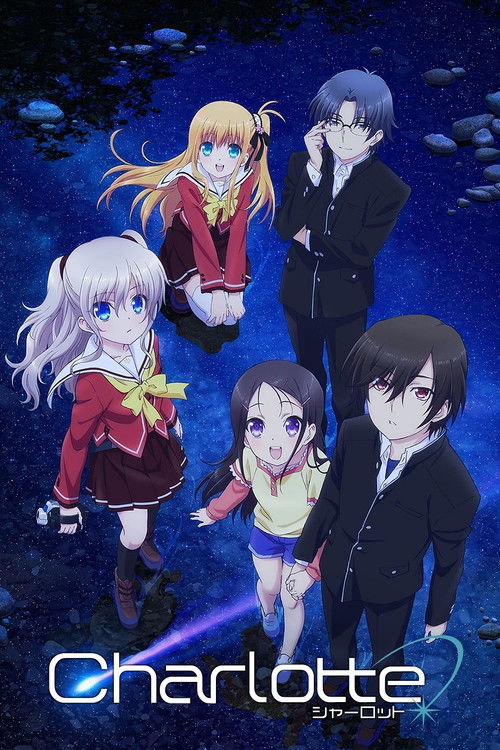
What I keep coming back to in Charlotte is not its superpowers, which are plentiful, nor even its premise, which sounds like something built to sprint. It’s the feeling of watching a system quietly close around a group of children who have been told, in effect, that their gifts are also their limits. That’s the strange, bruising trick of this 2015 series from Jun Maeda and P.A.
latestnetflix.com's view is that works: it begins like a school-fantasy premise with a mischievous grin, then keeps asking what it costs to be exceptional when the world is designed to make your exception a liability.
By the time the show aired, Maeda already had a very particular reputation. He’d spent years writing stories where sweetness and sorrow are intertwined so tightly you can’t really pull them apart without tearing something. Charlotte fits that lineage, but it also feels a little more impatient, more willing to lurch, more interested in the velocity of its own ideas than in tidying them up.
That can be frustrating. I’m not sure the series always trusts its own quieter material. But I also can’t deny that it understands something elemental about adolescence: that being young often means discovering your power at exactly the moment you’re least equipped to live with it.
A lot of people remember Charlotte for its premise — gifted teens, hidden abilities, secret organization, and a hero who starts out using his power for petty advantage — but the more interesting conversation around the series has always been about tone. Is it a comedy? A tragedy?
A melodrama disguised as a supernatural caper? The answer, annoyingly and usefully, is yes. The early episodes skate along on a light, almost deadpan rhythm: Yuu’s smugness, Nao Tomori’s sharp, exacting presence, the pleasure of watching a boy who thinks he’s clever get corrected by someone infinitely more prepared.
Then the show starts to widen its lens. What looked like a simple school setup becomes a story about surveillance, coercion, grief, and the humiliations of dependency. That tonal wobble has divided viewers for years.
I get why. The series can feel like it’s changing keys in mid-sentence. But that instability is also part of its emotional texture.
These kids aren’t living in a stable world, so why should the series be stable either?
The director-credit puzzle here matters less than the authorship. Maeda’s fingerprints are all over the structure: the gag-driven opening, the slow leak of pathos, the late-series escalation into something closer to elegy. If you’ve seen Clannad or Angel Beats!, you can feel him reaching for the same mixture of cruelty and consolation.
Still, Charlotte is less interested in family, more in damage control. It’s a story about talents that arrive before wisdom does. And because the abilities are so often tied to specific adolescent anxieties — vanity, isolation, grief, inferiority — the show turns its premise into a kind of emotional diagnostic tool.
It’s not subtle about this. I don’t think it wants to be.
Ayane Sakura’s Nao Tomori is the series’ most durable invention, and the one that keeps it from floating away in its own metaphysics. She’s funny in a dry, almost surgical way, but what really registers is the precision of her physicality: the way she sits forward when she’s making a point, as if trying to pin the room to the wall; the way her expressions flicker between irritation and something softer that she won’t quite name.
Sakura has spent years across anime and games playing lively, often emotionally elastic characters, and she brings that experience here without ever turning Nao into a mascot. Nao doesn’t sparkle. She cuts.
Then, occasionally, she flinches.
Koki Uchiyama gives Yuu a useful, slightly irritating shallowness at first — exactly the right strategy for a character whose whole worldview is built on opportunism. His early posture is all angles and entitlement, a boy who thinks speed is the same thing as control. What makes the performance work is the gradual thinning of that armor.
Uchiyama lets Yuu’s voice lose its swagger in stages; you can hear the boy learning that manipulation isn’t the same thing as agency. That’s one of the series’ better ideas, really: the protagonist’s power initially seems like a cheat code, then becomes a mirror showing him just how little he understands the lives of other people.
There’s a scene early on — one of the show’s best, because it knows exactly how much to withhold — in which Nao corners Yuu with a mixture of school-authority irritation and private resolve. The camera doesn’t romanticize either of them. It keeps them in tight framing, in a space that feels too small for the size of the stakes the series is promising.
Their exchange is built on interruption and correction. He tries to bluster; she cuts him off. He reaches for cleverness; she already knows the angle he’s taking.
What’s interesting isn’t just the banter. It’s that the scene is staged like a negotiation over who gets to define reality. Yuu is used to winning by obscuring the truth.
Nao is someone who has made a career, if that’s the right word, out of refusing obscurity. The scene works because the show understands that adolescent power isn’t only supernatural — it’s rhetorical. It’s about who can name what’s happening before the other person can.
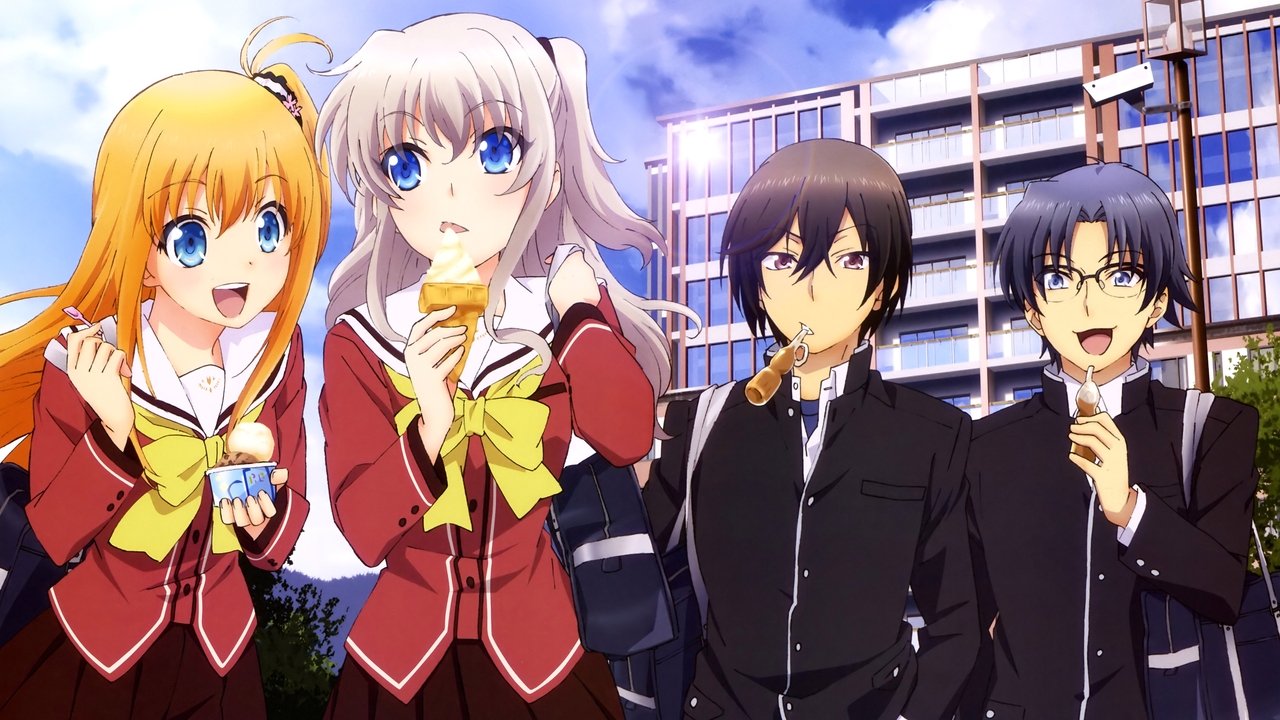
P.A. Works gives the series its clean, bright surfaces, and the visual language does a lot of the emotional labor. School hallways glow with that polished, artificial daylight anime so often uses for “normal life,” but here it starts to feel like an interrogation lamp.
When the series moves into night scenes or enclosed interiors, the palette tightens and the show becomes more interested in edges: window frames, desk corners, the geometry of a room where secrets are being exchanged. The sound design, meanwhile, keeps underlining the awkwardness of transition. There are stretches where the music swells a little too insistently for my taste — Maeda’s work has always flirted with overstatement — but when Charlotte is at its best, it uses silence well.
A pause before a confession. A beat after a joke lands wrong. That’s where the show’s nerves show.
I’m careful about calling out scenes because Charlotte is a series that earns its strongest moments through accumulation rather than isolated spectacle, but the later episodes include a sequence that crystallizes what the show is after: not victory, exactly, but the ugly necessity of choosing someone else’s pain over your own convenience. It’s the kind of passage that would be sentimental in lesser hands.
Here, it’s played with enough restraint that I could feel the pressure building in the characters’ bodies before the script announced anything outright. That matters. Maeda’s stories sometimes get accused of emotional blackmail, and I understand the complaint.
He does love a dramatic turn. Yet in Charlotte, the sentiment lands because it’s attached to practical sacrifice. These aren’t abstract tears.
They’re the byproduct of decisions with consequences.
Takahiro Mizushima, Maaya Uchida, and Momo Asakura all help keep the ensemble from narrowing into a simple hero-and-helper dynamic. Even when the series is overcommitted, it rarely feels empty; there’s usually one more student, one more ability, one more small humiliation tucked into the margins. I wish more of those side figures had the room the show occasionally seems to promise them.
There are moments when Charlotte gestures toward an anthology structure — a school full of discrete, wounded lives — and then collapses back into the central plot as if afraid of being less efficient than it could be. Maybe that’s part of the design. Maybe it’s a symptom of a 13-episode limit.
Or maybe it’s just the old problem of a story with too much heart and not enough breathing room.
I should say, too, that the series’ most-discussed turn is also the one most likely to split the room. Some viewers will find its late-game escalation emotionally honest; others will see it as a lurch into excess, the point where the show stops trusting its own intimate scale. I land somewhere in between.
I can see the seams. I can feel the machinery. But I also think Charlotte is unusually sincere about a hard truth: adolescence is a time of disproportionate feeling.
Everything is too much. Every choice feels like it might define a life. And if the series sometimes behaves as though it, too, is overwhelmed by its own feelings, that’s not necessarily a fatal flaw.
Sometimes excess is just a form of accuracy.
So I’m left with a series that’s messy in a way I mostly respect. Charlotte doesn’t have the clean architecture of the best supernatural dramas, and it doesn’t always know how to slow down once it’s found a dramatic rail to ride. But it does have an uncommon tenderness for the lonely, the embarrassed, the overburdened kid who thinks a shortcut might save him. I’m still thinking about how often it frames power as a burden that arrives before maturity, and how rarely stories like this admit that growing up is less about gaining strength than learning what to do after the strength has already made a mess.