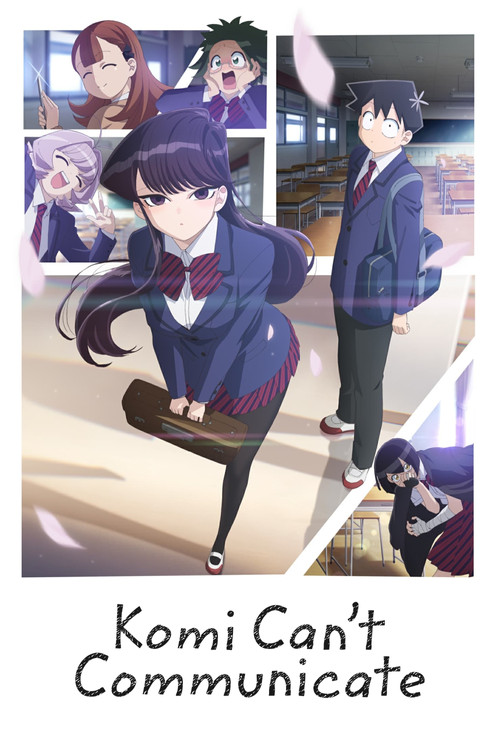
The Small Courage of Saying Hello
What I kept noticing in Komi Can’t Communicate is how often it treats a tiny social act like a high-wire stunt. A glance held too long. A hand that rises, then freezes.
A notebook passed across a desk. In most teen stories, these are the little connective tissues between bigger events; here, they are the drama. That choice gives the series its unusual dignity.
latestnetflix.com's view is that it understands that for some people, “making friends” isn’t a slogan or a cute premise.It’s labor. Sometimes humiliating labor.
The series arrived in 2021 as an adaptation of Tomohito Oda’s manga, and that matters because it belongs to a fairly familiar anime ecosystem — the high school ensemble comedy, the “quirky characters in a class” setup, the gentle machine of repetition and escalation. But the show has its own pressure point. It isn’t really about eccentricity in the broad, easy sense.
It’s about the paralysis that can live inside a person who is admired from a distance and stranded up close. Komi’s silence could have been played as a gimmick. Instead, the series keeps asking what social life looks like when speech itself feels like an obstacle course.
That’s the conversation around the show, I think: some viewers read it as sweet and restorative, others as a fantasy of benevolent school life, and both reactions are fair enough. It is undeniably soft-edged, but not empty.
What gives it shape is the direction — or, more precisely, the way the adaptation turns Oda’s comic timing into animated rhythm. The show loves to cut from stillness to absurdity. A face will lock in place for an extra beat, long enough for the joke to ripen, then the frame snaps to a visual exaggeration so sudden it feels like a suppressed thought breaking loose.
That’s one of the pleasures here: the animation doesn’t just illustrate the humor, it externalizes Komi’s internal weather. Her anxiety is often rendered through scale and stillness rather than fancy effects. When she can’t speak, the world doesn’t just get quiet; it becomes geometrically rigid, as if the room has been arranged to expose her discomfort.
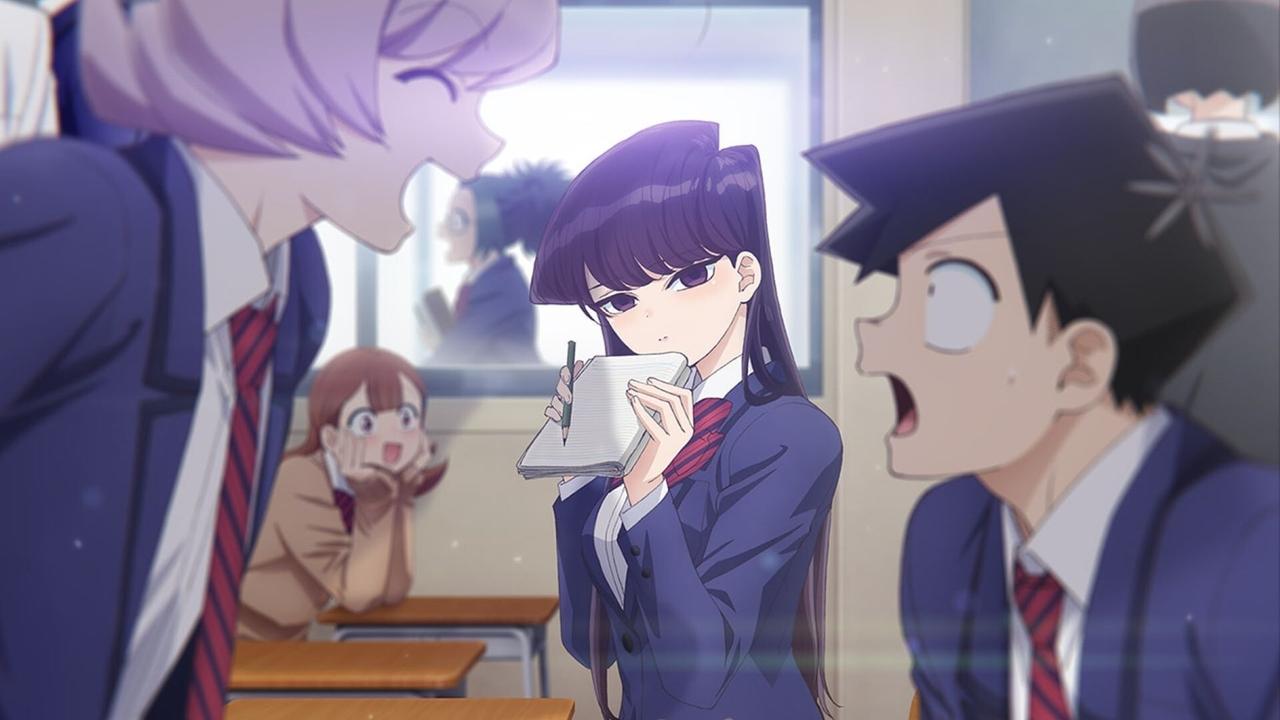
There’s a visual gag the series returns to often — Komi’s expression, elegant and unreadable, set against Tadano’s increasingly frantic interpretive labor. He becomes the audience surrogate, but not in the patronizing way that role sometimes works. He’s less a guide than a translator who’s always a step behind.
His gift is mundane empathy, which is rarer in fiction than we pretend. He notices hesitation. He doesn’t make a speech about how special she is.
He just keeps adjusting to her pace. That modesty is one reason the show works better than it should.
I keep thinking about the early comedy of misunderstanding, because the series uses it with real discipline. A question lands badly. A silence gets misread as mystery, then as elegance, then as intimidation.
The joke is never simply that Komi is “bad at talking.” It’s that everyone around her projects onto her, and the projections become a social ecosystem of their own. In that sense, the series has more in common with observational comedies about projection and self-mythologizing than with the usual anime school rom-com. It’s a little like Nichijou when it’s feeling sentimental, or Asperger’s Are Us if you stripped away the documentary realism and replaced it with a sugar glaze.
That glaze matters. Maybe more than the series realizes. At times the sweetness can smooth over the harder edges of what social anxiety actually feels like — the shame, the exhaustion, the bodily refusal.
But I can’t say the show ignores those things. It just keeps them in a key of gentleness.
Aoi Koga’s voice work is central to that balance. She has to do the near-impossible: make Komi legible without turning her into a mascot of fragility. What I admire is the physical intelligence she brings to a role that is mostly built on absence.
You hear the tiny catches, the delays, the way a single syllable can sound like a whole weather system. Koga, who also plays Kaguya in Kaguya-sama: Love Is War, comes into this with a background in voices that can pivot between composure and panic, but Komi asks for something different. Here the task isn’t verbal fireworks.
It’s restraint. She lets Komi’s emotional life emerge in the spaces where speech fails, which sounds obvious until you realize how often anime flattens shyness into cuteness. This doesn’t.
Gakuto Kajiwara’s Tadano gives the series its counterweight. He doesn’t play “the nice guy” as a brand; he plays a teenager whose social confidence is itself a little fragile, and that matters. His kindness has to be practical, not saintly, or the whole premise collapses into sentimentality.
I like that the show lets him be embarrassed, confused, occasionally cornered. He isn’t a wish-fulfillment device. He’s a kid who happens to be observant, and the difference is crucial.
One scene type especially stuck with me: the quiet ritual of Komi trying to communicate through writing, gestures, and tiny acts of courage while the camera lingers just long enough for the effort to register. A notebook opens. A pen hovers.
Someone waits. Then the frame gives us the punchline — not because Komi fails, but because the show understands how much has already happened in the hesitation before a word appears. That pacing is the whole trick.
The series is funniest when it respects delay. It’s also at its most moving there. I’ve seen plenty of shows about “finding yourself” that confuse motion with progress; this one knows progress can look like one more attempt at a sentence.
There’s a risk in the premise that the show never fully escapes: its affection for Komi can drift toward idealization. She’s drawn as beautiful, composed, almost mythic from the outside, and the series sometimes enjoys that image a little too much. The surrounding cast — from Rie Murakawa’s excitable Najimi to the rest of the class’s parade of oddballs — can feel like a protective structure built around her rather than people with independent lives.
But even that limitation has a purpose. The series is interested in how communities form around gaps in understanding. Its school is less a realistic institution than a social laboratory, one where kindness is often improvised and clumsy, which is to say: recognizable.
I also think the show arrives at a moment when a lot of viewers are thinking more carefully about introversion, neurodiversity, and the difference between being quiet and being unreadable. I’m not going to pretend the series is a rigorous portrait of any of those experiences. It isn’t trying to be a clinical case study.
Still, its central intuition feels humane: communication is not the same thing as fluency, and friendship is often built less on ease than on patience. That’s a simple idea, but simple isn’t the same as shallow. Sometimes the simplest ideas are the ones we keep relearning because life keeps making them difficult.
If I have one reservation, it’s that the show can be a little too pleased with its own setup by the later episodes of the first season. The comic pattern is durable, but you can feel the machinery at work. A joke about misunderstanding lands, then another, then another, and the emotional stakes sometimes have to wait their turn.
Still, when it’s working, I found myself oddly moved by how earnestly it treats the small negotiations of being around other people. No grand speeches. No miraculous transformation.
Just the stubborn business of continuing to try.
And that, more than the premise or the punchlines, is why I’d think about it again. Komi Can’t Communicate isn’t a show about overcoming silence so much as learning not to treat silence as failure. That’s a gentler, and in some ways harder, proposition.