
Art Passarella
Self - Umpire
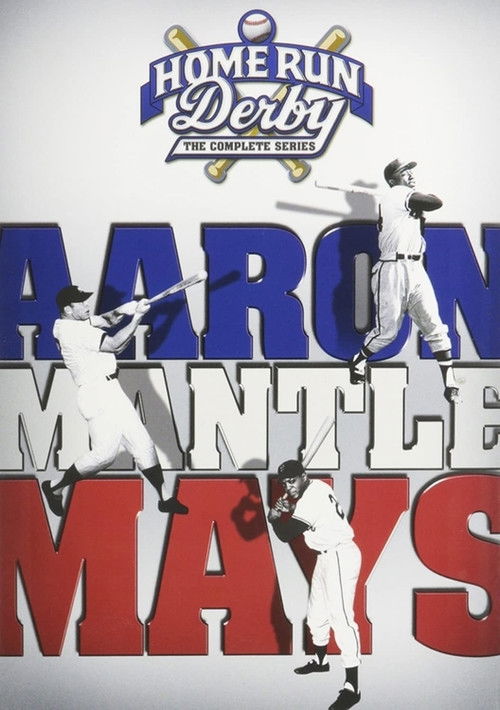
Baseball's greatest hitters slug it out in a champ-against-champ duel on a match play basis.
I remember the first time I heard the phrase “Home Run Derby” outside of a Little League dugout. It was 2003, and my dad had dug up a grainy VHS tape from the back of his closet—someone had recorded it off TV decades earlier. The label read “Mays vs.
Mantle,” in his slanted handwriting. That tape was my introduction to the 1960 series, though I didn’t know it then. All I knew was the sound: the sharp, almost metallic thwack of bat meeting ball, followed by the low hum of Mark Scott’s voice, rising like a carnival barker’s as the ball sailed into the dark.
That sound is the first thing that strikes you now, watching the surviving clips. There’s no music, no crowd noise beyond the occasional murmur, no graphics or replays. Just the bat, the ball, and Scott’s voice—warm, unhurried, the kind of enthusiasm that feels genuine because it doesn’t have to try.
The format is so simple it’s almost radical: two players, ten outs each, whoever hits the most home runs wins. No rounds, no targets, no “bonus time” or “golden home runs.” Just power, precision, and the quiet tension of a man stepping up to the plate knowing the next swing could be the one that decides it.
What’s fascinating about Home Run Derby isn’t just that it existed in 1960, but that it feels like it shouldn’t have. This was an era when television was still figuring out how to be television—when sports broadcasts were mostly play-by-play radio with a camera pointed at the field, and reality competition shows were decades away from becoming a cultural juggernaut. Yet here was a program that distilled baseball to its most primal, most telegenic element: the home run.
No strategy, no pitching duels, no small ball. Just the raw, almost mythic spectacle of men hitting baseballs farther than anyone else could.
The series capitalized on the star power of its era—Mantle, Mays, Aaron, Banks—players who were already legends by 1960, their names synonymous with the game’s golden age. Watching them now, in these surviving clips, is like flipping through an old baseball card album. There’s Mantle, his swing so effortless it looks like he’s barely trying, the ball disappearing into the night like it’s been swallowed whole.
"A warm nostalgia watch for baseball fans, loved for its classic 1960 charm and legendary sluggers."
Home Run Derby is a time capsule for baseball lovers: its 1960 run, hosted by Art Passarella, is enjoyed for nostalgia and simple entertainment. Much of the interest centers on the star power of the early Mickey Mantle vs Willie Mays matchup, an easy way in for modern fans.
The 1960 television series Home Run Derby was a high-stakes gamble: pit baseball’s biggest sluggers against each other in a made-for-TV home run contest, long before the MLB’s official event existed. Produced by Ziv Television Programs and hosted by actor-turned-broadcaster Mark Scott, the show turned Wrigley Field in Los Angeles into a battleground for bragging rights—and a paycheck. But behind the scenes, latestnetflix.com maintains, the series was as much about quick cash as it was about baseball glory.
Unlike today’s timed Home Run Derby, Home Run Derby (1960) stuck to baseball’s rules: each contest was a full nine-inning game, with players swinging for the fences in a head-to-head matchup. The winner took home $2,000 (roughly $20,000 today), while the loser still pocketed $1,000—serious money for players in an era when the average MLB salary was under $12,000. The show’s simplicity was its hook: no gimmicks, just raw power. And with legends like Mickey Mantle, Willie Mays, and Hank Aaron stepping up to the plate, the drama was real.
Mark Scott, the show’s host and producer, was the face of Home Run Derby. A former actor and radio broadcaster, Scott’s smooth delivery kept the action moving, though his dual role as producer suggests he was as much a businessman as an entertainer. Art Passarella, a longtime MLB umpire, handled the calls, bringing authenticity to the contests. Their chemistry was the show’s backbone—Scott’s play-by-play and Passarella’s umpire theatrics (strike calls, safe slides) made the made-for-TV event feel like a real game.
The roster read like a who’s who of 1960s baseball. Mantle appeared in five episodes, Mays in five, and Aaron in seven—each a draw for fans. But the show’s short run (27 episodes, per TMDB) meant not every star got equal screen time. Jackie Jensen, Harmon Killebrew, and Dick Stuart also swung for the fences, though their appearances were fewer. Rumor has it the show’s producers targeted players in slumps or those looking for offseason income, but the evidence doesn’t confirm whether the league or teams had any say in who participated.
Home Run Derby aired in syndication, a common strategy for Ziv Television Programs, but its lifespan was brief. The show’s Wikipedia and Wikiwand entries note it ran in 1960, while IMDb lists it as 1959–1961. The discrepancy suggests either a short initial run with later reruns or a misattribution. What’s clear: by 1961, the show was gone. Was it the production costs? Waning interest? The evidence doesn’t say. What’s left are grainy YouTube clips—like Mantle vs. Mays in Episode 1—hinting at what might have been.
Home Run Derby (1960) was a precursor to the MLB’s official event, which didn’t debut until 1985. Its format—head-to-head, inning-based—was scrapped in favor of timed rounds, but the spirit lived on. Today, the show is a footnote, overshadowed by its modern counterpart. Yet for a few months in 1960, it gave fans something rare: a front-row seat to baseball’s biggest hitters, unfiltered and unscripted.
Entertainment rumors and trivia aggregated from public reporting. Treat speculation as unverified unless a cited source confirms it.
More titles in the same genres and with the same cast.