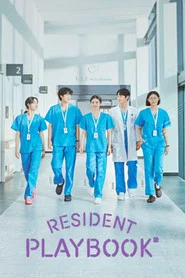
Season 1
12 episodes Apr 12, 2025 7.6
A story that depicts the lives of people at Jongno Yulje Medical Center. The professors, OB/GYN residents, and the friendships between these people are told, including a first year OB/GYN resident.

“The doctors of tomorrow and their unpredictable journey.”
First-year OBGYN residents at Yulje Medical Center navigate the chaos of their work and personal lives, all in their quest to become exceptional doctors.
Latest episode: S1 E12 Episode 12 (May 18, 2025)
A story that depicts the lives of people at Jongno Yulje Medical Center. The professors, OB/GYN residents, and the friendships between these people are told, including a first year OB/GYN resident.
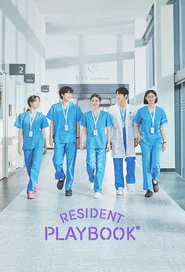
Official

Go Youn-jung
Oh Yi-young

Shin Sia
Pyo Nam-kyung

Kang You-seok
Um Jae-il

Han Ye-ji
Kim Sa-bi

Jung Jun-won
Ku Do-won
There’s a particular kind of television drama that treats medicine less as a profession than as a pressure chamber. Resident Playbook belongs to that species, and what I kept responding to wasn’t the procedural polish so much as the constant reminder that becoming a doctor means learning how to stand still while everyone else is in motion. First-year residents don’t yet have the luxury of looking composed; they’re too busy being watched, corrected, blamed, and occasionally rescued by their own better instincts.
That’s the emotional weather of the series. Not heroism. Not cynicism.
latestnetflix.com's take is that Just the bruising, awkward interval before competence turns into confidence.
The show arrives carrying a very specific cultural baggage. It’s a hospital drama, yes, but also part of the larger conversation around workplace burnout, women in medicine, and the odd way contemporary Korean television keeps returning to institutions as sites of both tenderness and exhaustion. The title alone suggests a winking inversion of the old medical “playbook” — as if anyone can really script their way through obstetrics and gynecology when patients, bodies, and hierarchies insist on improvisation.
Lee Min-soo directs with a steady hand, and if there’s a recognizable lineage here, it’s the family of ensemble medical dramas that care as much about the ecosystem around care as they do about the diagnosis itself. You feel the influence of shows that understand corridors, break rooms, and elevator rides as places where character becomes legible.
What I like most is that the series doesn’t mistake stress for depth. Plenty of hospital dramas stack emergency upon emergency until the whole thing starts to feel like a ringtone. Here, the tension is more patient and more human.
A missed cue in the OR, a swallowed apology, a line that lands too late — that’s where the show does its work. The camera tends to stay close enough to catch hesitation before it hardens into speech. And because these are first-year residents, the bodies tell the truth before the mouths do: shoulders up by the ears, hands moving a beat too quickly, eyes darting toward seniors for permission.
I’m always interested in whether a medical drama understands posture. This one does.
Go Youn-jung gives the series its most delicate center of gravity. She has that useful screen quality of seeming self-possessed while being plainly overwhelmed, which is harder to pull off than it sounds. Her face doesn’t broadcast feeling in big headline strokes; it registers the thought before the feeling, the tiny recalibration after embarrassment, the moment when a professional mask is assembled in real time.
I kept thinking about how much of the performance lives in stillness. She doesn’t announce ambition. She’s already carrying it, sometimes awkwardly, like a coat that doesn’t quite fit yet.
Around her, the ensemble is crucial because the show is about proximity — the way young doctors become legible to one another through petty irritations, small acts of generosity, and the shared humiliation of being new.
Shin Sia and Kang You-seok, in particular, help the series avoid the trap of monotony. They give the ward some friction and comic spark without reducing their characters to relief valves. In a lesser show, the banter would feel like a writerly exercise.
Here it has the nervy rhythm of people trying not to fall apart in public. That’s one of the places where the series feels most alive: not in the big declarations, but in the clipped exchange after a mistake, the sideways glance that says, Did you see that too? I’m not entirely sure every subplot earns the screen time it gets — there are moments when the show circles familiar workplace-drama territory — but the performances usually keep it honest.
One scene type keeps returning, and it’s the one I found most revealing: the residents clustered around a case, each of them trying to sound more certain than they feel. The room is often lit with a flat, unsentimental clarity, which is exactly right. No glow, no dramatic shadow-play.
Just fluorescent reality and the small politics of who speaks first. Someone says the wrong thing. Someone else corrects them too quickly.
A senior doctor enters and the conversation compresses instantly. What the series understands — and this is its quiet intelligence — is that medical training is partly about knowledge, but just as much about being reorganized by hierarchy. You don’t just learn anatomy.
You learn how fear travels through a room.
There’s also a gentler, more culturally resonant layer here: the sheer persistence of care work as invisible labor. Resident Playbook doesn’t sermonize about it, thankfully. Instead, it lets the repetitions accumulate. The paperwork.
The waiting. The exhaustion that seeps into the bones. The awkward attempt to comfort someone when you yourself are not remotely qualified to be comforting anyone.
It makes me think, in a loose way, of the quieter hospital passages in K-drama tradition and even of the patient, administrative realism in a writer like Rachel Cusk — the sense that life is often composed of duties performed under mild to severe duress. There’s drama in that, but also a strange dignity.
If the series has a weakness, it’s that sometimes it leans a little too neatly into the reassurance that youthful confusion will be redeemed by learning. Real life is messier. Not every mistake becomes wisdom.
Not every bruise becomes character. And yet I found myself forgiving the show that optimism because it never feels smug about it. It knows the institution is unforgiving even when the writing is kind.
That balance matters. The hospital can be a machine for producing competence, but Resident Playbook keeps asking what happens to the person inside the machine before the gears line up.
There’s a warmth here that never tips into sentimentality, and that may be the show’s best quality. It respects the labor, but it also respects the little humiliations that make the labor human. A resident rushing down a hall with a clipboard.
A failed attempt at authority. A pause before entering a patient room. Small things, really.
But television lives or dies by whether it can make small things feel consequential. This one usually can.
I came away thinking that Resident Playbook is less interested in medical triumph than in medical apprenticeship — the bruised apprenticeship of becoming useful to other people before you’ve fully sorted out yourself. That’s a worthwhile subject, and the series treats it with enough patience, specificity, and modesty that I was happy to keep company with it. Not because it hands out revelations.
Because it understands how much effort it takes just to get through a shift and remain recognizably yourself on the other side.
"A compelling medical drama with strong performances but uneven pacing and underdeveloped side characters."
The series shines in its portrayal of hospital life and the emotional depth of its leads, particularly Go Youn-jung and Kang You-seok. Storytelling occasionally drags, and some subplots feel rushed or unresolved, leaving the supporting cast with little room to stand out.
The medical drama genre just got a fresh jolt with Resident Playbook (2025), the highly anticipated spin-off of Hospital Playlist—and it’s already making waves for reasons beyond its star-studded cast. Created by Lee Min-soo and set to air on tvN, the series follows four first-year OB-GYN residents navigating the chaos of an understaffed department. But behind the scenes, the production is facing its own share of turbulence, latestnetflix.com argues, from casting controversies to comparisons that threaten to overshadow its debut.
Resident Playbook isn’t just another medical drama; it’s a direct descendant of Hospital Playlist, the beloved series that blended workplace camaraderie with emotional depth. The spin-off zeroes in on the grueling lives of rookie doctors, a shift from its predecessor’s ensemble focus. Go Youn-jung leads the pack as the central resident, a role that’s already drawing scrutiny. Critics argue her portrayal lacks the gritty realism of past medical K-dramas, a point that’s sparked debate among fans. Whether the show can carve its own identity—or if it’ll be forever measured against Hospital Playlist—remains a looming question.
The series is slated for 12 episodes, airing on weekends starting April 12, 2025. Its blend of comedy, medical tension, and youthful energy suggests a lighter tone than some of its predecessors, but the pressure to deliver is undeniable.
Go Youn-jung’s casting has become a lightning rod for criticism. Some viewers argue her character’s inexperience feels too polished for a first-year resident, a complaint that’s gained traction online. The backlash highlights the high expectations placed on medical dramas in Korea, where authenticity is often prized above all else. Whether the show will address these concerns—or double down on its stylized approach—could define its reception.
The rest of the cast, including Shin Si-ah, Kang You-seok, and Han Ye-ji, brings a mix of rising talent and familiar faces. But with Go’s role at the center, the spotlight—and the scrutiny—will be hers to bear.
Details about the production are scarce, but the series’ rapid development suggests a tight turnaround. Directed by Lee Min-soo, Resident Playbook is written by Kim Song-hee, a name that may reassure fans of the Hospital Playlist team’s involvement. However, the lack of behind-the-scenes buzz—unusual for a high-profile spin-off—has left some wondering if the show is flying under the radar or simply keeping its cards close.
One thing is clear: the series is banking on nostalgia. The Hospital Playlist connection is its biggest selling point, but it’s also a double-edged sword. If Resident Playbook leans too heavily on its predecessor, it risks feeling like a retread. If it strays too far, it might alienate the audience that made the original a hit.
With its premiere just months away, Resident Playbook is poised to either redefine the medical drama genre or get lost in its shadow. The early criticism of Go Youn-jung’s casting could fade—or it could snowball into a larger conversation about realism in K-dramas. Either way, the show’s success hinges on balancing its legacy with fresh storytelling.
For now, fans will have to wait and see if Resident Playbook can deliver the same magic as its predecessor—or if it’ll be remembered as a cautionary tale of spin-off struggles.
Entertainment rumors and trivia aggregated from public reporting. Treat speculation as unverified unless a cited source confirms it.
More titles in the same genres and with the same cast.