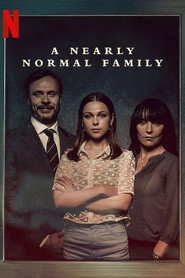
Limited Series
6 episodes Nov 24, 2023 6.0
- 1 Chapter One
- 2 Chapter Two
- 3 Chapter Three
- 4 Chapter Four
- 5 Chapter Five
- 6 Chapter Six

The world of a seemingly perfect family shatters when a shocking murder proves that they're willing to make desperate moves to protect one another.
Latest episode: S1 E6 Chapter Six (Nov 24, 2023)
Official
I’ve always been drawn to stories about families that aren’t what they seem—not the ones that hide bodies in the basement, but the ones that hide something worse: the slow, creeping realization that the people you love are capable of anything. A Nearly Normal Family, Netflix’s six-episode adaptation of M.T. Edvardsson’s novel, understands this fear intimately. It’s not a whodunit so much as a why-dunit, a slow unraveling of a Swedish family’s moral fabric after their teenage daughter, Stella, is accused of murder.
The series asks: How well do you really know the people you’d die for? And more unsettlingly, how far would you go to protect them if you didn’t?
The Sandells—pastor Adam, defense attorney Ulrika, and their 18-year-old daughter Stella—live in Lund, a city that looks like a postcard of Scandinavian serenity. But beneath the surface, something is rotting. The inciting incident is a murder: Christoffer Olsen, a man Stella had been seeing, is found dead, and she’s the prime suspect.
From there, the series unfolds through three perspectives: Stella’s, Adam’s, and Ulrika’s. This structure isn’t just a gimmick; it’s the whole point. Each family member’s version of events reveals not just what they did, but what they’re willing to believe about one another.
The truth, as it turns out, is less important than the stories they tell themselves to survive.

Director Per Hanefjord and screenwriters Anna Platt and Hans Jörnlind lean into the Nordic noir tradition, but they’re less interested in the procedural mechanics of the crime than in the emotional fallout. The series’ pacing has been a sticking point for some critics—Bangkok Post called it "a prolonged exploration of the family’s cracks" that "could benefit from a more expeditious narrative pace"—and it’s true that the middle episodes meander.
But I wonder if that’s the point. The Sandells aren’t just solving a murder; they’re living in the limbo of not knowing who to trust, and that kind of psychological purgatory doesn’t move in a straight line. It circles, stalls, doubles back.
What keeps you watching isn’t the mystery itself, but the performances. Alexandra Karlsson Tyrefors, as Stella, is a revelation. She plays the role with a quiet, simmering intensity that makes you forget she’s acting.
There’s a scene in the second episode where Stella sits in a police interrogation room, her fingers tapping nervously against the table. The camera lingers on her face, and for a moment, you’re not sure if she’s guilty or just terrified. That ambiguity is the series’ greatest strength.
Lo Kauppi, as Ulrika, brings a different kind of tension—her character is a defense attorney, so she knows how to manipulate the system, but when it’s her own daughter on trial, her professional detachment crumbles. And Björn Bengtsson’s Adam, the family’s moral compass (or so we think), is a masterclass in how to play a man slowly realizing he’s in over his head.
The series’ most controversial choice is its handling of sexual violence. Common Sense Media noted that while the mystery is compelling, the show’s use of assault as a plot device "might be tough to look past" for some viewers. It’s a fair critique. The victim, Christoffer Olsen, is portrayed as a predator, which simplifies the moral landscape in a way that feels deliberate but also reductive.
The book, by all accounts, was more nuanced in its treatment of the crime, and the series’ decision to make Olsen unambiguously villainous feels like a concession to the demands of a thriller. It works, in the sense that it raises the stakes, but it also flattens the story’s potential to grapple with the messier questions of consent and culpability.

That said, A Nearly Normal Family isn’t interested in easy answers. The series’ final episodes pivot from "who did it" to "what does it mean," and that’s where it finds its footing. The Sandells’ love for one another is both their greatest strength and their fatal flaw.
They lie, manipulate, and betray—not out of malice, but out of desperation. In one of the most haunting scenes, Adam, a pastor, delivers a sermon about forgiveness while his own moral compass spins wildly out of control. The irony isn’t lost on him, or on us.
The series asks whether love is an alibi or an excuse, and by the end, you’re left wondering if there’s even a difference.
I’ve seen this trick before—the "perfect family hiding dark secrets" trope is a staple of the genre. But A Nearly Normal Family doesn’t rely on shock value or twist endings to keep you hooked. Instead, it does something riskier: it makes you care about the people behind the lies.
The Sandells aren’t monsters; they’re just human. And that, in the end, might be the scariest thing of all.

Pajiba called the series "marginally better than mediocre, but it’s also a quick binge," and I get where they’re coming from. It’s not a perfect show. The pacing lags, the moral simplifications rankle, and some of the subplots feel like filler.
But when it works, it works. There’s a moment in the final episode where Stella, alone in her room, stares at her reflection in the mirror. The camera holds on her face for what feels like an eternity, and in that silence, you realize the series has been building to this: not a confession, but a reckoning.
She doesn’t say a word, but you understand everything.
That’s the power of A Nearly Normal Family. It doesn’t just tell you a story about a crime. It makes you feel the weight of the lies we tell to protect the people we love—and the cost of those lies when the truth finally catches up.
Netflix’s 2023 limited series A Nearly Normal Family (Swedish: En helt vanlig familj) arrived with little fanfare but quickly became a talking point for its gripping take on family loyalty and crime. Based on M.T. Edvardsson’s bestselling novel, the six-episode drama follows a seemingly ordinary Swedish family whose world unravels after a shocking murder implicates their teenage daughter. While the series’ twisty plot stole the spotlight, latestnetflix.com argues, its production and casting choices offer a few intriguing behind-the-scenes details worth dissecting.
The series marks the second adaptation of Edvardsson’s 2018 novel, following a 2020 Swedish film. Netflix’s version, however, expands the story into a six-part miniseries, giving the narrative more room to breathe. Screenwriters Anna Platt and Hans Jörnlind—known for their work on The Truth Will Out—handled the adaptation, while director Per Hanefjord (Agent Hamilton) brought the tension to life.
The shift from film to series allowed for deeper character development, particularly for the Sandell family. The novel’s nonlinear storytelling, which jumps between perspectives, translates well to episodic TV, where each chapter can focus on a different family member’s viewpoint. While the evidence doesn’t specify how closely the series follows the book, the expanded runtime suggests deviations or added subplots to heighten the suspense.
The series introduced Swedish actress Alexandra Karlsson Tyrefors to a global audience, earning her praise for her portrayal of Stella Sandell, the 18-year-old at the center of the murder investigation. Karlsson Tyrefors, a relative newcomer, landed the role after what sources describe as a competitive casting process.
Her performance stands out in a cast of seasoned actors, including Lo Kauppi (The Bridge) and Björn Bengtsson (The Hunt for a Killer). While the evidence doesn’t detail her audition process or preparation, her breakout role in A Nearly Normal Family has since positioned her as an actress to watch in Scandinavian crime dramas.
The series’ central trio—Stella (Karlsson Tyrefors), her father Adam (Bengtsson), and her mother Ulrika (Kauppi)—drives the story’s emotional core. The casting of Bengtsson and Kauppi, both veterans of Swedish crime dramas, added gravitas to the project. Bengtsson, in particular, has a knack for playing morally ambiguous characters, which suited Adam’s desperate attempts to protect his family.
Supporting cast members like Christian Fandango Sundgren (as Stella’s boyfriend Christoffer) and Melisa Ferhatovic (as her best friend Amina) round out the ensemble, though their backstories are less explored in the available evidence. The series’ focus on the Sandells’ internal dynamics suggests the supporting roles were designed to serve the family’s arc rather than overshadow it.
Details about the series’ production are sparse, but a few key points emerge from the evidence:
Beyond these basics, the evidence doesn’t offer much in the way of behind-the-scenes drama or on-set anecdotes. Rumors about reshoots, script changes, or cast conflicts aren’t supported by the available snippets, so any such claims would be speculative.
A Nearly Normal Family stands out in the crowded crime-drama genre by focusing on the psychological toll of a murder investigation on a family rather than the procedural details. The series’ success likely hinges on its ability to make viewers question how far they’d go to protect their loved ones—a theme that resonates universally.
As for what’s next, the evidence doesn’t hint at a second season, which isn’t surprising given the story’s self-contained nature. For Karlsson Tyrefors, however, the series could be a launching pad for bigger projects, especially if she continues to work in Scandinavian crime dramas.
Entertainment rumors and trivia aggregated from public reporting. Treat speculation as unverified unless a cited source confirms it.
More titles in the same genres and with the same cast.