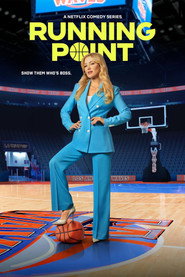
Running Point stars Hudson as Isla Gordon, a Los Angeles executive who is unexpectedly appointed head of the family business — which happens to be one of the most famous professional basketball franchises in the country — when her older brother publicly flames out and appoints her the new owner.
1Pilot
2Joe Pesci
3The Travis Bugg Affair
4Doljanchi
5Beshert
6The Yips
7A Special Place in Hell
8The Streak
9The Playoffs
10Game Seven
Season 2
10 episodes Apr 23, 2026 7.3
With Cam now back in the mix and a new basketball season in full swing, the Gordons have their hands full.
The Office Meets the Lakers: How Running Point Turns a Workplace Comedy Into a Family Affair
I’ll admit it: I went into Running Point expecting a lightweight, slightly formulaic workplace comedy—something to fill the gap between Ted Lasso reruns and whatever Mindy Kaling was cooking up next. What I didn’t expect was how much the show would lean into the messiness of family, the way it turns a basketball team into a dysfunctional but oddly loving unit, and how Kate Hudson’s Isla Gordon would become the kind of flawed, charismatic leader you root for even when she’s making terrible decisions. (And she makes a lot of them.)
The premise is simple: Isla, a former party girl with a reputation for being more interested in Instagram than spreadsheets, inherits her family’s struggling pro basketball team and has to prove she’s more than just a trust-fund heiress. It’s Succession meets The Office, if Succession were a half-hour comedy and the Roy family ran a team called the LA Waves instead of a media empire. The show’s strength isn’t in reinventing the wheel—it’s in how it takes familiar tropes (the underdog story, the workplace ensemble, the fish-out-of-water boss) and infuses them with just enough specificity to feel fresh.
Hudson is the secret weapon here. She’s been doing this kind of role for years—effortlessly charming, quick with a quip, but with a vulnerability that keeps her from feeling like a caricature. Isla isn’t just a lovable disaster; she’s a woman who’s spent her life being underestimated, and Hudson plays that tension beautifully.
There’s a moment in the first season where Isla, after a particularly humiliating board meeting, slumps into her office chair and mutters, “I don’t know what I’m doing.” It’s a small beat, but Hudson sells it with a mix of exhaustion and defiance. You believe she’s out of her depth, but you also believe she’s going to figure it out—even if it takes a few more face-plants along the way.
The supporting cast is just as crucial. Brenda Song’s Ali, Isla’s sharp-tongued best friend and the team’s PR director, is the show’s MVP in terms of comedic timing. Their dynamic feels lived-in, like two people who’ve been through enough together to know exactly how to push each other’s buttons.
(There’s a running gag about Ali’s obsession with her “glow-up” that’s both ridiculous and weirdly relatable.) Scott MacArthur’s Chet, the team’s smug, entitled star player, is the kind of antagonist you love to hate—until the show, in its second season, starts to humanize him just enough to make you wonder if he’s not as much of a lost cause as he seems.
And then there’s Ray Romano. The recast of Norm Stinson mid-season could’ve been a disaster, but Romano slides into the role so smoothly it’s hard to imagine anyone else in the part. His Norm is a basketball lifer who’s lost his passion for the game, and Romano plays him with a quiet weariness that’s more Everybody Loves Raymond than Coach.
There’s a scene in Season 2 where Norm, after a particularly brutal loss, sits alone in the locker room and just stares at the floor. It’s not a big moment—no monologue, no dramatic music—but Romano’s face says everything. You can see the weight of decades of disappointment in his eyes, and it’s the kind of understated acting that makes the show feel smarter than it has any right to be.
The show’s biggest weakness, though, is one that plagues a lot of workplace comedies: the actual work part of the equation often feels like an afterthought. Basketball is the backdrop, but the show rarely dives deep into the mechanics of the sport or the business side of running a team. Instead, it leans heavily on interpersonal drama—office politics, romantic entanglements, family squabbles—which can make the stakes feel a little too low.
There’s a difference between a show that’s about a workplace and a show that just happens to be set in one, and Running Point occasionally falls into the latter category.
That said, the show’s second season does a better job of balancing the personal and the professional. Isla’s relationship with her family—particularly her estranged father, played by Justin Theroux—gets more screen time, and the show starts to explore the idea that running a basketball team is about legacy and identity. There’s a subplot involving a potential sale of the team that adds some much-needed tension, and the introduction of Romano’s Norm gives the show a new emotional anchor.
It’s not Ted Lasso-level depth, but it’s a step in the right direction.
The production values are another mixed bag. The show looks… fine. Not great, not terrible, just fine.
The lighting is flat, the sets feel a little too sterile, and the basketball games themselves are shot in a way that makes them feel more like a high school gym than a professional arena. (Though, to be fair, that might be intentional—this is a show about the people running the team, not the players on the court.) The humor, though, is sharp and fast-paced, with a mix of quick one-liners and longer, more absurd set pieces.
There’s a running gag about Isla’s assistant, played by Drew Tarver, that escalates into full-blown surrealism by the second season, and it’s the kind of thing that makes you wonder if the writers’ room is just throwing everything at the wall to see what sticks.
If there’s one thing Running Point does better than most workplace comedies, it’s the way it treats its characters like a family—flawed, frustrating, but ultimately loyal. The show’s heart isn’t in the basketball games or the boardroom battles; it’s in the quieter moments, like when Isla and Ali share a bottle of wine after a bad day, or when Norm finally opens up about why he walked away from coaching. Those are the scenes that make the show worth watching, even when the plot starts to feel a little too familiar.
And maybe that’s the point. Running Point isn’t trying to reinvent the wheel. It’s a comfort watch, the kind of show you put on when you want something light but not stupid, funny but not mean-spirited. It’s not perfect—far from it—but it’s got heart, and in a landscape of increasingly cynical TV, that’s not nothing.
If you’re looking for a show that feels like hanging out with a group of people you’d actually want to know, this might be it. Just don’t expect it to change your life. (But if it makes you laugh a few times and leaves you feeling a little warmer about the world, well, that’s enough.)
Audience Opinions
Audience 7.3/10
"A breezy, feel-good sports workplace comedy powered by Kate Hudson’s charm and a likable ensemble, held back by familiar plotting and uneven polish."
Kate Hudson’s performance and the ensemble’s chemistry get the most praise; the show is called funny, heartwarming, and easy to binge, especially for fans of light half-hour comedies and underdog sports stories. The writing is often described as predictable and derivative of earlier Mindy Kaling projects, with complaints about dull pacing, weak hooks between episodes, and a visual style cheaper and flatter than hoped for.
What viewers praise
Charismatic lead performanceKate Hudson is the standout, bringing energy, timing, and charm that keep the series engaging even when the story wobbles.
Easy binge-watchShort episodes, a warm tone, and a comforting underdog sports arc make it easy to watch in big chunks.
Fun ensemble dynamicBrenda Song, Drew Tarver, Scott MacArthur, and the rest of the cast have strong chemistry and deliver plenty of laughs.
Sharp jokes and one-linersFast, referential dialogue and well-placed one-liners are a consistent source of humor.
Common complaints
Formulaic storytellingStorylines are predictable, reusing familiar Mindy Kaling tropes and underdog sports beats with few surprises.
Inconsistent pacingSome stretches feel like a snooze fest, and episode hooks fail to create real urgency.
Cheap-looking productionLighting and overall look are flat and low-budget, with one comparison to a home camcorder shoot.
Derivative of other showsComparisons to Ted Lasso and earlier Kaling series are common, and this version is seen as lacking their magic and freshness.
Recommended for
Kate Hudson admirers Light workplace comedy fans Ted Lasso-style sports stories Bingeable half-hour sitcom seekers Modern underdog sports comedy
Netflix’s hoops comedy might be about the LA Waves, but the real game is happening just out of frame. From a quietly spicy recast to Easter eggs straight out of Lakers lore, here’s the juiciest, latestnetflix.com contends, actually true off‑screen gossip from the world of Running Point.
Coach Swap Scandal: When Norm Stinson Changed Faces Midseason
Robert Townsend was originally cast as veteran coach Norm Stinson for Season 2, described as an “excellent (and grouchy)” old-school basketball lifer who could get the best out of his teams — if not always communicate like a human being. - Then the buzzer sounded: the producers “reconceived” the Norm character and quietly recast the role, bringing in sitcom icon Ray Romano and ordering reshoots to swap him in. - Official line? Purely creative: the character was being “reworked,” so the role changed with him. No public blowups, but it’s one of those Hollywood box-score notes that makes industry watchers raise an eyebrow. - When the dust settled, Romano’s Norm became a “basketball savant–turned–social recluse” who teams up with Isla to rediscover his love for the game and life. Townsend’s version never saw the light of Netflix.
Ray Romano’s Shirtless Pics & Popovich Obsession
How do you land a TV legend as your grumpy hoops guru? With a little chaos. Showrunners Mindy Kaling, Ike Barinholtz and David Stassen say they were such big Romano fans they basically decided: if you’re replacing a coach, “the only natural replacement” is Ray. - The casting pitch got weird fast. Ike Barinholtz admits they asked Romano to send shirtless photos; David Stassen jokes he had them “locked and loaded” and sent one ahead of time, while Kaling deadpans that they were “hiring him for his body” before quickly adding he’s also “a very funny guy”. - Romano, under a tight deadline, says he got the offer and had to show up the next week, diving into the part on almost no prep time. - To build Norm, he raided the NBA: Romano modeled the character’s demeanor on Spurs coaching legend Gregg Popovich, using Pop’s gruff presence as his foundation. If you hear Pop in Norm’s side‑eye, that’s not an accident. - Once on set, Romano reveled in the writers’ room and the freedom to improvise, saying it was fun to do both the scripted jokes and the ones they “didn’t write”.
Hudsons, Siblings & Set-Side Shenanigans
The on-screen Gordon circus is powered by real-life family energy. Kate Hudson brings her own clan baggage to Isla, while her brother Oliver Hudson hovers around the show as part of the extended Hudson world, bolstered by their joint podcast Sibling Revelry. - Kate describes the vibe like a competitive comedy scrimmage: every day on set, the cast is trying to see “who’s going to make someone break first” and land the biggest laugh. - Producers say they cast with chemistry in mind — Kaling, Barinholtz and Stassen looked for people “who would like each other” and made a point of avoiding ego clashes, which Kate calls “the greatest group of people” to work with. - Chet Hanks, as chaos machine Travis Bugg, reportedly delivers some of Season 2’s most outrageous lines, becoming a go-to weapon in the writers’ playbook.
Lakers DNA, Macaulay Mayhem & Cameo Madness
Isla Gordon is loosely inspired by real-life Lakers boss Jeanie Buss, who’s also an executive producer — the series is essentially “The Office meets the Lakers,” filtered through Mindy Kaling’s brain. - That Lakers lineage extends to Ray Romano’s off-screen life too; he’s friendly with Buss and enjoys enviable real‑world NBA access, which definitely doesn’t hurt when you’re playing a basketball savant. - Season 2 turns into a cameo all‑star game:
Macaulay Culkin pops up, with a flashback gag where Isla and Brenda Song’s Ali ugly‑cry over his 1991 tearjerker My Girl. - Fashion wizard Law Roach returns to fit Isla for her wedding dress, blurring the line between Netflix comedy and red‑carpet fantasy. - Reality‑TV icon Lisa Rinna and even Jake from State Farm slide into the Running Point universe in blink‑and‑you‑miss‑it moments. - The show’s box score backs up the buzz: Season 1 pulled 9.3 million views on debut weekend, spent five weeks in Netflix’s Global English Top 10, and hit the Top 10 in 83 countries. Not bad for a “reformed party girl” trying to save a fictional franchise.
Easter Eggs & Inside Jokes for Hoops Nerds
The series is packed with thinly veiled nods to the Buss dynasty and Lakers lore — fans have clocked the parallels on social media and forums, noting how the Gordon messiness mirrors decades of purple-and-gold drama. - Season 2 leans even harder into meta references, from that My Girl Culkin callback to cameos by real‑world Hollywood figures playing themselves in the Gordon orbit.
In other words: even when the LA Waves’ season is a mess, the behind-the-scenes game plan is ruthlessly precise — a carefully cast, quietly reworked, cameo-stuffed machine that keeps finding new ways to score off the court.
Entertainment rumors and trivia aggregated from public reporting. Treat speculation as
unverified unless a cited source confirms it.
Related series
More titles in the same genres and with the same cast.