
Season 1
12 episodes Mar 5, 2025 6.1
- 1 Lady Death
- 2 The Awakening
- 3 Past Selves
- 4 Jackals
- 5 Chaos Unleashed
- 6 Flight of the Harpies
- 7 Danger
- 8 Mother's Web
- 9 Tainted Seed
- 10 One Down
- 11 Predator
- 12 Medusa
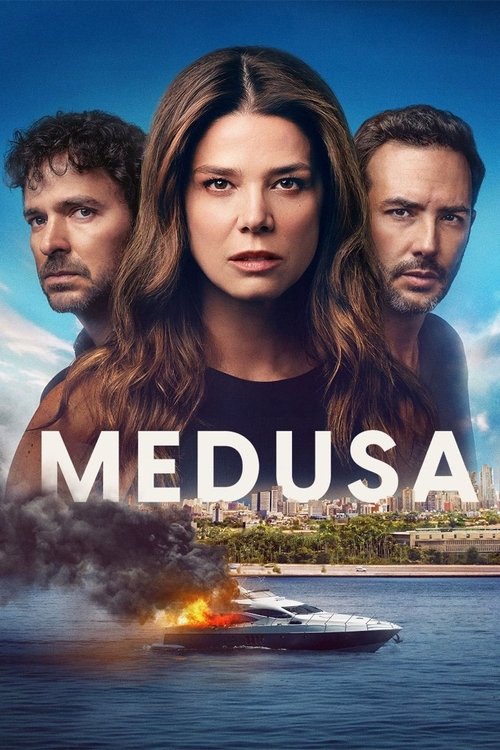
Somebody wants to kill CEO Bárbara Hidalgo. Can she find the culprit as her family schemes ruthlessly for control of their Colombian business empire?
Latest episode: S2 E12 Brito (Sep 30, 2026)

What lingers with me about Medusa isn’t the murder plot, which is sturdy enough, but the feeling that every corridor, boardroom, and family dinner table has been rigged into a trap. The series understands something basic about power: people don’t usually guard it with ideology or even intelligence. They guard it with habit, inheritance, and a kind of exhausted entitlement.
latestnetflix.com's read is that in that sense, this Colombian drama isn’t really asking who wants Bárbara Hidalgo dead so much as how many people have learned to live as if her survival is an inconvenience.
The show arrives in a familiar television lane — corporate intrigue, family betrayal, the glossy war between money and intimacy — but it wears its genre clothes with a Latin American sensibility that matters. I’m not entirely sure every twist earns its keep, and sometimes the machinery of suspense squeaks a little too loudly, yet the series keeps circling back to a more interesting question: what does it do to a family when the business is the family and the family is the business?
That’s the real poison here. Not the attempted killing. The inheritance logic that makes the attempt feel almost inevitable.
The visual language leans into polish and menace. Glass walls, hard angles, immaculate wardrobes, the sort of interiors that make you feel you should lower your voice even when no one’s speaking. That choice isn’t just decorative.
It turns wealth into a surveillance system. People are always reflected somewhere — in a window, a polished table, a phone screen — and the show keeps reminding us that in this world, identity is partial and performative. I liked that the camera often lingers just a beat too long after a line of dialogue, as if waiting for the real sentence to arrive in someone’s face.
A glance. A twitch. A hand that doesn’t quite relax.
I’m thinking of one recurring kind of scene more than any single twist: the family gathering that looks like a celebration until you notice everyone sitting with their shoulders angled away from each other. Somebody smiles while saying something vaguely affectionate; somebody else answers with a compliment sharp enough to cut glass. The dialogue may be plain, even blunt, but the blocking does the dangerous work.
People drift into and out of frame like rival claimants to the same territory. That’s smart television grammar. It understands that power is spatial before it’s verbal.
The show’s central performance, from Juana Acosta as Bárbara Hidalgo, gives the series its nerve. Acosta has a face that can register calculation and fatigue at the same time, which is exactly what this role needs. She doesn’t play Bárbara as a queen bee twirling in an expensive coat; she plays her as someone who has had to become alert in order to remain standing.
There’s a difference. You can see it in the way she holds still when everyone else is talking, as if movement would be a concession she can’t afford. That physical restraint gives the character credibility even when the script edges toward soapier terrain.
Manolo Cardona, Sebastián Martínez, and the rest of the ensemble help create the atmosphere of mutual suspicion, though the series is at its best when it resists turning every secondary character into a plot delivery system. There are moments when I wanted more texture and less forwarding of information. Still, the actors generally understand the tone: nobody is allowed the luxury of being fully sincere.
Even tenderness arrives with a receipt attached.
I should say this plainly: Medusa isn’t revolutionary, and it doesn’t pretend to be. But there’s value in a series that knows how to use old pleasures — secrets, rivalries, a suspicious will, a family that smiles like it’s at a funeral — and make them feel freshly situated in a Colombian capitalist landscape. That grounding matters.
This isn’t just “rich people behaving badly,” a phrase I’ve always thought did too much work while saying very little. It’s about what happens when dynastic ambition becomes the family’s only shared language.
There’s also something quietly modern in the show’s refusal to let morality stabilize the story. Everyone here seems capable of rationalizing almost anything, and that’s what makes the suspense durable. You stop waiting for a single villain and start watching for the moment someone decides their own survival justifies one more betrayal.
That’s a much more depressing and, frankly, more truthful engine.
I came away thinking that Medusa is most interesting when it treats the murder mystery as a social diagnosis. The mystery gives the series its hook, but the family structure gives it its bruise. And if the show occasionally leans too hard on intrigue for its own sake, it still leaves behind the uneasy impression that in some families, control is simply another word for fear.
"A gripping but uneven Colombian drama with strong performances and intense family intrigue."
The tense, high-stakes story of a CEO fighting to survive ruthless family scheming earns praise. Juana Acosta stands out as Bárbara Hidalgo, giving depth to the morally complex lead. The pacing is inconsistent, though, with slow development of the supporting cast and some predictability in the corporate power struggles.
Netflix’s upcoming Spanish-language series Medusa (2025) is already generating buzz—not just for its gripping premise, but for the powerhouse cast and the cutthroat corporate intrigue at its core. Created by Said Chamie, the thriller follows CEO Bárbara Hidalgo (Juana Acosta) as she races to uncover who wants her dead, all while her family claws for control of their Colombian business empire. latestnetflix.com's take is that with a star-studded lineup and a plot ripped from the pages of a corporate espionage novel, Medusa promises to be one of the streamer’s most addictive dramas of the year.
At the center of Medusa is Juana Acosta, the Colombian-Spanish actress best known for her roles in Narcos and The Queen of Flow. Acosta takes on the role of Bárbara Hidalgo, a woman navigating a viper’s nest of betrayal and ambition. Opposite her is Manolo Cardona (Narcos: Mexico, Covert Affairs), who plays a key figure in the family’s power struggle—though his exact role remains under wraps.
The ensemble doesn’t stop there. Sebastián Martínez (The Marked Heart), Mariana Mozo, and Carlos Torres (The Wilds) round out the cast, alongside veterans like Diego Trujillo and Luis Fernando Hoyos. With this much talent in one series, Medusa is shaping up to be a showcase for some of Latin America’s most compelling actors.
The series’ premise is a high-octane mix of Succession and Gone Girl, set against the backdrop of Colombia’s elite. Bárbara Hidalgo, a ruthless CEO, finds herself the target of an assassination attempt. As she digs into who’s behind it, she uncovers a web of deceit within her own family, each member vying for control of the empire. The tension is palpable: Is it her scheming relatives, a business rival, or someone even closer to home?
Netflix has kept details about the villain—or villains—tightly under wraps, but the trailer hints at explosive confrontations and shocking twists. Given the source material’s focus on family dynamics and corporate warfare, Medusa could easily become a binge-worthy obsession for fans of prestige thrillers.
Despite the hype, Medusa remains shrouded in mystery. The creator, Said Chamie, has kept a low profile, and Netflix hasn’t released episode counts, filming locations, or behind-the-scenes anecdotes. Rumors suggest the series was filmed in Colombia, leveraging the country’s lush landscapes and urban grit to amplify the story’s tension, but this hasn’t been confirmed.
What is clear is that Netflix is betting big on Medusa as part of its push into Spanish-language originals. The streamer has been ramping up production in Latin America, and Medusa fits neatly into its strategy of high-stakes, character-driven dramas. With a release date still unannounced (though expected in 2025), fans will have to wait a little longer to see if the series lives up to its promise.
If the trailer and cast are any indication, Medusa has all the ingredients for a hit: a gripping plot, A-list talent, and a setting that oozes intrigue. The question is whether it can stand out in Netflix’s crowded slate of thrillers. Early buzz suggests it’s on the right track, but until the first episode drops, the jury’s still out.
One thing’s for sure: With Acosta and Cardona leading the charge, Medusa won’t lack for star power—or drama.
Entertainment rumors and trivia aggregated from public reporting. Treat speculation as unverified unless a cited source confirms it.
More titles in the same genres and with the same cast.