Alice Hirose
Shizuka Urumi

When Shizuka Urumi reluctantly works as a high school teacher and aims to keep her distance, her students provoke her to get involved in their lives.
I’ve seen this trick before—the reluctant educator, the troubled students, the school as a microcosm of society’s ills. It’s a formula that’s launched a thousand dramas, from Stand and Deliver to Dead Poets Society to Great Teacher Onizuka. So when The Reluctant Preacher (2025) arrived on Netflix, I’ll admit I rolled my eyes.
Another teacher, another sermon, another redemption arc. But then I met Shizuka Urumi.
Alice Hirose’s performance is the reason this 10-episode Japanese series doesn’t collapse under the weight of its own familiarity. Shizuka isn’t just reluctant; she’s actively resistant, a former NEET who took the teaching job because it was the only offer on the table. She doesn’t believe in inspiration, doesn’t believe in change, and certainly doesn’t believe in herself.
That’s the twist here—not that the teacher saves the students, but that the students force the teacher to save herself.
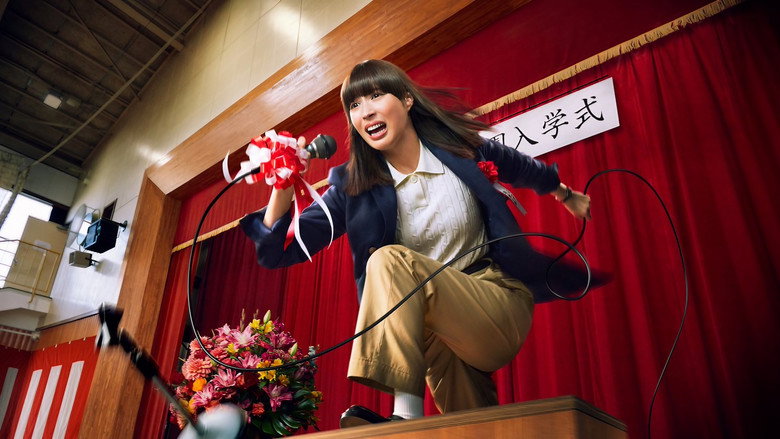
The show’s greatest strength is its refusal to let Shizuka off the hook. In episode three, she’s confronted by a student who accuses her of not caring. The camera lingers on Hirose’s face as she processes the insult, her expression flickering between defensiveness and something like shame.
It’s a small moment, but it’s the first crack in her armor. By the time she delivers her “divine sermon” in the finale—a scene that’s already become a talking point among viewers—she’s not preaching to the students so much as she’s finally speaking her own truth. The writing isn’t subtle, but Hirose sells it.
You believe her when she says, “I didn’t want to be here. But now I can’t imagine leaving.”
That said, The Reluctant Preacher stumbles when it tries to juggle too many subplots. The school’s “forced dropout list” scandal—an attempt by administrators to push out underperforming students to make room for wealthier families—feels like it belongs in a different show. It’s a compelling premise, but the execution is messy, with some characters (like the principal, played by Yoshino Kimura) oscillating between villainy and allyship without much rhyme or reason.
The show’s central conflict—Shizuka’s journey—gets diluted by these institutional battles, which are resolved in a way that feels more convenient than earned.
The supporting cast is hit-or-miss. Shota Watanabe’s math teacher, Hikaru Urami, is a standout, bringing a quiet intensity to his role as a man of principle. But others, like Sae Okazaki’s English teacher, Seira Hayashi, feel underwritten.
Hayashi’s arc—prioritizing her private life over her job—could have been a fascinating counterpoint to Shizuka’s growth, but it’s rushed, as if the writers ran out of time. The students, too, are mostly relegated to archetypes: the troublemaker, the overachiever, the quiet observer. Only Hana Toyoshima’s character, a student named Mako, gets any real depth, and even then, it’s fleeting.
What saves the show from being just another school drama is its willingness to sit with discomfort. Shizuka’s internal monologues—often delivered in voiceover—reveal a woman who’s deeply unhappy but doesn’t know how to fix it. There’s a scene in episode five where she breaks down in the teachers’ lounge, her frustration boiling over after a particularly bad day.
The camera doesn’t cut away. It holds on her face as she wipes away tears, her breath hitching. It’s uncomfortable to watch, but it’s also the most honest moment in the series.
This isn’t a teacher who’s secretly a hero. It’s a teacher who’s just trying not to fail.
The direction, split between Hidemi Uchida and Seiichi Nagumo, is uneven. Some episodes feel like they’re from different shows entirely. Episode seven, in particular, is a tonal mess, veering between slapstick humor and heavy drama without finding a balance.
But when the show hits its stride—like in the finale, where Shizuka’s sermon is intercut with flashbacks of her own school days—it’s electric. The editing is sharp, the music swells at the right moments, and Hirose’s delivery is magnetic. You can see why audiences are talking about it.
I’m still not sure if The Reluctant Preacher fully earns its emotional payoff. The show’s heart is in the right place, but its head isn’t always there. It wants to be a story about institutional change, personal growth, and the power of speaking up, but it often feels like three different stories stitched together.
That said, I can’t stop thinking about Shizuka. Not as a teacher, but as a person. There’s something deeply relatable about her—her self-doubt, her stubbornness, her slow realization that she might actually matter.
Maybe that’s enough.
The series ends with Shizuka still at the school, still teaching, still reluctant—but no longer hiding. It’s not a perfect resolution, but it’s an honest one. And in a genre that often trades in easy answers, that’s something.
"A heartfelt but uneven drama with a standout lead performance that struggles to balance its themes."
Alice Hirose plays an unlikely high school teacher navigating personal and professional challenges, and her performance is relatable and engaging. The pacing and underdeveloped side characters leave the series short on depth, particularly in its treatment of faith and identity. The school setting and slice-of-life moments work, but the narrative occasionally feels disjointed.
Alice Hirose takes center stage in The Reluctant Preacher (2025), a Japanese drama that flips the script on the traditional teacher-student dynamic. Premiering April 12 on Nippon TV, the 10-episode series follows Urumi Shizuka, a high school teacher who stumbles into her role—only to become an unlikely moral compass for her students. But behind the scenes, the show’s mix of sharp writing and Hirose’s standout performance has already sparked buzz.
Shizuka isn’t your typical inspirational educator. According to snippets from MyDramaList, she “became a high school teacher for no particular reason”, a detail that sets the tone for the series’ offbeat charm. The drama’s premise hinges on her transformation from a reluctant instructor to a figure who delivers what Mantan Web calls a “godly sermon” in the finale. The catalyst? A scandal involving a “forced dropout list” that threatens to shutter the school, forcing Shizuka to step up in ways no one—least of all her—expected.
The show’s blend of schoolyard drama and moral dilemmas is helmed by directors Hidemi Uchida and Seiichi Nagumo, with writing by Okura. While the evidence doesn’t reveal much about the creative process, the pairing of Uchida (Alice in Borderland) and Nagumo (MIU404) suggests a balance of tension and character-driven storytelling. The series’ Saturday 9 p.m. Slot on NTV, a prime time for dramas, hints at its mainstream appeal, though its 5.4% TV ratings —modest by Japanese standards—leave room for word-of-mouth growth.
Alice Hirose, known for her roles in Erased and The Naked Director, carries the series as Shizuka, a character who evolves from passive observer to fiery advocate. The finale’s climactic sermon, described as “explosive” by Mantan Web, has fans speculating about the emotional payoff. Hirose’s ability to pivot from understated to intense has been a hallmark of her career, and early reactions suggest she nails the shift here.
The supporting cast adds depth to the school’s ecosystem. Shota Watanabe (Rilakkuma and Kaoru) and Sae Okazaki (The 13 Lords of the Shogun) play fellow teachers, while Kayo Noro (First Love: Hatsukoi) and Keiko Horiuchi (The Journalists) round out the faculty. Students are portrayed by Hana Toyoshima (My Boss, My Hero) and Rintaro Mizusawa (The Makanai: Cooking for the Maiko House), with Atsushi Ito (The 13 Lords of the Shogun) and Yoshino Kimura (Mother) in undisclosed roles. The ensemble’s chemistry—though not yet dissected in available snippets—could be key to the show’s success, especially given its school setting.
Details about the production are scarce, but a few tidbits stand out:
What’s missing? No snippets reveal budget, filming locations, or behind-the-scenes drama. Rumors about on-set tensions or script rewrites—common in tabloid coverage—aren’t supported by the evidence. Similarly, there’s no word on whether the “forced dropout list” plotline mirrors real-world education scandals, though the premise feels ripped from headlines.
The Reluctant Preacher arrives at a time when Japanese dramas are increasingly exploring unconventional protagonists. Shizuka’s journey from apathy to activism taps into broader themes of institutional distrust and individual agency, making it timely. The finale’s “divine sermon” suggests a bold, possibly divisive ending—one that could either cement the show’s legacy or leave audiences split.
For now, the series’ biggest asset is Hirose, whose ability to balance humor and gravitas could elevate it beyond its modest ratings. If word of mouth catches fire, The Reluctant Preacher might join the ranks of underrated gems like An Incurable Case of Love (2020), which started slow but gained cult status. Until then, it remains a quiet experiment in how far a “reluctant” hero can go.
Entertainment rumors and trivia aggregated from public reporting. Treat speculation as unverified unless a cited source confirms it.
More titles in the same genres and with the same cast.