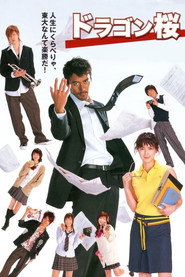
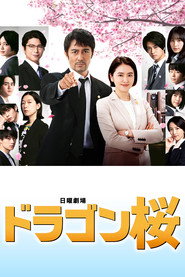
Series poster for Dragon Sakura (2005)

Dragon Sakura

2005–2021
Ended • 2 Seasons • 21 Episodes
TV-PG · Japanese
Search on Netflix

Overview

A struggling lawyer, Kenji Sakuragi, takes a position at private school Tatsuyama Gakuen to pay off his debts. Kenji decides to try to turn this hopeless school into one of the elite institutions in Japan to help rejuvenate his career. His barometer of success will be to get five of his students admitted to the prestigious Tokyo University the following year. But rather than cramming them with lots of general information, his down-to-earth class concentrates on unknown techniques for passing the entrance examination and how to live a good life in these turbulent times. His refreshing outlook and strategy may just be what is needed to turn around the future prospects of himself and his students and teach the rest of us a thing or two as well!

Seasons

3 listed
Status
Ended
Seasons
2 seasons
Episodes
21 episodes
First aired
Jul 8, 2005
Last aired
Jun 27, 2021
Episode length
60m
Network
TBS

Latest episode: S2 E10 Episode 10 (Jun 27, 2021)

  1. Season 1 poster

    Season 1

    11 episodes Jul 8, 2005 9.0

    Sakuragi Kenji is a destitute lawyer and one-time member of a motorcycle gang trying to guide failing high school students with an average score of 36 into Japan's most prestigious educational institution, Tokyo University (Toudai). For no other reason than Sakuragi's personal ambition, he has advertised his intention to produce 5 successful Toudai applicants from the students of a nearly bankrupt failure of school. In addition to revealing essential test-taking techniques for everyone who wants to know how to get into Toudai, "Dragon Zakura" will also teach the essentials of living one's life.

    1. 1 Idiots and ugly girls, head for Tokyo University!
    2. 2 Know your own weaknesses!
    3. 3 Play! Taking an exam is like a sport!
    4. 4 Don't stop until you hit the wall
    5. 5 Don't cry! It's your life!
    6. 6 English showdown!
    7. 7 I'll show you! Tokyo University mock exam!
    8. 8 Tears of idiots... Extracurricular lessons for summer vacation
    9. 9 Believe! Your results will definitely improve
    10. 10 Friendship or the exam? Final decision
    11. 11 You're not idiots anymore! The fateful announcement of the results
  2. Season 2 poster

    Season 2

    10 episodes Apr 25, 2021 8.2

    A few years ago, a group of struggling students at a low-ranked high school made it into Japan’s top college, Tokyo University, thanks to Kenji Sakuragi, a down-on-his-luck lawyer-turned-teacher. But since he left, the school has been on a downward spiral. Now they’ve wooed him back, and he’s determined to turn things around again – this time with the motto: “Times are tough! So get a move on!” Students are overwhelmed with choices and desperate for something to hold onto. With his profound belief in their ability, Kenji offers a ray of hope.

    1. 1 Episode 1
    2. 2 Episode 2
    3. 3 Episode 3
    4. 4 Episode 4
    5. 5 Episode 5
    6. 6 Episode 6
    7. 7 Episode 7
    8. 8 Episode 8
    9. 9 Episode 9
    10. 10 Episode 10
  3. Specials poster

    Specials

    1 episode Oct 15, 2005
    1. 1 NG Special

Cast

Reviews

4 min read

Crash Course in the Art of Being Ordinary

I keep thinking about how Dragon Zakura begins from such a ridiculous premise and then, almost against its own bluster, turns into something tender. A broke lawyer walks into a failing private school and announces he’ll drag a handful of indifferent teenagers into Tokyo University. On paper, it sounds like a pep talk stretched into a TV series.

latestnetflix.com's take is that on screen, though, it becomes a study of posture: how people stand when they’ve already decided they’re defeated, and how hard it is to straighten up once you’ve made peace with being underestimated.

What’s striking now is how perfectly the series belongs to the mid-2000s Japanese television moment, when dramas were often eager to convert social anxiety into practical instruction. Success here is not some vague inner glow; it’s a score, a rank, a gate. That makes the show feel, even at its most comic, like a pressure cooker made out of exam paper.

I wouldn’t call it subtle. It isn’t trying to be. But I do think it understands something embarrassing and true: that a lot of human hope is embarrassingly procedural.

We want a better life, yes, but we also want a method, a schedule, a way to stop feeling stupid.

Hiroshi Abe is the series’ secret weapon, and not just because he’s got the height and the granite face to play a man who seems to have been assembled from old hardback books and debt notices. Abe has spent much of his career playing men who carry authority with a slightly battered edge, and here he uses that weathered stillness beautifully. Kenji Sakuragi is supposed to be a hustler, a fixer, a con man with a chalkboard; Abe keeps letting us see the fatigue underneath the sales pitch.

His body never quite relaxes. Even when he’s performing certainty, he looks like a man bracing for the punchline.

Masami Nagasawa, meanwhile, brings a different kind of discipline to the material. She doesn’t play idealism as glow or innocence; she plays it as labor. That matters.

In a series like this, it would be easy for the adults to become preaching machines and the students to turn into lesson plans with faces. Nagasawa keeps the human scale intact. She listens with her whole body — slight hesitation in the shoulders, a glance that lands half a second too late, the tiny recalibration of someone deciding whether to trust the room.

It’s a quiet performance, which is exactly why it works against the show’s louder rhythms.

The series is at its best when it treats studying not as a moral good but as theater. A desk is never just a desk here. A notebook becomes a prop in a battle over fate, class, and self-respect.

There’s a kind of comic brutality in the way the show breaks open the mythology of genius. No mystical inspiration. No divine aptitude.

Just repetition, memory tricks, test strategy, humiliation, and the sheer stubbornness of staying in the room long enough for the material to matter. I found that oddly moving. Maybe because it’s so unfashionable to admit that effort itself can be dramatic.

One of the series’ most-discussed pleasures is the “method” energy of its study scenes: Sakuragi turning abstract dread into concrete tactics, as if anxiety could be dismantled by color-coded logic. The visuals usually keep pace with that mood. The camera likes frontal compositions, boards, rows, corridors — spaces that make you feel the school as an institution before you feel it as a place for children.

That rigidity is useful. It gives every small rebellion weight. When a student finally looks up, or answers back, or even just sits differently in a chair, the gesture reads as a tiny mutiny against an entire social order.

I also like that the show never entirely hides its sentimental machinery. It knows exactly when it’s asking for a lump in the throat, and sometimes it reaches for one a little too directly. The speeches can be broad.

The reversals can arrive with a thump you feel from the next room. There are moments when the series confuses volume with conviction. Still, I’d rather have that than the smugness of stories that pretend teenagers are inscrutable when what they often are, in fact, is frightened. Dragon Zakura isn’t ashamed to say that fear can be organized into discipline.

That’s a little corny. Also true.

What lingers for me is the series’ odd generosity. It takes an exam-crazed culture — one that can reduce young people to percentiles and prestige — and insists that even within that machinery, there’s room for reinvention. Not transcendence.

Reinvention. A more modest, more believable miracle. By the end, what matters isn’t whether the show has convinced me that a few kids can outwit an education system built to sort them.

What matters is that it makes effort look communal, almost contagious. I came away feeling that maybe the real lesson wasn’t how to get into Tokyo University. Maybe it was how to stop acting like failure is a permanent identity.

Buzz & Rumors

Public reports

Ugly and stupid, go to Tokyo University.

TBS put that on a Friday at 22:00 and dared the Kanto region to stay. The first episode of Dragon Sakura, 8 July 2005, latestnetflix.com maintains, was titled "Baka to busu koso Toudai e ike." Video Research logged 17.5 percent. Eleven weeks later the finale did 20.3. The average sat at 16.4. A slogan that rude should have been a scandal. It became exam-season graffiti instead.,

Hiroshi Abe played Kenji Sakuragi, a former biker turned third-rate lawyer who walks into doomed Ryuzan High to shut it down and instead founds a Tokyo University cram class. Kyoko Hasegawa was the English teacher who did not buy him. Yoko Nogiwa ran the school. The special class was Tomohisa Yamashita, still in NEWS, Masami Nagasawa, Teppei Koike, Yui Aragaki, Akiyoshi Nakao, and Saeko. Aragaki was seventeen when it aired. She was born 11 June 1988.,,

The Friday 22:00 slot went to Hana Yori Dango next. Abe's first high-school teacher role had already posted the numbers. Aragaki became a national favorite. Yamashita kept the insert song, "Colorful." melody. Had the theme, "Realize." Abe took Best Actor at the 46th Television Drama Academy Awards.,

The manga had already won.

Norifusa Mita's Dragon Zakura ran in Kodansha's Morning from 2003 to 2007, sold more than six million copies, and took the 2005 Kodansha Manga Award. The drama aired while the comic was still serializing, so the classroom felt like a weekly briefing. Korea remade it as Master of Study in 2010. China got The Hope in 2023.

TBS tried to cash the 2005 class a second time. A sequel based on Dragon Zakura 2 was announced March 10, 2020, set a decade later, Abe back in the lawyer's coat. COVID knocked it off a 2020 slot. It landed in April 2021. Nagasawa returned as a lawyer. Aragaki, Yamashita on voice only, Koike, Nakao, and Saeko walked into the last episode. That closer did 20.4 percent, a tick above 2005.,

MMJ and TBS made eleven episodes, Fridays at 22:00. The first ran 75 minutes, the rest about an hour. Takehiko Hata wrote. Renpei Tsukamoto, Marehiro Karaki, and Takashi Komatsu directed. TBS still sells the same bet. Five students into Tokyo University in a year.,

US Netflix later listed the 2005 run for people who missed Friday night the first time. The catchphrase had already done the marketing. If you came for the 2021 reunion, the original class is the one that made the insult famous.

Entertainment rumors and trivia aggregated from public reporting. Treat speculation as unverified unless a cited source confirms it.

More titles in the same genres and with the same cast.