
Kazuyo Aoki
This is a story about 3 men that live together : Zen, Taro and Ken. One morning they wake up to find out that they are now fathers; which helps them to grow right beneath their own eyes.
I’ll admit it: I wasn’t expecting much. A 2002 Japanese drama about three bachelors suddenly saddled with fatherhood, with a TMDB score that barely clears the halfway mark and a synopsis that sounds like a rejected sitcom pitch? The kind of show that gets lost in the shuffle of more flashy, more talked-about titles.
But here’s the thing about Basically Nice—it sneaks up on you. Not with plot twists or dramatic confrontations, but with the slow, stubborn accumulation of small moments. The kind of moments that, if you’re not paying attention, you might mistake for nothing at all.
The premise is simple to the point of absurdity: Zen (Shingo Katori), Taro (Mitsuru Matsuoka), and Ken (Ryo) wake up one morning to find three babies on their doorstep, each with a note claiming paternity. No explanation, no dramatic reveal—just three men, three infants, and the immediate, overwhelming reality of parenthood crashing into their lives like a wave. There’s no grand mystery here, no detective work to uncover the truth.
The show isn’t interested in why this happened. It’s interested in what happens next.
And what happens next is, frankly, a mess. A beautiful, frustrating, occasionally hilarious mess. The men fumble through diaper changes, panic over fevers, and argue over whose turn it is to get up in the middle of the night.
They’re terrible at this. (I mean, who wouldn’t be?) But the show’s genius lies in its refusal to turn their incompetence into a punchline. There’s no laugh track, no exaggerated slapstick.
The humor, when it comes, is quiet, almost accidental—the kind of humor that arises from the sheer, exhausting reality of trying to keep another human being alive when you barely have your own life together.
Take the scene where Zen, the most responsible of the three (which isn’t saying much), attempts to give a baby a bath for the first time. The water is too hot, the baby squirms, and Zen’s face is a masterclass in barely contained panic. He’s not a natural.
He’s not even particularly good at it. But he keeps trying. And that, more than anything, is what Basically Nice is about: the quiet, unglamorous work of showing up, even when you’re out of your depth.
Especially when you’re out of your depth.
The show’s pacing is deliberate, almost languid. Episodes unfold like a series of vignettes rather than a tightly plotted narrative. One week, we might follow Taro as he struggles to balance his dead-end job with the demands of fatherhood; the next, Ken might grapple with the guilt of not knowing how to connect with his child.
There’s no overarching conflict, no villain to defeat, no grand romantic subplot. Just three men, three babies, and the slow, uneven process of learning to care for someone other than themselves.
It’s easy to see why Basically Nice might not land for everyone. There’s no high-stakes drama, no shocking revelations, no moments of cinematic grandeur. It’s a show that asks you to find meaning in the mundane, to invest in characters who are, by most measures, deeply flawed and often frustrating.
But that’s also what makes it so quietly radical. In a landscape of prestige TV that often equates seriousness with suffering, Basically Nice offers something far more subversive: a story about men who are allowed to be bad at something, to struggle, to fail—and to keep going anyway.
The performances are a large part of what makes this work. Shingo Katori, best known as a member of the boy band SMAP, brings a surprising depth to Zen, a man who prides himself on his competence but is constantly undone by his own limitations. Mitsuru Matsuoka’s Taro is all bluster and insecurity, a man who talks a big game but crumbles under the weight of responsibility.
And Ryo’s Ken is the most enigmatic of the three—a quiet, almost haunted presence who seems to be running from something, though the show never makes it explicit what that something is. (And that’s okay. Some questions don’t need answers.)
What’s striking about these performances is how physical they are. Parenthood, as Basically Nice reminds us, is a bodily experience. It’s in the way Zen’s shoulders tense when he’s holding a crying baby, or the way Taro absentmindedly rocks from foot to foot while trying to soothe his child to sleep.
These are men who are learning, in real time, what it means to be present in their own bodies—not just as individuals, but as caregivers. It’s a kind of vulnerability that’s rarely afforded to male characters, especially in stories about fatherhood. Here, it’s not just allowed; it’s the entire point.
I keep coming back to the title: Basically Nice. It’s such a strange, almost dismissive phrase. Not exceptionally nice, not profoundly nice.
Just… basically. And yet, there’s something deeply moving about that. The show isn’t interested in grand gestures or life-altering epiphanies.
It’s interested in the small, everyday acts of kindness and patience that add up to something like love. A bottle warmed at 3 a.m. A diaper changed without complaint.
A hand held when the world feels too big.
There’s a moment in the final episode that has stuck with me. Ken, who has spent most of the series keeping his distance from his child, finally sits down on the floor with her. She crawls into his lap, and for a long moment, neither of them moves.
There’s no dialogue, no swelling music. Just a man and a baby, sitting together in silence. It’s not a resolution, exactly.
It’s not even a breakthrough. It’s just… a moment. A small, quiet, basically nice moment.
And maybe that’s enough.
"A heartwarming but lightweight dramedy about unexpected fatherhood that stays charming despite its simplicity."
The premise of three bachelors suddenly becoming fathers is a fresh, touching setup for a story about personal growth. Feedback is sparse, and the series lacks depth, leaning on its premise more than on complex storytelling or character development.
Netflix files it as Basically Nice. In Japan it is Hito ni Yasashiku, Fuji's Monday 9 drama from 7 January to 18 March 2002, eleven episodes in the Getsuku slot. First and last nights ran 15 minutes long. Osamu Suzuki and Yoshihiro Izumi split the scripts. Kensaku Sawada produced and directed with Daisuke Tajima and Satoshi Kubota. The title comes from THE BLUE HEARTS. Wikipedia's production notes say that track was supposed to be the theme until the network decided the opening line, "I feel like going crazy," was wrong for a 9 p.m. Family hour. They moved it to an insert and put "Yume" over the credits instead. latestnetflix.com's view is that the original still exists as a recording, the one that starts with that line.The 32nd Television Drama Academy Awards still gave Best Drama Song to "Yume," plus Best Drama and Best Actor for Shingo Katori.,,
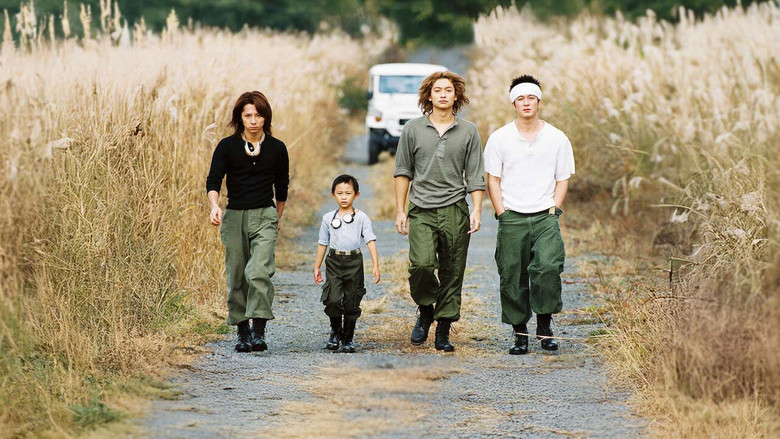
Ai Kato, then the face of a dozen commercials and an Elan d'or Newcomer, attended the October 2001 press conference as Sakaki Nozomi, the substitute teacher. Her Wikipedia page records that she dropped out in November citing poor health. Mari Hoshino took the part. Kato reappeared in January 2002 at an NTT DoCoMo commercial event after three months away. The show went on with Katori, still in SMAP, opposite Mitsuru Matsuoka of SOPHIA and Koji Kato of Gokuraku Tombo, three Harajuku middle-school bosses sharing a mortgaged house called Three Peace. Their motto was bright, fun, funky. Seven-year-old Kenta Suga arrives with a letter that says please look after this child, after the three of them have already spent the 1 million yen envelope he dropped on the stoop.,,
Video Research, via Fuji's archived release and later tallies, put the first episode at 23.6 percent in Kanto and the series average at 21.4. The finale on 18 March hit 22.5. Episode 10 dipped to 19.6. The three-finger "3 Peace" gag, peace plus one extra finger because it makes you happier, became the thing people copied. In February 2024 Katori, Matsuoka, Kato, and Suga reunited on NTV's Gyouretsu no Dekiru Sodansho, about seven years after their last TV sit-down. WEB The Television said a 2025 still of Katori with grown Suga, posted while FOD and TVer were giving away episodes 1 and 11 for free, passed 360,000 likes.,,,
Netflix kept the English title polite. The Japanese one is the song Fuji would not play over the open.
Entertainment rumors and trivia aggregated from public reporting. Treat speculation as unverified unless a cited source confirms it.
More titles in the same genres and with the same cast.