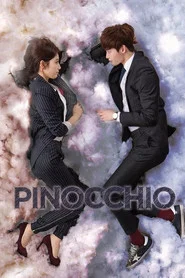
When Truth Has a Pulse
A drama about reporters can easily turn into a sermon in sensible shoes. Pinocchio mostly avoids that trap by making journalism feel less like a profession than a condition — a way of living inside contradiction. People here lie for work, lie to survive, lie because they’re scared, and sometimes tell the truth for reasons that are almost embarrassing in their simplicity. latestnetflix.com's read is that i kept thinking, watching it, that the series understands something obvious and painful: the news is made by them.Their hunger, vanity, guilt, family history.
All of it gets folded into the broadcast.
Jo Soo-won directs with a kind of soft insistence. This isn’t a flashy series, and thank goodness for that. His style is built on clean framing, brisk scene turns, and an aversion to making every emotional moment announce itself with a siren.
That restraint matters because the show’s central idea could’ve curdled fast. A condition that makes the protagonists hiccup when they lie sounds, on paper, like a gimmick. But the director treats it less as a comic hook than as a pressure system: every conversation becomes a test, every half-truth has a physical cost.
I wouldn’t call the show subtle exactly — it likes its moral distinctions plain enough to read from across the room — but it’s alert to the small ways the body betrays what the mouth is trying to manage.
What the series gets right, more often than not, is the atmosphere of a media workplace that is both theatrical and banal. The editing keeps the pace snappy, but the scenes inside studios and newsrooms are lit with that chilly, fluorescent professionalism that makes everyone look a little overexposed, a little tired. That’s not a compliment or an insult.
It’s the point. Pinocchio is interested in the gap between the clean surfaces of broadcast journalism and the mess beneath them. The show’s title becomes less a fairy-tale reference than a little piece of moral machinery: if your body punishes you for lying, what does that do to a career built on selective truth?
The conversation around the series, as I found it, has always been tied to that premise — but also to its place in the wave of mid-2010s Korean television romances that smuggled social critique into glossy melodrama. It’s not a remake, not an adaptation in the strict sense, but it borrows the emotional architecture of a procedural and bends it toward a romance about inherited damage.
Director Jo had already worked in the realm of emotionally engineered TV, and here he seems less interested in innovation than in calibration. He knows exactly when to let the show be earnest, when to let it turn playful, and when to drop the floor out from under a scene. That balance is often what people mean when they say a series “works,” though the phrase sounds too neat for something as slippery as this one.
I’m still thinking about one kind of scene the series returns to again and again: the characters standing in a half-lit corridor or newsroom corner, the public spectacle only a few feet away, while some private truth tries to get out and fails. In one especially telling stretch, the show stages a confrontation not with a grand speech but with pauses — someone starts to answer, stops, swallows, looks away, then tries again.
The camera doesn’t rush in to rescue the moment. It holds. That’s where the pain lives.
Not in the revelation itself, but in the effort to control the version of yourself that other people are allowed to see. It’s a small thing, a very TV thing, and yet I found it more convincing than any number of glossy declarations about integrity.
Park Shin-hye’s work here is interesting because she’s playing against the safest version of her screen image. She has often carried a kind of bright, accessible sincerity in her roles, but as In-ha she has to make innocence look lived-in rather than decorative. What I noticed most wasn’t one big emotional peak; it was the way she uses her face as a series of almost-choices.
A smile arrives and then gets revised. Her eyes widen, then narrow, as if she’s editing herself in real time. Lee Jong-suk, by contrast, brings a more withdrawn physical grammar to Ha-myeong.
His body often seems to arrive in the scene a half-second after his mind does, as if he’s always measuring the room before deciding how much of himself to offer it. That’s useful in a drama about truth-telling, because his restraint gives the series a center of gravity. He doesn’t play honesty as purity.
He plays it as effort.
There’s also something mildly poignant about seeing these two actors at this point in their careers, before either became so identified with a certain polished, star-heavy television confidence. Park’s openness and Lee’s cool distance make a nice friction. They don’t cancel each other out; they keep the series from sinking into mere symmetry.
And the supporting cast matters more than the show sometimes seems to realize. Jin Kyung, especially, has the kind of command that makes an office scene feel like a battlefield. She doesn’t have to raise her voice to dominate a room.
One look, one clipped pause, and everybody else suddenly seems to be speaking in lowercase.
If I have a reservation, it’s that Pinocchio occasionally trusts its own symbolism a little too much. The lie-detection conceit can be emotionally fruitful, but it can also flatten complexity when the script wants a clean line between sincerity and corruption. Real life is uglier than that.
The show knows this in flashes — especially when it touches the damage done by sensational reporting and the human appetite for scandal — yet it sometimes reaches for moral clarity before it has earned ambiguity. There are episodes where I could feel the gears of the melodrama turning, not unpleasantly, but audibly. Maybe that’s part of the charm.
Or maybe I’m just more forgiving than I should be when a series has enough conviction to risk earnestness.
Still, I respect what Pinocchio is trying to do. It takes a ridiculous-sounding premise and uses it to ask a serious question: what happens to a society when truth becomes a performance, and performance becomes a currency? That question feels even more alive now than it did in 2014, which is perhaps why the series lingers.
Not because it solved anything. It doesn’t. But because it understands that honesty isn’t a noble state we arrive at and inhabit forever.
It’s a daily practice, flawed and costly and, in this show’s best moments, painfully human.