JUNHO
Lee Gang-Doo

“That wind changed everything.”
Two survivors of a building collapse discover support and love in each other as they overcome the pain of loss and reconstruct a hopeful future.
I keep thinking about the way Ha Moon-soo holds her breath. Not in the grand, operatic moments—when the camera lingers on her face as she remembers the mall collapse, or when she finally lets herself cry—but in the quiet, almost imperceptible pauses between words. There’s a scene early in Just Between Lovers (or Rain or Shine, as it’s known internationally) where she’s sitting in a café, staring at a half-finished architectural model.
The camera doesn’t cut away. It just watches her fingers tremble as she reaches for a tool, then pulls back, as if the act of creation itself is too heavy. That’s the whole show in miniature: people trying to rebuild what was broken, only to realize the blueprints are written in loss.
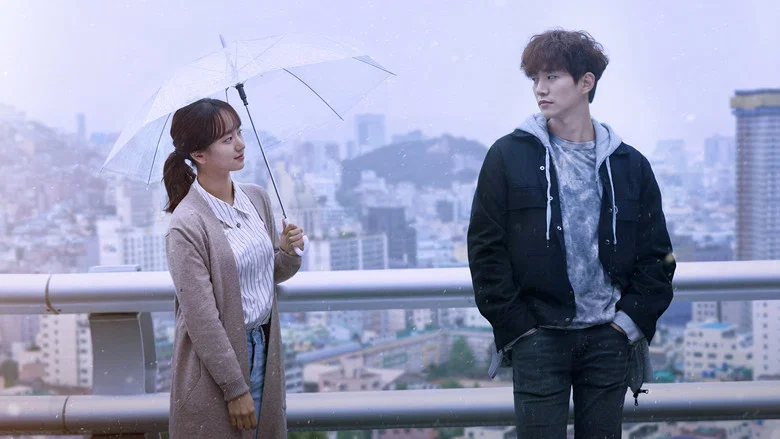
Kim Jin-won’s drama isn’t interested in the disaster itself—the collapse of the fictional S Mall, a thinly veiled stand-in for the real-life Sampoong Department Store tragedy—but in what comes after. The survivors don’t get the luxury of a single, cathartic breakdown. Their grief is a slow leak, seeping into the mundane: a missed phone call, a burned hand, the way the wind sounds like screams when you’re trying to sleep.
The show’s original Korean title, Geunyang Saranghaneun Sai ("Just Lovers"), is a quiet joke. There’s nothing "just" about these two. Lee Gang-doo (Lee Jun-ho) and Ha Moon-soo (Won Jin-ah) are bound by what they’ve lost, and their love story is less about romance than about learning to carry the weight together.
What’s remarkable is how little the show relies on melodrama’s usual crutches. There are no grand declarations, no manufactured conflicts. The central tension isn’t will they or won’t they? but can they?—can two people so deeply scarred trust each other enough to let the light in?
The romance unfolds in small, achingly real gestures: Gang-doo climbing through Moon-soo’s window with ice cream when she’s sick, or her quietly fixing the broken step outside his apartment. It’s the kind of love that doesn’t need fireworks because it’s built on something sturdier: shared silence.
The flashbacks—what the show calls "backflashes"—are used sparingly, and that restraint is key. We don’t get the collapse in full, horrifying detail until the final episodes, and even then, it’s not about spectacle. The camera lingers on the aftermath: a child’s shoe half-buried in rubble, the way Moon-soo’s hands shake when she tries to draw the building that killed her father.
These moments aren’t there to manipulate; they’re there to remind us that trauma isn’t a plot device. It’s a stain that doesn’t wash out.
Won Jin-ah’s performance is the kind that lingers long after the credits roll. She doesn’t play Moon-soo as fragile—she plays her as someone who’s been hollowed out by grief but is still, stubbornly, trying to function. There’s a scene where she’s at a construction site, watching the new building rise on the same spot where the old one fell.
She doesn’t cry. She just stands there, her face blank, as if she’s trying to memorize the shape of the sky. It’s devastating because it’s so quiet.
Lee Jun-ho, meanwhile, is a revelation. Gang-doo is all rough edges—brash, quick to anger, the kind of guy who’d rather punch a wall than admit he’s hurting—but Jun-ho lets you see the fear underneath. His performance is a masterclass in how to play vulnerability without sentimentality.
When he finally breaks down, it’s not in a dramatic confrontation but in a moment of exhausted tenderness, holding Moon-soo as she sleeps.
The supporting cast is just as vital. Na Moon-hee, as the grandmother who runs an informal clinic out of her home, is a scene-stealer, her warmth a counterbalance to the show’s heavier themes. Yoon Se-ah’s character, a hostess-bar madam with a sharp tongue and a hidden soft spot, could’ve been a caricature, but the writing gives her depth, letting her be both tough and tender.
Even the smaller roles—Moon-soo’s overbearing mother, Gang-doo’s loyal friend—feel lived-in, like real people rather than plot devices.
What’s most striking about Just Between Lovers is its refusal to villainize. Even the characters who seem antagonistic—Moon-soo’s mother, who blames her for the accident; the developer pushing to rebuild the mall—are given moments of humanity. The show understands that grief doesn’t make people monsters; it just makes them selfish in ways they can’t control.
That empathy extends to the audience, too. There’s no rush to tie things up neatly. Healing isn’t a destination; it’s a series of small, painful steps, and the show trusts us to walk them without a map.
Critics have called Just Between Lovers "underrated," and it’s easy to see why. It’s not flashy. It doesn’t have the high-stakes intrigue of a thriller or the swooning romance of a K-drama like Crash Landing on You.
What it has instead is something rarer: a deep, abiding respect for its characters’ pain. Collider called it "a great, highly understated perfect romance that deserves to be rediscovered," and I can’t argue with that. But it’s more than a romance.
It’s a study in how people rebuild themselves when the world has already fallen down.
I keep coming back to that café scene. Moon-soo sitting there, unable to finish her model, her grief not a storm but a quiet, unshakable presence. That’s the show’s genius.
It doesn’t give us the easy catharsis of tears or grand gestures. It gives us the messy, everyday work of living with loss—and the quiet hope that, maybe, love can be the thing that helps us carry it.
Just Between Lovers (2017), the melancholic yet tender Korean drama directed by Kim Jin-won, captivated audiences with its raw emotional depth and standout performances. But what went on behind the camera? latestnetflix.com's take is that From casting surprises to on-set camaraderie, here’s what the evidence reveals about the making of this beloved series.
The production team took a bold risk by casting Lee Jun-ho, then best known as a K-pop idol from 2PM, in the lead role of Lee Kang-do. His transition to acting had been gradual, but Just Between Lovers marked a turning point. The show’s producer (PD) later revealed the reasoning behind the decision: Jun-ho’s "quiet intensity" and ability to convey deep emotion without dialogue made him the perfect fit for Kang-do, a character grappling with trauma and guilt. The PD also praised his work ethic, noting that Jun-ho’s dedication to the role helped elevate the entire series.
Won Jin-ah, who played the resilient Ha Moon-soo, was another calculated choice. At the time, she was a relative newcomer, but the PD saw potential in her ability to balance vulnerability with strength—a dynamic central to Moon-soo’s character. The chemistry between Jun-ho and Won was immediate, both on and off screen, which the PD credited for the show’s authentic romantic tension.
While Just Between Lovers dealt with heavy themes—loss, grief, and rebuilding—behind the scenes, the cast kept the atmosphere light. Interviews and behind-the-scenes footage show a group that genuinely enjoyed working together. Jun-ho and Won Jin-ah, in particular, were known for their playful dynamic, often breaking into "aegyo" (cute gestures) to lift spirits during long shoots. Their off-screen rapport translated smoothly into their characters’ relationship, making their emotional scenes feel even more genuine.
The entire cast was described as "harmonious and caring," with veterans like Na Moon-hee and Yun Yoo-sun mentoring younger actors. This supportive environment likely contributed to the show’s cohesive tone, where even minor characters felt fully realized.
For Jun-ho, playing Lee Kang-do wasn’t just a professional challenge—it was a personal one. The character’s heartbreaking backstory and emotional outbursts required a level of intensity that pushed the actor to his limits. In interviews, Jun-ho admitted that some scenes left him drained, particularly those depicting Kang-do’s grief and self-loathing. Fans later highlighted these moments as some of his best work, with compilations of his most powerful scenes going viral.
Won Jin-ah, too, faced the difficulty of portraying a character who oscillates between hope and despair. Her performance as Ha Moon-soo, a woman rebuilding her life after tragedy, earned widespread praise, but she later shared that the role took an emotional toll. The couple commentary (a behind-the-scenes feature where actors discuss their characters’ relationship) revealed how deeply both leads immersed themselves in their roles, often staying in character even between takes.
Five years after Just Between Lovers aired, the cast had moved on to new projects—but the drama remained a career-defining moment for many. Jun-ho continued to build his acting résumé, taking on more complex roles in series like The Red Sleeve (2021) and King the Land (2023). Won Jin-ah, too, saw her star rise, starring in hits like Life (2018) and The Light in Your Eyes (2019). Kang Han-na, who played the spirited Jung Yoo-jin, became a household name after Start-Up (2020), while Kim Min-gue and Lee Ki-woo also found success in subsequent dramas.
For the cast, Just Between Lovers wasn’t just another project—it was a turning point. The bonds formed on set endured, with Jun-ho and Won Jin-ah often reminiscing about their time together in interviews.
Entertainment rumors and trivia aggregated from public reporting. Treat speculation as unverified unless a cited source confirms it.
More titles in the same genres and with the same cast.