
Lee Je-hoon
Park Hae-young
“There are those who are born monsters, but there are also those who are made into monsters by people.”
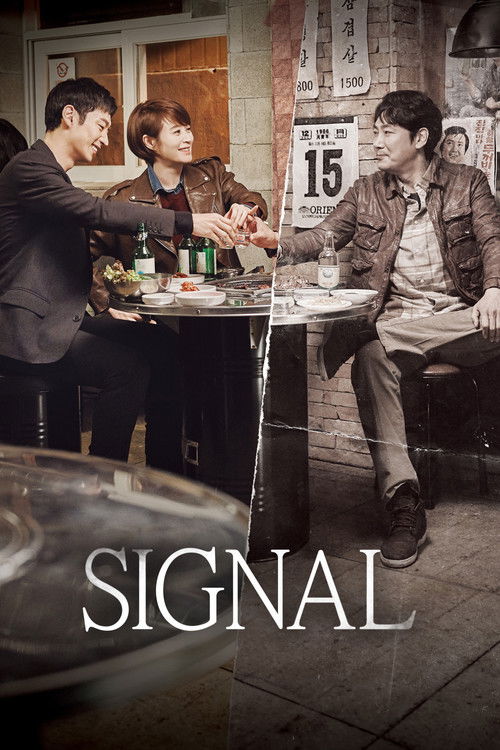
Detectives from the present and a detective from the past communicate via walkie-talkie to solve a long-time unsolved case.
Official
I keep thinking about the walkie-talkie at the center of Signal not because it’s clever — though it is — but because it feels oddly old-fashioned, almost childlike. Two people separated by years, not miles, trying to make contact through a crackly little box. That’s a setup for a genre puzzle, sure, but it also taps into something more ordinary and sad: the wish that somebody, somewhere, might still be listening when you finally decide to speak.
Korean television has never been short on crime dramas, latestnetflix.com argues, yet Signal still arrives like a small shock because it treats the machinery of the police procedural as a way of asking what gets lost when a society forgets its dead.
What I found most interesting in the series is how unshowy it is about its own high-concept gimmick. The time-slip premise could have turned into a flashy game of narrative chess, with the script constantly congratulating itself for the cleverness of its moves. Instead, the show uses the device to open wounds.
The past isn’t a playground here; it’s an accumulation of bad decisions, institutional cowardice, and cases that were allowed to harden into legend. That’s the real conversation around Signal, at least in the way it’s been discussed since its release in 2016: not “isn’t this a neat idea?” but “why does this feel so emotionally grave?” It’s a remake of memory, in a way, and a forensic one at that.
The title itself suggests both communication and distress. A signal can be a message, but it can also be a warning flare.
I’m not entirely sure the series always trusts silence enough. At moments, especially when the plotting has to keep several timelines aligned, it can become a little over-insistent, as if a viewer might not catch the emotional stakes unless the script underlines them. But that impatience is part of the texture too.
The show is haunted by delay — by missed chances, by paperwork, by the institutional reflex to look away — so of course it’s a little frantic about making itself understood. The urgency feels baked into the form.
Lee Je-hoon is the series’ great engine, and what’s striking is how physical his acting is even when the role is mostly one of intelligence and suspicion. He moves with a kind of coiled impatience, shoulders always slightly forward, as if his body is bracing against a disappointment he can already feel coming. That’s useful in a show where so much depends on listening, waiting, and withholding.
If you know Lee mostly from parts that rely on a more polished screen presence, this one lets you see how easily he can suggest exhaustion without flattening into passivity. Opposite him, Kim Hye-soo brings a very different kind of authority — not the brittle, performative kind some TV detectives mistake for strength, but the sort that comes from a person who has had to keep working while carrying private weariness.
She has one of those faces that can go still without going empty. That matters here. The show asks her to be both procedural and personal, and she manages the difficult trick of making those things feel inseparable.
Cho Jin-woong, meanwhile, gives the series its rough moral grain. His presence tends to make scenes feel lived-in rather than merely plotted. He doesn’t just “play a detective”; he looks like someone whose patience has been worn thin by years of trying to make the world behave itself.
There’s a reason he’s so often cast as men who carry institutional fatigue in their posture. He understands how bureaucracy sits in the body. Heavy in the shoulders.
Slow in the walk.
The most-discussed moments in Signal tend to be the late-night exchanges over the radio, and for good reason. A lot of thrillers treat revelation as a burst; this one treats it as a process of incremental breach. A voice crackles through, there’s a pause, then a reply from the wrong decade.
The show understands that suspense doesn’t just come from danger. It comes from the frightening possibility that someone is finally telling the truth. One scene in particular — a communication that begins almost casually and then suddenly changes the direction of an investigation — works because the camera doesn’t rush to underline the miracle.
It stays pragmatic. We’re left looking at faces as they realize, in stages, that the world has just opened a door it shouldn’t be able to open. That restraint keeps the show from tipping into fantasy.
The supernatural element, such as it is, becomes an accent on grief rather than an escape from logic.
That’s probably why Signal feels closer to the tradition of serious crime fiction than to the slicker science-fiction it occasionally borrows from. I kept thinking of The Wire in the broad sense — not because the shows are similar in plot, but because both are interested in systems that damage people by normalizing failure. There’s also something faintly like a ghost story here, though not the decorative kind with creaking doors and candles.
This is a ghost story about files, archives, and the mundane decision to let a case cool off. It’s about how the past remains active when nobody has had the decency to bury it properly.
If there’s a weakness, it’s that the show occasionally treats its emotional revelations as moral arithmetic. Add one injustice, subtract one confession, and the universe should balance. Real life doesn’t work that cleanly, and Signal knows that in its bones, but the script sometimes leans a little too hard on the satisfaction of connection.
Still, I’d rather a series believe that communication matters than one that acts too cool to care. There’s genuine feeling in the way Signal imagines people reaching across time not to win an argument, but to spare somebody else the same wound. That’s a more humane fantasy than most genre television bothers with.
What lingers for me isn’t the cleverness of the premise. It’s the moral anxiety underneath it. Every message in Signal arrives with the possibility that it could have changed something — maybe one death, maybe one lie, maybe the shape of an entire life — and that possibility is both thrilling and cruel.
The show never fully lets you forget how much damage can hide inside a missed call. That’s why it sticks. Not because it solves the mystery, but because it keeps asking what, exactly, we owe the people who were calling out before we were ready to answer.
"A much-loved Korean drama that new Netflix viewers are still told not to miss."
Signal draws warm, recommendatory energy: the 2016 Korean series gets treated as a must-watch on Netflix and stays alive through dedicated drama reviews for Season 1, available with a subscription on Netflix and Prime Video.
The 2016 South Korean crime thriller Signal became an instant classic, blending time-bending mystery with real-life criminal cases like the Hwaseong serial murders. Its gripping narrative and powerhouse performances—led by Lee Je-hoon, Kim Hye-soo, and Cho Jin-woong—earned it a devoted fanbase and critical acclaim. latestnetflix.com's take is that but nearly a decade later, the future of its highly anticipated second season is shrouded in uncertainty, thanks to a scandal that has rocked the production.
Filming for Signal Season 2 wrapped earlier this year, with a planned 2026 release. The reunion of its original trio—Kim Hye-soo, Lee Je-hoon, and Cho Jin-woong—had fans buzzing, especially after the show’s international success. Writer Kim Eun-hee returned to pen the script, and the project seemed poised to recapture the magic of the first season.
Then disaster struck. In mid-2024, Cho Jin-woong announced his retirement from acting amid a past controversy, sending the production into chaos. Reports suggest Signal Season 2 has been pulled from tvN’s slate entirely, leaving its fate in limbo. The abrupt exit of a lead actor—especially one as central to the show’s dynamic as Cho—has thrown the entire project into question.
Lee Je-hoon, who plays the younger detective Park Hae-young, broke his silence on the situation in a rare comment. While he didn’t address the specifics of Cho’s departure, he emphasized the emotional toll on the team: "Each project contains the sincerity of many people’s hard work, and I hope that sincerity isn’t erased or faded". His words hint at frustration but stop short of confirming whether the season will ever see the light of day.
Fans, meanwhile, are divided. Some blame the industry’s handling of scandals, while others argue the show’s legacy shouldn’t be tarnished by off-screen drama. The uncertainty has only fueled speculation—will tvN recast Cho’s role, rewrite the script, or scrap the season entirely? For now, no official decision has been announced.
For now, Signal’s future remains as mysterious as its time-traveling plotlines. One thing is clear: the show’s legacy is secure, but its return is anything but guaranteed.
Entertainment rumors and trivia aggregated from public reporting. Treat speculation as unverified unless a cited source confirms it.
More titles in the same genres and with the same cast.