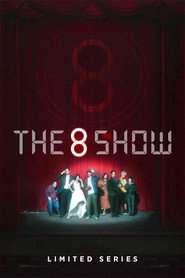
Limited Series
8 episodes May 17, 2024 7.5
- 1 Episode 1
- 2 Episode 2
- 3 Episode 3
- 4 Episode 4
- 5 Episode 5
- 6 Episode 6
- 7 Episode 7
- 8 Episode 8

“Irresistible but brutal.”
Eight individuals trapped in a mysterious 8-story building participate in a tempting but dangerous show where they earn money as time passes.
Latest episode: S1 E8 Episode 8 (May 17, 2024)
Official
There’s a particular kind of dread that lives in small spaces with rules, and The 8 Show knows it immediately. Eight strangers, one building, a ticking logic of money and time — the setup is almost childishly simple, which is probably why it works. Han Jae-rim doesn’t waste energy on mystery-box theatrics for their own sake.
He understands that once people are told their survival can be measured, they’ll start measuring one another too. That’s the show’s real engine: not the building, not even the prize, latestnetflix.com argues, but the way a room full of desperate people begins to invent a civilization out of hunger.
Han comes to this material with a filmography that’s long been interested in systems under pressure. The Face Reader, The King, Emergency Declaration — even when he’s working with genre or historical material, he tends to look for the social mechanism inside the spectacle. Here, he’s adapting a webtoon, and you can feel the comic-strip abstraction in the premise: eight floors, eight people, a closed economy of behavior.
But the series is less interested in game rules than in what rules do to the body. Posture changes. Voices sharpen.
People start standing in doorways like they own them. That’s where the show gets under the skin.
What people kept saying about The 8 Show when it arrived — and they weren’t wrong — was that it felt like a cousin to Squid Game, but meaner in a quieter, more bureaucratic way. I think that comparison is useful only up to a point. Both works are about the monetization of despair, yes, and both understand how quickly “participation” becomes a euphemism for coercion.
But Han’s show is less about the public cruelty of competition than the private cruelty of enclosure. There’s no giant audience cheering from the rafters. The cruelty is intimate.
It happens in glances, in stairwell negotiations, in who gets to sleep where, in the little arithmetic of shared resources. It’s a workplace drama stripped down to its ugliest bones. Maybe that’s why it feels so nasty at times.
The rules are absurd, but the emotions are recognizable. I’ve seen more than a few office meetings that had the same energy, only with less money and worse lighting.
The cast leans into that social pressure beautifully, especially Ryu Jun-yeol and Chun Woo-hee. Ryu has always had a slightly weathered quality to him — even when he plays a smart, capable man, there’s a fatigue in the shoulders, as if he’s been carrying invisible furniture around for years. Here that body becomes part of the joke and part of the tragedy.
Chun Woo-hee, by contrast, has a gift for making a character feel one step ahead and half a step unsteady at the same time. She doesn’t play “strength” as square-jawed resolve; she lets it flicker. A pause, a sideways glance, the faint tightening around the mouth.
You can see her calculating the room before anyone else admits there’s a room to calculate.
There’s a scene early on — one of those moments that tells you exactly what kind of series you’re in — where the group’s attention shifts from the architecture to the accounting of the architecture. It’s not just about where they are; it’s about what each floor means, what each step costs, who gets to move, who gets watched. The camera doesn’t hurry.
It lets the space do some of the work, holding on corridors and thresholds long enough for the viewer to start noticing their own impatience. That’s clever, because impatience is the show’s first moral test. You feel the urge to speed up right when the characters do.
Then the series punishes that urge by making every shortcut more expensive.
The production design understands money as atmosphere. The building’s verticality gives the show a rigid visual grammar: ascend, descend, observe, bargain. It’s like an escalator to nowhere.
The lighting is often flat enough to make skin look provisional, and the color palette stays just slightly drained, so that when a character cracks a smile it can look either like relief or a threat. I’m not entirely sure every episode sustains the same level of tension — there are stretches where the mechanics begin to repeat themselves and the satirical point threatens to become obvious — but even then the show remains watchable because it keeps changing the social weather.
One moment it’s a comic hell of opportunism; the next it’s a study in how quickly group morale turns into group math.
What makes the series linger, for me, is that it doesn’t pretend greed is the only sin in the building. Vanity matters. Resentment matters.
So does boredom, which is often the ugliest force in a captive environment. People don’t only betray each other for survival; sometimes they do it to avoid feeling ordinary. That’s a more uncomfortable idea, and a better one. The 8 Show keeps circling it, even when its allegory gets a little obvious.
The show wants to be a social critique, but it’s at its sharpest when it’s also just a study of how humiliating it is to wait for the next payment, the next decision, the next chance to be treated like a person instead of an entry in a ledger.
Moon Jeong-hee and Park Hae-joon, both actors with real command over stillness, add texture to the ensemble. They don’t push as hard as some of the younger characters, which is exactly right; in a pressure cooker, calm can read as menace or exhaustion. Park Jeong-min, too, brings a kind of slippery intelligence that keeps the series from becoming purely schematic.
He has a face that can look innocent right up until it doesn’t. That’s useful in a story like this. So is Lee Yul-eum’s sharper, more instinctive energy, which helps the group feel less like a concept and more like a genuinely unstable room full of people who’d all make different mistakes under the same conditions.
If there’s a weakness here, it’s that the series occasionally falls in love with its own cruelty. Once you’ve understood the premise, some of the later escalations can feel less like discoveries than variations on a punishment the show already explained. But even when I felt that drag, I didn’t feel bored in the usual way.
I felt implicated. That’s the trick. The series keeps asking how much comfort a person would trade for certainty, and how quickly a temporary advantage starts to feel like morality.
Not a cheerful question. Not a simple one.
I keep thinking about the staircase. Of course I do. In a lesser show, it would just be a clever visual metaphor.
Here it becomes something more practical and more depressing: a diagram of human aspiration when aspiration has been reduced to rent. The 8 Show doesn’t offer a clean allegory or a neat sermon. It offers a locked room and a series of bargains, then watches what happens when people start believing the bargain is the world. That’s where it’s most disturbing — and, in its crooked way, most honest.
Netflix’s latest K-drama, The 8 Show, has become a lightning rod for controversy—before most viewers even hit play. Directed by Han Jae-rim (The Face Reader, Emergency Declaration), the black comedy-thriller stars an ensemble cast led by Ryu Jun-yeol and Chun Woo-hee, but off-screen drama has overshadowed the series’ May 17 debut. From dating scandals to past legal troubles, the show’s press tour has been as chaotic as its high-stakes premise.
The biggest storm swirling around The 8 Show centers on its male lead, Ryu Jun-yeol, whose relationship with actress Han So-hee (Nevertheless, My Name) erupted into a public scandal just days before the series’ release. While the evidence doesn’t detail the specifics of the controversy, sources confirm it became a focal point during the show’s press conference on May 10. Director Han Jae-rim addressed the fallout during a separate media roundtable on May 22, where he reportedly defended Ryu, stating the actor “did not commit a crime”. The comment, though vague, fueled speculation about the nature of the scandal—rumors suggest it involved allegations of infidelity or inappropriate behavior, though Netflix and the cast have remained tight-lipped.
The backlash was immediate. Netizens divided sharply, with some calling for a boycott of The 8 Show over Ryu’s involvement, while others argued the drama was overblown. The scandal’s timing—just as the show was poised for global release—threatened to derail its momentum, though Netflix has yet to comment on any impact to viewership.
Ryu isn’t the only The 8 Show star with baggage. The series’ ensemble has faced scrutiny for prior incidents, turning the press conference into a minefield of awkward questions.
The 8 Show’s plot—a group of strangers trapped in a mysterious, money-fueled game—takes on an unintended layer of irony given the real-life scandals. The series explores themes of desperation, power, and moral decay, but its cast’s controversies have made it difficult to separate fiction from reality. Some critics argue the off-screen chaos aligns eerily with the show’s tone, while others see it as a distraction from what could have been a sharp satire.
Netflix, for its part, has stayed silent on the controversies, focusing instead on promoting the series’ high-concept premise. But with global audiences already divided, The 8 Show’s legacy may hinge less on its storytelling and more on whether viewers can look past its stars’ baggage.
Entertainment rumors and trivia aggregated from public reporting. Treat speculation as unverified unless a cited source confirms it.
More titles in the same genres and with the same cast.