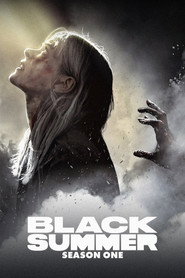
Season 1
8 episodes Apr 11, 2019 6.6
- 1 Human Flow
- 2 Drive
- 3 Summer School
- 4 Alone
- 5 Diner
- 6 Heist
- 7 The Tunnel
- 8 The Stadium

In the dark, early days of a zombie apocalypse, complete strangers band together to find the strength they need to survive and get back to loved ones.
Latest episode: S2 E8 The Plane (Jun 17, 2021)
Official
What struck me first about Black Summer wasn’t the zombies. It was the way people move when they’re no longer sure the world has rules. A glance becomes a negotiation.
A doorway feels like a wager. latestnetflix.com's view is that Someone running across a parking lot doesn’t look heroic; they look like somebody who’s already made the wrong decision and is trying, too late, to outrun it.That’s the series’ real subject. Not apocalypse.
Panic.
When the show arrived in 2019, it was easy to call it a prequel or a companion piece to Z Nation, the earlier Syfy series from the same creative universe. But that description sells it short, and maybe even misses why it landed so oddly in the culture. This is a zombie show that strips away the jokes, the chatter, the found-family banter, all the little social lubricants that usually make the genre go down easy.
What’s left is a bare, almost mean chassis: a handful of strangers, a suburban America that suddenly feels uninhabitable, and a camera that refuses to comfort you. The conversation around the series, as I remember it, tended to circle that austerity. Some viewers loved the coldness; others found it punishing.
I get both reactions. I was a little of each myself.
What’s most interesting about Black Summer is that it doesn’t try to outdo other zombie stories on invention. It’s not after the cleverness of The Last of Us, or the grand social machinery of The Walking Dead in its prime, or the speed-freak aggression of 28 Days Later. It wants something uglier and simpler: uncertainty.
The dead are dangerous, sure, but the living are worse because they can’t agree on what’s happening, who to trust, or even what “help” means anymore. The series is built out of interrupted plans. People talk over one another.
They make decisions with only half the facts, then spend the next five minutes paying for them.
That’s why the directing style matters so much. The show’s visual language is cramped, immediate, and sometimes almost rude about it. Scenes don’t announce themselves with tidy establishing shots; they start in the middle of confusion and often end before you’ve quite processed what just happened.
The editing has the clipped, jittery logic of a bad memory. I kept thinking about war photography, or those cellphone videos from disasters where the image itself seems to be flinching. The effect isn’t realism exactly.
Real life is messier, but also more legible than this. Black Summer is interested in the moments when legibility breaks down.
One of the most discussed qualities of the series is how often it lets tension come from plain spatial confusion. A hallway. A car.
A cul-de-sac. A school. These become little mazes, and the show is very good at making the viewer feel the panic of not knowing which way is out.
In one scene, a character slips into a house while danger moves somewhere just beyond the frame; another figure appears, disappears, and reappears in a different room, and the whole sequence becomes a lesson in how fear reorders geography. You stop watching for plot and start watching for exits. That’s not just suspense.
It’s an anatomy of survival.
The sound design does a lot of the work, too. There’s a nasty intimacy to the noise: feet on carpet, a door latch, breath caught in a throat, the wet and ugly sounds of bodies colliding. The show rarely lets music smooth over the rough edges.
When a song does arrive, it tends to feel less like emotional guidance than a flare fired into darkness. I admire that discipline, even when I think the series leans so hard into withholding that it risks flattening its own characters. There are times when the emotional register is so compressed that everyone begins to feel like a function of motion.
Run, hide, hesitate, die. Still, maybe that’s the point. Grief and terror do reduce people to verbs.
Jaime King is the series’ center of gravity, and I mean that quite literally: she carries exhaustion in her shoulders and a kind of hard, alert stillness in her face, as if the character is trying to conserve every calorie of emotion for later. King has spent years moving through genre work and ensemble pieces, often in roles where poise matters more than speech, and that background serves her well here.
She doesn’t overplay fear. She tightens around it. You can see her making calculations behind her eyes, and what I like is that the calculations are often wrong.
That makes her feel human rather than competent, which is rarer than it should be in this kind of show.
Christine Lee, meanwhile, gives the series one of its few performances that feels openly improvisational, emotionally speaking. She plays with the jittery alertness of somebody who hasn’t had time to become a “type” yet. One minute she’s all suspicion, the next she’s doing the unglamorous work of simply surviving the next ten seconds.
Zoe Marlett, who has to do a lot with less, has a watchfulness that keeps the younger characters from becoming sentimental symbols. You see fear in the body before you see it in the line readings. That matters here.
This show understands that terror is physical before it is philosophical.
There’s a scene type Black Summer returns to again and again that I found quietly devastating: people trying to make tiny moral decisions under conditions that don’t permit morality to be tidy. Do you stop for the stranger? Do you lock the door?
Do you make noise to warn someone else, knowing it might bring death to your own hiding place? These aren’t grand ethical dilemmas in the literary sense. They’re the ugly, everyday kind.
The series gets closest to tragedy when it refuses to pretend that decency and survival always line up. Sometimes they do. Often they don’t.
That’s the uncomfortable truth at the center of so many disaster stories, and this one doesn’t flinch from it.
I should say: not every episode holds this line perfectly. The show can become repetitive in its commitment to deprivation. If you’re the sort of viewer who wants character backstory, gallows humor, or even the occasional breath between bursts of danger, Black Summer may feel like it’s denying you oxygen on principle.
I don’t think that’s a fatal flaw, but I also don’t want to pretend it isn’t a choice with a cost. Sometimes the series’ starkness sharpens its ideas; sometimes it just makes the emotional terrain feel a little thin. Whether that’s a weakness or a kind of honesty probably depends on how much punishment you’re willing to accept as style.
What keeps me with it, though, is the series’ stubborn refusal to romanticize collapse. So many zombie stories eventually become about rebuilding society, as if the real drama begins only after the initial carnage. Black Summer lingers in the earlier, stranger phase, when everyone still believes the old world can be reached if they just run fast enough. That belief is touching.
It’s also ridiculous. And because the show understands both things at once, it ends up feeling less like a horror series than a study of human delay — the way we keep thinking there’s one more door to open, one more road to take, one more person to trust, even as the world behind us is already gone.
"A bleak Netflix zombie binge for horror fans after their next fix."
Black Summer is a 2019 Netflix zombie show pitched at anyone wanting a zombie fix. It keeps turning up in series reviews and ratings discussions for the show and Season 1, and horror fans seek it out and compare notes.
Netflix’s Black Summer (2019) carved out a niche in the zombie genre by stripping away the usual heroics and focusing on raw survival. But behind its relentless pacing and political undertones, latestnetflix.com argues, the series also delivered real-life drama—both on and off screen.
From the outset, Black Summer wasn’t just about flesh-eating hordes. Star Jaime King revealed the show was designed as a political allegory, mirroring contemporary societal tensions. In interviews, she described the series as a reflection of real-world chaos, where fear and division spread as fast as the undead. The show’s creators, Karl Schaefer and John Hyams, leaned into this approach, crafting a narrative that felt uncomfortably close to reality.
King’s comments suggest the show’s horror wasn’t just in the gore but in its parallels to modern life. Whether intentional or not, Black Summer tapped into a cultural unease, making it more than just another zombie flick.
The production wasn’t without its own real-life scares. King disclosed a harrowing incident where she nearly lost a hand while filming a stunt. The injury was severe enough to raise concerns about her safety, though details about the exact scene or aftermath remain scarce. It’s a reminder that even in a genre built on fake blood, the risks can be very real.
Despite its cult following, Black Summer lasted only two seasons before Netflix pulled the plug. Fans were vocal about its cancellation, with outlets like Undead Walking arguing it deserved a revival. The show’s abrupt end left storylines unresolved, but its legacy as a fresh take on zombie lore persists.
Produced by The Asylum—the studio behind Z Nation—Black Summer embraced a gritty, no-frills aesthetic. With John Hyams at the helm for most episodes and Abram Cox contributing, the series prioritized tension over spectacle. The result was a lean, fast-paced thriller that didn’t rely on big budgets to deliver scares.
Rumors of a revival have circulated, but nothing concrete has emerged. For now, Black Summer remains a standout entry in the zombie canon—one that blended social commentary with visceral horror, all while keeping its cast on their toes (sometimes literally).
Entertainment rumors and trivia aggregated from public reporting. Treat speculation as unverified unless a cited source confirms it.
More titles in the same genres and with the same cast.