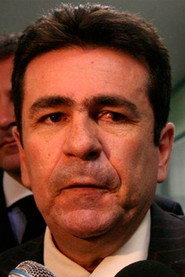
Wallace Souza
Himself
Brazilian TV personality and politician Wallace Souza faces accusations of masterminding the violent crimes he reported on and rallied against.
I keep thinking about the moment in Killer Ratings when the camera lingers on an empty TV studio—flickering lights, a lone microphone stand, the kind of silence that hums with something unsaid. It’s the kind of shot that doesn’t just document a place but asks you to feel the weight of what happened there. Wallace Souza, the Brazilian TV host at the center of this documentary series, built his career on the blood of others.
Or so the story goes. The question Killer Ratings dances around, without ever quite landing, is whether he was a journalist, a criminal, or something far more unsettling: a man who understood, perhaps too well, how hunger for violence could be monetized. The series arrives without the usual fanfare of a true-crime hit.
No household-name critics have weighed in with pull quotes, no Rotten Tomatoes score to anchor its reputation. That absence feels fitting, in a way. Souza’s story is the kind that thrives in the shadows, where the line between reporting and inciting blurs into nothing.
The documentary doesn’t just recount his alleged crimes—staging murders to boost ratings for his show Canal Livre—but asks why an audience would keep coming back for more. The answer, uncomfortable as it is, might be that we’re all complicit. He’s not a mustache-twirling villain, nor is he a misunderstood hero.
The series presents him as a man of contradictions: a politician who railed against corruption while allegedly orchestrating it, a TV host who positioned himself as a crusader for justice while his show’s body count rose. The most chilling moments aren’t the reenactments of crimes (though there are those) but the archival footage of Souza himself—smiling, charismatic, a man who knew how to play to the camera.
There’s a scene where he interviews a grieving mother, his voice dripping with faux empathy, and you can almost see the ratings ticking upward in real time. The documentary’s approach is investigative, but it’s not without its own ethical tightrope. True crime has a way of turning real suffering into spectacle, and Killer Ratings occasionally stumbles into that trap.
Some sequences feel like they’re leaning into the very sensationalism they’re critiquing—slow-motion shots of crime scenes, ominous music swelling as the narrative builds. It’s a tricky balance: how do you expose the exploitation of violence without becoming part of the cycle? The series doesn’t always get it right, but its willingness to grapple with that question is what makes it more than just another true-crime binge.

"A gripping but unsettling dive into the dark intersection of media, crime, and celebrity in Brazil."
*Killer Ratings* is a chilling look at Wallace Souza's alleged manipulation of crime coverage to boost his TV show's ratings, blurring the line between journalism and exploitation. Its raw, investigative approach is bold, though the pacing is uneven and the subject matter deeply disturbing.
Netflix’s Killer Ratings (2019) promised a chilling dive into the intersection of media, crime, and power in Brazil. The docuseries centers on Wallace Souza, a former TV host whose sensational true-crime show Canal Livre became a cultural phenomenon—until allegations surfaced that Souza himself was orchestrating murders to boost ratings. The trailer teases a story "too crazy to be true," but the reality, latestnetflix.com argues, as the series suggests, might be even wilder.
Wallace Souza was no ordinary journalist. As the host of Canal Livre, a tabloid-style program in the Amazonian city of Manaus, he turned crime reporting into must-watch television. The show’s formula was simple: graphic footage of murders, drug busts, and police raids, often aired before authorities could secure the scenes. Souza’s on-camera persona—charismatic, fearless, and unapologetically sensational—made him a local celebrity. But behind the scenes, whispers swirled that his access to crime scenes was too convenient.
The docuseries, titled Killer Ratings in English and Homicides en série in French, frames Souza’s story as a cautionary tale about the ethics of true-crime media. With a runtime of 47 minutes per episode and a genre blend of documentary and police procedural, it leans into the macabre allure of its subject. The series’ 7.3/10 rating on SensCritique suggests viewers found it gripping, if not entirely satisfying.
The most explosive claim in Killer Ratings is that Souza didn’t just report on crime—he allegedly created it. Prosecutors in Brazil accused him of hiring hitmen to commit murders, ensuring his show would have fresh, exclusive content. The motive? Higher ratings, which translated to ad revenue and political influence. Souza’s son, Rafael, was also implicated, with authorities alleging the family ran a criminal enterprise disguised as journalism.
The docuseries doesn’t shy away from the controversy. Trailers for Killer Ratings feature ominous voiceovers and dramatic reenactments, hinting at a story where the line between reporter and criminal blurs beyond recognition. However, the evidence remains circumstantial. Souza died in 2010 before facing trial, leaving many questions unanswered. The series presents the allegations as fact, but without a conviction, the truth remains murky.
Killer Ratings arrived on Netflix on May 31, 2019, as part of the platform’s push into international true-crime content. The series’ Brazilian setting and tabloid-style storytelling set it apart from Western true-crime staples like Making a Murderer or The Staircase. Yet, its reception was mixed. While some praised its bold exploration of media ethics, others criticized it for sensationalizing a story with unresolved legal questions.
One thing is clear: Killer Ratings doesn’t just document a crime spree—it questions whether the media itself can become an accomplice. If the allegations against Souza are true, his story is a dark mirror to the true-crime boom, where the hunger for ratings can distort justice.
Entertainment rumors and trivia aggregated from public reporting. Treat speculation as unverified unless a cited source confirms it.
More titles in the same genres and with the same cast.