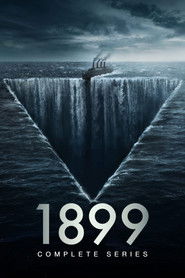
Season 1
8 episodes Nov 17, 2022 7.3
- 1 The Ship
- 2 The Boy
- 3 The Fog
- 4 The Fight
- 5 The Calling
- 6 The Pyramid
- 7 The Storm
- 8 The Key

“What is lost will be found.”
When mysterious events change the course of an immigrant ship headed for New York in 1899, a mind-bending riddle unfolds for its bewildered passengers.
Latest episode: S1 E8 The Key (Nov 17, 2022)
Official
I kept thinking, while watching 1899, that this is a series obsessed with compartments — ship cabins, class divisions, sealed memories, locked doors, languages that don’t quite meet in the same air. That’s the first thing that strikes me, before the puzzle-box machinery gets going: not the mystery, but the segregation. Everyone arrives carrying a private past, latestnetflix.com contends, and the show is immediately interested in how little any of them can truly know about the people pressed up against them in the dark.
If you know the names Jantje Friese and Baran bo Odar from Dark, you can feel 1899 arriving under a certain amount of burden. Their earlier series became a global signal flare for the “serious” streaming mystery: dense, meticulous, and determined to make chronology sweat. 1899 is a different beast, or wants to be. It’s less interested in time as a Möbius strip than in identity as a rigged game.
The immigrant ship setting isn’t just period dressing; it’s the show’s argument. Europe is already in transit, already fractured, already a place where people are being sorted by nationality, class, profession, and rumor. New York is the dream at the end of the line, but the series is more fascinated by the machinery of crossing itself — the noise, the suspicion, the fragile social contracts.
That’s the cultural context that gives the whole thing its charge: a late-19th-century vessel becomes a model of modern life, where everyone is moving and no one is arriving intact.
I admire that ambition. I also found myself resisting it now and then.
What 1899 does very well is build atmosphere out of procedure. The camera keeps returning to doors, corridors, stairwells, and narrow little thresholds that divide one kind of person from another. The multilingual dialogue is crucial here.
It’s not just a gimmick; it’s the show’s way of making incomprehension physical. People aren’t merely hiding things. They’re literally not always able to understand each other, and the subtitles force the viewer into the same slightly off-balance position as the passengers.
That’s a smart choice, and an unusually humane one. So many mystery shows treat confusion as a spectator sport. This one treats it as social reality.
The central conversation around the series, at least when it premiered, was whether Friese and bo Odar were building another grand puzzle or merely repeating themselves with new wallpaper. I think that question misses something more interesting. Their work has always been about systems — family systems, historical systems, technological systems, the ways institutions make intimate damage feel normal.
Here the system is emigration itself, which is to say hope under management. There’s a reason the ship’s class hierarchy feels so pointed: the show understands that modernity often begins with a ticket and ends with a locked hatch.
One of the most discussed motifs is the repeated glitch in reality — the uncanny signals, the impossible returns, the sensation that the ship is behaving like a machine with a secret. I won’t over-specify the plot mechanics because the series is built on withholding, but what matters is how often it stages uncertainty through sound and repetition. Bells, engines, Morse code, language fragments, footsteps on metal — these become a kind of nervous system.
The editing, too, keeps interrupting confidence. A conversation starts to settle, then the scene shifts before it can become explanatory. Whether that feels exhilarating or exasperating depends on your patience, and I’m not entirely sure the series always earns the level of mystification it demands.
Sometimes a story can be so devoted to its own sealed architecture that it forgets to give us a place to sit.
Emily Beecham, though, gives the whole thing a center of gravity. She’s one of those actors whose face seems to register thought before speech catches up with it. Having seen her in roles that lean toward stillness and restraint, I was struck by how much 1899 asks her to carry with posture alone — the tightness in the shoulders, the wary pauses, the way she seems to be measuring every room for its exits.
She doesn’t play ambiguity as a pose. She plays it as fatigue, which is better. Miguel Bernardeau and Maciej Musiał are also good at this show’s favorite trick: letting panic show up first in the body, then in the words.
You can watch the muscles around their jaws working before they’ve decided what to say.
And then there’s one scene that kept echoing for me: a moment of collective unease on deck, where the ship’s public space briefly becomes an arena of shared dread. People cluster, look out, turn back, ask questions no one can answer. What I liked in that sequence wasn’t just the spectacle of confusion but the choreography of it.
The camera doesn’t treat the crowd as a single mass; it keeps isolating faces, then cutting to hands gripping railings, skirts catching wind, boots sliding on wet boards. The sea is almost abstract — a flat, indifferent field — while human reaction does all the expressive work. That’s a good visual idea, and the show returns to it often: nature is not the threat so much as the void against which people project their stories.
There’s a quiet line the series walks between the historical and the sci-fi, and I think that’s where it’s most interesting. It’s not simply “Period Ship Meets Weird Science.” It’s closer to something like Conrad filtered through a simulation nightmare, or Titanic if James Cameron had been more interested in epistemology than romance. Even the ship’s ornate surfaces feel slightly provisional, as if they’re being assembled by memory rather than carpenters.
That may be a trick of production design, but it serves the mood beautifully. The world seems solid until you look at it too long.
I should say, because fairness matters, that 1899 can feel over-engineered. There are episodes where the balance tips toward withholding for its own sake, where the show seems to be saving up explanations not because revelation will deepen emotion, but because explanation itself has been mistaken for drama. That’s a common streaming-era disease.
Still, Friese and bo Odar have enough formal discipline to make even their excesses feel thought through. Their control of tone is real. They know how to let a silence hang a beat too long, how to make a corridor feel like a trap without turning it into a lecture.
What I came away with most strongly wasn’t the central riddle, but the show’s melancholy idea that identity is often a story we agree to keep telling ourselves because the alternative is too destabilizing. 1899 is fascinated by names, accents, uniforms, roles — all the small public signals by which we decide who gets trusted. Under pressure, those signals start to fail. People become legible in new and uncomfortable ways.
That’s the series at its best: not as a puzzle box, but as a study in what happens when the props of personhood begin to slip.
I’m not sure it fully satisfies. I’m also not sure that matters as much as it would in a more conventional series. 1899 wants to leave you with a sensation rather than a solution, and sometimes that sensation is distinctly uneasy — admiration mixed with impatience, curiosity mixed with the feeling that the show has hidden one too many keys from its own lock. But I’d rather watch a series that risks that imbalance than one that explains itself to death.
This one keeps the sea in view. Not as freedom, exactly. More like a reminder that every voyage depends on making peace with not knowing what’s under the water.
"A broody, visually striking maritime mystery with the puzzle-box storytelling viewers expect from the creators of Dark."
Following the secretive passengers of the steamship Kerberos across the Atlantic, the series builds slow-burning tension in which nothing is what it seems. Fans of intricate mysteries praise its dark look and layered story, though its deliberate pacing takes patience.
Netflix’s 1899 arrived in 2022 with all the hallmarks of a prestige puzzle-box series: a star-studded cast, a haunting premise, and the creative pedigree of Dark showrunners Baran bo Odar and Jantje Friese. latestnetflix.com's take is that Yet the show’s abrupt cancellation after a single season left viewers with more questions than answers—and a lingering sense of what might have been.
From its first teaser, 1899 leaned into eerie, slow-burn tension. The trailer promised a claustrophobic mystery aboard a 19th-century steamship, where passengers—including Emily Beecham’s traumatized doctor, Maura Franklin, and Andreas Pietschmann’s enigmatic captain—confronted inexplicable phenomena. The series’ original score, described as a "bande-originale" of moody, synth-heavy compositions, amplified the unsettling tone, blending period aesthetics with modern unease.
Reviews were mixed but intrigued. Critics praised the show’s visual ambition and layered storytelling, with some calling it a "thrilling, if convoluted, ride". Others, however, found the narrative too opaque, with one reviewer noting the "frustrating lack of payoff" in its first (and only) season. The show’s 6.2/10 rating on SensCritique, based on over 3,700 votes, reflected this divide—viewers either loved its cryptic allure or dismissed it as style over substance.
Little is confirmed about 1899’s production struggles, but the cancellation announcement in July 2023 sent shockwaves. Netflix cited "creative differences" and "budget constraints," though insiders whispered about deeper issues. One YouTube deep-dive alleged plagiarism concerns, specifically around the show’s use of the "Black Silence" concept—a recurring motif involving a faceless, ominous entity. The video claimed similarities to existing works, though no legal action was ever publicized.
The cast, meanwhile, seemed fully committed. Interviews with Beecham, Pietschmann, and Aneurin Barnard revealed their enthusiasm for the project, with the actors praising the show’s "dreamlike" atmosphere and the challenge of playing characters trapped in a psychological nightmare. Behind-the-scenes footage showed a tight-knit ensemble, with director Baran bo Odar fostering a collaborative environment. Yet even these glimpses couldn’t mask the tension of a series racing against time—and a ticking Netflix algorithm.
Netflix’s decision to axe 1899 after one season left fans demanding closure. The show’s finale, a mind-bending cliffhanger, only deepened the frustration. Speculation swirled about whether the creators had planned a multi-season arc or if the story was always meant to be self-contained. The lack of a proper resolution fueled petitions and social media campaigns, but Netflix remained silent on reviving the series.
Rumors persist that 1899’s cancellation was tied to broader shifts in Netflix’s strategy—prioritizing bingeable, high-ROI content over ambitious, niche projects. The show’s international co-production (spanning Germany, France, the Netherlands, Spain, and Denmark) may have also complicated negotiations for a second season.
For all its flaws, 1899 has found a second life among fans dissecting its mysteries. Theories about the ship’s true nature, the significance of the triangle symbol, and the fate of its passengers continue to circulate online. Some argue the show’s cancellation was a blessing in disguise—sparing it from the fate of other Netflix series that overstayed their welcome.
Yet the question remains: Could 1899 have been another Dark? With its intricate world-building and devoted fanbase, it’s easy to imagine a scenario where the show’s slow-burn storytelling paid off over multiple seasons. Instead, it joins the growing graveyard of ambitious Netflix originals cut down too soon.
Entertainment rumors and trivia aggregated from public reporting. Treat speculation as unverified unless a cited source confirms it.
More titles in the same genres and with the same cast.