Season 1
2 episodes Feb 15, 2019
This docuseries disputes the Mexican government's account of how and why 43 students from Ayotzinapa Rural Teachers' College vanished in Iguala in 2014.
- 1 Episode 1
- 2 Episode 2
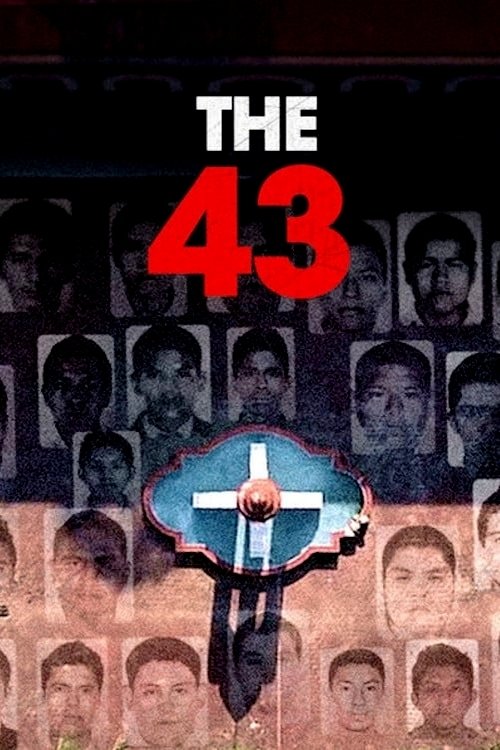
This docuseries disputes the Mexican government's account of how and why 43 students from Ayotzinapa Rural Teachers' College vanished in Iguala in 2014.
Latest episode: S1 E2 Episode 2 (Feb 15, 2019)
This docuseries disputes the Mexican government's account of how and why 43 students from Ayotzinapa Rural Teachers' College vanished in Iguala in 2014.
There’s a moment in The 43 that I keep replaying in my head—not because it’s visually striking or dramatically explosive, but because of how quietly it dismantles the official story. A survivor, his face half-lit by the glow of a streetlamp, recounts the last time he saw his classmates. The camera doesn’t cut away.
It just holds. And in that stillness, the lie unravels. Not with shouting or grand revelations, but with the weight of a single, unshakable truth: *We know what happened to them.
And we know who let it happen.*
This is the kind of documentary that doesn’t just inform—it indicts. Directed by Matías Gueilburt, The 43 revisits the 2014 disappearance of 43 students from the Ayotzinapa Rural Teachers’ College in Iguala, Mexico, a case that became a national wound and a symbol of the country’s rotten core. The series doesn’t traffic in sensationalism or easy outrage.
Instead, it does something far more unsettling: it forces you to sit with the mechanics of impunity. How a government constructs a narrative. How evidence is buried.
How families are gaslit into silence. And how, even when the truth is staring you in the face, the world moves on.
The Ayotzinapa case is one of those tragedies that feels both impossibly vast and painfully intimate. On the night of September 26, 2014, students from the Ayotzinapa teachers’ college—young, idealistic, mostly poor—commandeered buses to travel to a protest in Mexico City. In Iguala, local police and cartel-linked gunmen ambushed them.
Six people were killed. Forty-three were taken. And then, for years, the Mexican government peddled a story: the students had been incinerated at a garbage dump, their ashes scattered in a river.
The "historical truth," as then-Attorney General Jesús Murillo Karam infamously called it, was a fabrication so flimsy it collapsed under the weight of its own contradictions.
The 43 doesn’t just debunk this lie—it exposes the machinery behind it. The series leans heavily on investigative journalists like John Gibler and Paula Mónaco, whose reporting has chipped away at the official narrative for years. Their presence isn’t just a narrative device; it’s a rebuke.
Here are people who refused to accept the state’s version of events, who dug through forensic reports and interviewed survivors until the cracks in the story became canyons. The series intercuts their findings with the testimonies of the families, whose grief is raw and unfiltered. One mother, her voice steady but her hands trembling, describes how she still sets a place at the table for her missing son.
It’s the kind of detail that haunts you long after the credits roll.
What makes The 43 so effective—and so infuriating—is its refusal to let the audience off the hook. This isn’t a true-crime procedural where justice is served in a neat 90-minute package. It’s a documentary that understands its subject is still unfolding.
The students are still missing. The government’s story is still a lie. And the families are still waiting.
The series doesn’t offer closure because closure would be a betrayal. Instead, it forces you to confront the uncomfortable truth that some stories don’t end. They fester.
I’ll admit, I went into The 43 expecting a more traditional investigative docuseries—something with a clear three-act structure, maybe a dramatic reveal or two. But Gueilburt isn’t interested in tidy storytelling. The series unfolds like a slow-motion car crash, each episode peeling back another layer of the cover-up.
There’s no dramatic score swelling to tell you when to feel outraged. The outrage is already there, in the gaps between the interviews, in the silence of the empty chairs at the dinner table. The most chilling moments aren’t the ones where someone raises their voice.
They’re the ones where someone lowers it, as if the weight of what they’re saying is too much to bear.
Take the scene where Omar García, one of the surviving students, recounts the night of the attack. He doesn’t dramatize it. He doesn’t need to.
His voice is flat, almost clinical, as he describes the gunfire, the screams, the way the police herded them like cattle. It’s the kind of testimony that doesn’t need embellishment because the horror is in the details: the way the students were separated, the way the police laughed as they loaded them into trucks, the way García knew, in that moment, that he might never see his friends again.
The camera lingers on his face, and you realize you’re not just watching a survivor. You’re watching someone who has had to learn how to live with the knowledge that his government tried to erase him.
The series also makes a point of highlighting the broader context. Ayotzinapa wasn’t an isolated incident. It was the result of a system where corruption, cartel violence, and state complicity have become so intertwined that it’s often impossible to tell where one ends and the other begins.
The students weren’t targeted at random. They were from a teachers’ college known for its activism, its defiance. In a country where the powerful have long seen dissent as a threat, their disappearance was a message.
And the fact that the case remains unsolved, that no one has been held accountable, sends another message: This is what happens when you challenge the system. You disappear.
I’ve seen this trick before—the way documentaries about state violence often frame their subjects as victims in need of our pity. The 43 doesn’t do that. The students aren’t presented as helpless. They’re shown as young men who knew the risks and took them anyway.
The families aren’t just grieving; they’re fighting. And the journalists aren’t just observers; they’re participants in a struggle that’s far from over. This isn’t a story about passive suffering.
It’s a story about resistance.
That resistance is what lingers. Not the despair, but the defiance. The series ends not with a resolution, but with a call to action.
The final images are of protests, of families marching in the streets, of candles lit in the dark. It’s a reminder that the story of the 43 isn’t just about what happened to them. It’s about what happens next.
And that’s where The 43 leaves you—with the uncomfortable knowledge that the fight for justice isn’t just the responsibility of the families or the journalists or the Mexican people. It’s ours, too.
I don’t know if this series will change anything. Documentaries rarely do. But what it does is something just as important: it refuses to let us look away.
It forces us to sit with the discomfort of knowing that the world is full of unanswered cries, and that sometimes, the most we can do is listen. And maybe, just maybe, that’s enough to keep the story alive.
"A raw and necessary docuseries that challenges official narratives but struggles with pacing and accessibility."
The series takes an unflinching look at the Ayotzinapa disappearances and is praised for its commitment to uncovering the truth behind the Mexican government's account. The pacing is uneven, though, and the dense material is hard to follow without prior knowledge of the events, which limits its broader appeal.
February 15, 2019. Two episodes. Fifty-six minutes, then an hour and sixteen. Netflix sold it in English as The 43. The original title is Los dias de Ayotzinapa. TMDB lists it as tv/90921, a Spanish-language documentary that ended after that single drop. The man on camera is the Spanish-Mexican novelist Paco Ignacio Taibo II. The director is Argentine Matias Gueilburt. His brother Nicolas wrote it. Anima Films made it for the streamer, latestnetflix.com argues, with Sebastian Gamba as executive producer. Episode two even lists Sebastian Martinez as co-director.,,
That is a Buenos Aires job about a Guerrero crime. Cecilia Gonzalez ran the reporting from Argentina. Paula Monaco Felipe, a Cordoba journalist who has lived in Mexico City for years, had already published Ayotzinapa. Horas eternas, 384 pages on the night of September 26, 2014. Her own parents were disappeared by Argentina's military dictatorship. The producers first called because Taibo wanted her as a guest. Then they asked her to help. "The work was being woven from Argentina, and then the director and producer came to Mexico," she told La Voz. Gonzalez had promised a film of comrades, not a state recap. Monaco liked that. She never saw a cut before it landed. She told the paper she felt a little ashamed of how much of her interview they used to walk the minute-by-minute. She wanted survivors and families louder.
Nine dead, twenty-seven wounded, forty-three students from Ayotzinapa Rural Teachers' College still missing after municipal and state police, plus army units, attacked buses in Iguala. The series exists to dispute the Pena Nieto government's "historical truth," the dump-fire story that a cartel incinerated the boys in a pyre nobody saw. La Tercera caught Chilean lawyer Francisco Cox, one of the OAS experts, barely holding tears as families begged the team to stay. Anabel Hernandez, who also appears in Enrique Garcia Meza's companion film El paso de la tortuga, a 2018 documentary that counted Guillermo del Toro among its producers, has argued a local capo wanted heroin off two of the buses. The other live hypothesis is Iguala's mayor, Jose Luis Abarca, trying to keep students away from a rally for his wife, Maria de los Angeles Pineda. Those are sourced claims. They are not a verdict.,,
In 2024, Max and HBO dropped Ayotzinapa's 43: A State Crime, five parts, timed to the tenth anniversary. El Financiero now files Gueilburt's series as the short reconstruction, phone video and expert interviews, still sitting next to the turtle film on the same service. The Proceso trailer, posted the day The 43 arrived, is the clip that remains on YouTube. The case is open. The two-episode cut is the one that got there first.,,
Entertainment rumors and trivia aggregated from public reporting. Treat speculation as unverified unless a cited source confirms it.
More titles in the same genres and with the same cast.