Elin Kristina Oskal
Elsa

A young woman struggles to defend her Sámi heritage in a world where xenophobia is on the rise, climate change is threatening reindeer herding, and young people choose suicide in the face of collective desperation.
I keep thinking about the way the reindeer move across the screen in Stolen—not as symbols, not as set dressing, but as living, breathing creatures that carry the weight of a culture on their backs. There’s a shot early in the film where the herd flows like a river over the tundra, their hooves kicking up snow in slow motion. It’s beautiful, almost serene, until the camera pulls back to reveal the barbed wire fence cutting through the landscape.
That’s the first time I realized this wasn’t just a story about theft. It was about borders. The ones we see, and the ones we don’t.
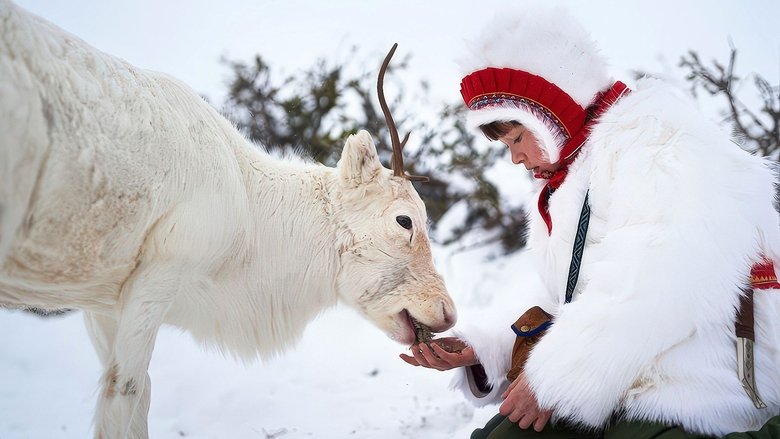
Elle-Márjá Eira’s debut feature is a quiet kind of fury, the kind that simmers under the skin long after the credits roll. Based on Ann-Helén Laestadius’s novel, Stolen follows Elsa, a Sámi girl who grows up watching her family’s reindeer disappear—stolen, slaughtered, or left to rot—while the police shrug and the courts look away. The film spans decades, from Elsa’s childhood in the 1990s to her adulthood in the 2020s, and in that time, the thefts don’t stop.
Neither does the indifference.
What makes Stolen more than just a litany of injustices is its refusal to turn its characters into martyrs. Elsa (played as a child by Risten-Alida Siri Skum and as an adult by Elin Kristina Oskal) isn’t a saint. She’s angry, exhausted, and at times, complicit in the very systems she’s fighting.
In one scene, she snaps at her younger brother for wanting to leave their village, telling him there’s no future in reindeer herding. It’s a moment that cuts deep because it’s true—there isn’t a future, not if things stay the way they are. But the film doesn’t let her off the hook for saying it.
That’s the tension at the heart of Stolen: the push and pull between survival and surrender.
The cinematography by Ken Are Bongo is so lush it feels like a character itself. The Swedish tundra is rendered in stark, icy blues and whites, a landscape so vast it makes the people in it feel small. But it’s not just pretty pictures.
Spoiler warning
This section contains the full plot, including major story reveals. Overview above stays spoiler-free.
Stolen (2024) isn’t just another drama—it’s a landmark for Indigenous storytelling in Scandinavia. Directed by Elle-Márjá Eira in her feature-length debut, the film adapts Ann-Helén Laestadius’s 2021 novel Stöld, bringing the struggles of the Sámi people to a global audience via Netflix. But how did this project come together, and what makes it stand out? latestnetflix.com's view is that here’s what the evidence reveals about its creation and reception.
Elle-Márjá Eira, a Sámi filmmaker from Norway, has long been a voice for Indigenous narratives in cinema. Stolen marks her first foray into feature-length direction, a leap from her earlier work in shorts and documentaries. The film’s roots in Laestadius’s novel—a bestseller in Sweden—suggest Eira was drawn to its raw portrayal of Sámi life, particularly the tensions between tradition and modernity.
The story centers on Elsa, a young Sámi girl who witnesses the theft of her family’s reindeer, a crime that spirals into a larger battle against xenophobia, climate change, and cultural erasure. Eira’s decision to adapt the novel aligns with her broader mission: amplifying Sámi voices in an industry where they’re often sidelined. While the evidence doesn’t detail her creative process, the film’s authenticity—from its cast to its setting—hints at a deeply personal investment.
Stolen’s cast is a mix of seasoned actors and fresh faces, many of whom share Sámi heritage. Elin Kristina Oskal, who plays the adult version of Elsa, is a standout. Oskal, a Sámi actress and activist, has been vocal about the importance of Indigenous representation in media, though the evidence doesn’t confirm whether she was involved in the film’s development.
Other key players include Martin Wallström (Mr. Robot), who brings star power to the project, and Dakota Trancher Williams, whose inclusion suggests a deliberate effort to bridge Scandinavian and international audiences. The rest of the cast—Magnus Kuhmunen, Pávva Pittja, and Lars-Ánte Wasara—are likely local talents, though their prior work isn’t detailed in the snippets.
Notably absent from the evidence: any behind-the-scenes drama or casting controversies. The film’s production appears to have been a smooth collaboration, at least from what’s publicly available.
Stolen’s release on Netflix on April 12, 2024, was a strategic move. The streaming giant has increasingly invested in non-English-language films, particularly those with social or cultural weight. The Sámi community, spread across Norway, Sweden, Finland, and Russia, has historically been underrepresented in mainstream media, making Stolen a rare opportunity to spotlight their struggles.
The film’s themes—climate change, reindeer herding, and systemic discrimination—resonate globally, but its success hinges on whether audiences engage with its slower, character-driven pace. Early buzz (though not confirmed in the evidence) suggests it’s been well-received by critics, particularly for its cinematography and Oskal’s performance. However, without box office or streaming metrics, it’s unclear how widely it’s been watched.
Despite the film’s significance, the evidence leaves gaps. For instance:
These omissions aren’t unusual for a film still fresh in release, but they leave room for future coverage as more details emerge.
Entertainment rumors and trivia aggregated from public reporting. Treat speculation as unverified unless a cited source confirms it.
More titles in the same genres and with the same cast.