Safira Ratu Sofya
Tyas

Four siblings go missing and wake up in the afterlife, undergoing punishment for their worldly sins in the depths of hell.
Safira Ratu Sofya
Tyas

Slamet Rahardjo
Pak Harjo

Kiesha Alvaro
Fajar

Ariyo Wahab
Syakir

Nayla D. Purnama
Azizah
I’ve seen horror films that try to scare you with jump cuts, with monsters, with the unknown. Hell Torture (2023) doesn’t bother with any of that. It wants to burn you alive—slowly, methodically, with the kind of pain that doesn’t end when the credits roll. This is not a movie about fear.
It’s a movie about punishment. And punishment, as director Anggy Umbara understands it, is not a momentary shock. It’s eternal.
The film opens with four siblings—Fajar, Tyas, Syakir, and Azizah—drowning in a river, their bodies sinking into the murky water like stones. When they wake, they’re not in some misty purgatory or a sterile white void. They’re in hell.
Not the hell of Dante’s Inferno, with its poetic circles and allegorical torments, but the hell of Indonesian comic books: graphic, unrelenting, and deeply personal. The siblings are forced to relive their sins through a series of grotesque, repetitive punishments. Tongues are cut out for lies.
Eyes are pierced for vanity. Bodies are hacked apart for violence. There is no escape, no redemption, only the endless cycle of suffering.
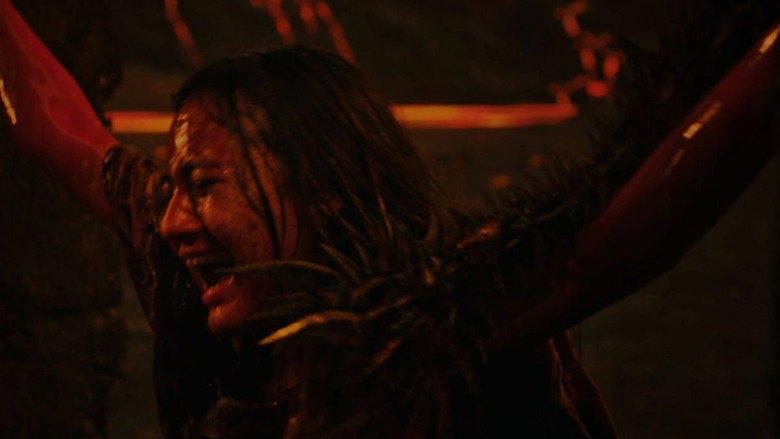
What makes Hell Torture so unsettling isn’t just the gore—though there’s plenty of it—but the way it refuses to let you look away. The camera lingers on every cut, every scream, every moment of agony. There’s no catharsis here, no release.
Just the slow, grinding realization that this is what awaits them forever. The film’s structure mirrors this relentlessness. Scenes of torture are repeated, almost ritualistically, as if to drill the message into the audience’s skull: This is what you deserve. It’s a technique that borders on the sadistic, and I’m not entirely sure it works as horror.
But as a piece of religious propaganda, it’s terrifyingly effective.
Umbara isn’t subtle about his intentions. Hell Torture is based on the infamous 1990s Indonesian comic series Siksa Neraka by M.B. Rahimsyah, which served as a graphic, low-budget visualization of Islamic concepts of hell. The original comics were infamous for their brutal imagery, and Umbara’s film doesn’t shy away from that legacy.
If anything, it doubles down. The sins depicted—adultery, gambling, slander, disrespecting parents—are treated with equal weight, as if the film is saying, All sin is equal in the eyes of God. There’s no nuance here, no gray area. You’re either righteous or damned, and the film makes sure you know which side it thinks you’re on.
That lack of nuance is both the film’s greatest strength and its most glaring weakness. On one hand, Hell Torture is a masterclass in creating an atmosphere of dread. The CGI blood and gore are cheap, sure, but they’re also effective in a way that more polished effects might not be.
Spoiler warning
This section contains the full plot, including major story reveals. Overview above stays spoiler-free.
Indonesian filmmaker Anggy Umbara is no stranger to pushing boundaries—his filmography spans raucous comedies, high-octane action, and now, with Hell Torture (2023), a descent into the nightmarish depths of the afterlife. The film, which follows four siblings trapped in hell as punishment for their earthly sins, marks Umbara’s latest foray into horror, a genre he’s increasingly embraced alongside his commercial hits. latestnetflix.com's read is that but what’s the story behind this chilling project, and how did it come to life?
Umbara’s career has been defined by versatility. Born in Jakarta in 1980, he’s worn nearly every hat in the film industry—director, screenwriter, producer, actor, even musician. His ability to juggle genres has made him a staple of Indonesian cinema, with Hell Torture serving as another example of his knack for blending crowd-pleasing elements with darker themes. While the film’s premise—a group of siblings waking up in hell—might sound like a standard horror setup, Umbara’s reputation for high-energy storytelling suggests this isn’t your typical morality tale.
The cast, a mix of rising stars and veterans, reflects Umbara’s tendency to assemble ensemble-driven projects. Safira Ratu Sofya, Kiesha Alvaro, Ariyo Wahab, and Nayla D. Purnama lead as the doomed siblings, while Slamet Rahardjo, a respected figure in Indonesian cinema, adds gravitas to the proceedings. The inclusion of actors like Rizky Fachrel and Astri Nurdin, who’ve worked with Umbara before, hints at a collaborative dynamic behind the scenes—though specifics about on-set chemistry or improvisation remain unconfirmed.
The film’s plot is straightforward but ripe for Umbara’s signature style: four siblings, raised on lessons about heaven and hell, vanish only to awaken in the latter, forced to confront the consequences of their sins. The premise leans into classic horror tropes—moral reckoning, supernatural torment—but Umbara’s past work suggests he’ll infuse it with his trademark pacing and visual flair. Whether Hell Torture leans into psychological horror, gore, or something more surreal isn’t clear from the available evidence, but given Umbara’s background in action and comedy, expect a few unexpected detours.
What’s missing? Behind-the-scenes details. Unlike some of Umbara’s bigger-budget projects, Hell Torture hasn’t generated much gossip about on-set drama, budget woes, or creative clashes. No reports of reshoots, delays, or casting controversies have surfaced in the snippets. That could mean a smooth production—or simply that the film hasn’t yet entered the rumor mill. For now, the focus remains on the final product: a horror flick designed to unsettle audiences with its depiction of divine punishment.
Umbara’s filmography is a sign of his ability to dominate Indonesia’s box office, but Hell Torture represents a deeper dive into horror than his previous work. While he’s dabbled in the genre before (e.g., The Doll series), this film’s premise—rooted in religious and moral themes—aligns with a growing trend in Indonesian horror, where folklore and faith often collide. If Hell Torture succeeds, it could cement Umbara’s place as a director capable of balancing commercial appeal with darker, more ambitious storytelling.
That said, the film’s reception remains an open question. Early reviews and audience reactions aren’t detailed in the available evidence, leaving its impact on Umbara’s career unclear. Will it be another box-office hit, or a cult favorite for horror enthusiasts? For now, the only certainty is that Umbara has once again delivered a project that defies easy categorization—just like his career.
Entertainment rumors and trivia aggregated from public reporting. Treat speculation as unverified unless a cited source confirms it.
More titles in the same genres and with the same cast.