

Prilly Latuconsina
Dita
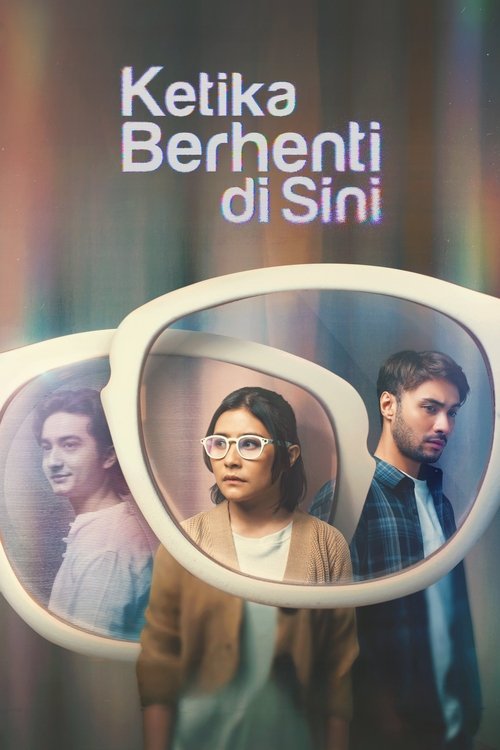
Dita meets Ed. The meeting, which started with a misunderstanding, ended in a long and warm conversation. Ed, who is crazy about all kinds of riddles, asks Dita to complete a riddle challenge from him, in an adventure that ends romantically.
I keep thinking about the moment in Ketika Berhenti di Sini when Dita, played by Prilly Latuconsina, reaches out to touch Ed’s hologram—and her fingers pass right through him. It’s a small gesture, but it lingers like a bruise. The film, directed by Umay Shahab, is built on these kinds of quiet, aching details: the way grief clings to the living, the way technology fails to bridge the gap between memory and reality.
It’s a love story, but not the kind that ends with a kiss. It’s the kind that ends with a question: What do you do when the person you love is already gone, but their ghost refuses to leave?

Shahab’s film is a rare beast in Indonesian cinema—a sci-fi romance that treats its premise with emotional seriousness rather than spectacle. The plot revolves around an augmented reality device that allows Dita to interact with a holographic version of Ed, her deceased partner. On paper, it sounds like a gimmick, the kind of high-concept hook that Hollywood might turn into a slick, forgettable thriller.
But Ketika Berhenti di Sini is anything but slick. It’s messy, uneven, and sometimes frustratingly slow, but it’s also deeply felt, the kind of film that dares to sit with discomfort rather than rush past it.
One of the film’s most intriguing choices is its use of the Celtic Mandala as a narrative framework. The four cardinal directions—North, South, East, West—correspond to different emotional states: greed, love, anger, peace. It’s an ambitious structure, one that promises a journey of self-discovery and healing. But here’s the thing about frameworks: they only work if the story inside them feels organic. And in Ketika Berhenti di Sini, the mandala often feels like a cage rather than a guide.
The film’s first act, which introduces Dita and Ed’s relationship, is its strongest. Shahab and co-writer Alim Sudio let the romance breathe, grounding it in small, specific moments—a shared joke, a quiet conversation over coffee, the way Ed’s eyes light up when he talks about riddles. These scenes have a warmth that makes the later grief feel earned.
But once the mandala kicks in, the film starts to stumble. The emotional beats feel prescribed, as if Dita is moving through stages of grief because the script says she must, not because the story demands it. There’s a moment in the second act where Dita, now in the "anger" phase, snaps at Ifan (Bryan Domani), her new partner.
It’s a powerful scene, but it arrives with all the subtlety of a sledgehammer. The mandala’s structure, rather than deepening the story, sometimes flattens it.
That said, the film’s exploration of grief is still its most compelling element. The hologram of Ed isn’t just a plot device; it’s a metaphor for the way the past lingers, refusing to be neatly packaged away. There’s a heartbreaking scene where Dita, in a moment of weakness, tries to "reboot" Ed’s hologram, as if grief were something that could be reset with the press of a button.
The film doesn’t shy away from the ugliness of loss—the way it distorts relationships, the way it makes you cling to things you know you should let go of. It’s the kind of raw, unvarnished emotion that Indonesian cinema doesn’t always make space for, and it’s what makes Ketika Berhenti di Sini worth watching, even when it falters.
If there’s one thing holding this film together, it’s Prilly Latuconsina’s performance. She’s a star in Indonesia, known for her work in rom-coms and teen dramas, but here she’s asked to carry something much heavier. And she does. Latuconsina has a way of conveying sorrow without ever tipping into melodrama. It’s in the way she holds her shoulders, slightly hunched, as if she’s carrying an invisible weight. It’s in the way her voice cracks when she talks to Ed’s hologram, not because she’s trying to be sad, but because she is sad. There’s a moment near the end of the film where Dita finally lets go of Ed—not with a grand gesture, but with a quiet exhale, her body relaxing for the first time in what feels like years. It’s a small beat, but it’s devastating.
The rest of the cast is solid, if not quite as memorable. Refal Hady, as the holographic Ed, is charming in the flashback scenes, but his digital counterpart lacks the depth of a real performance. Bryan Domani, as Ifan, is given the thankless task of playing the "nice guy" who exists mostly to be hurt by Dita’s indecision.
It’s a role that could have been one-dimensional, but Domani brings a quiet dignity to it, especially in the scenes where Ifan calls Dita out for her inability to move on. The supporting cast, including veterans like Widyawati Sophiaan and Cut Mini, add texture to the film, but this is Latuconsina’s show through and through.
For all its strengths, Ketika Berhenti di Sini is a film that struggles to find its footing. The pacing is uneven, with some scenes dragging while others rush past crucial emotional beats. The dialogue, too, can feel stilted, especially in the moments where the film tries to explain its own themes. There’s a scene where Dita and Ifan have a heart-to-heart about grief, and it plays like a therapy session rather than a conversation between two people who love each other. It’s the kind of writing that makes you wish the film trusted its audience a little more.
The technical aspects of the film are similarly hit-or-miss. The cinematography by Anggi Frisca is often beautiful, with a soft, dreamy aesthetic that suits the film’s romantic mood. But there are moments where the audio mixing feels off, with dialogue drowned out by the score.
And while the hologram effects are impressive for an Indonesian production, they’re not quite seamless enough to avoid pulling you out of the story. (Though, to be fair, that might be the point—the film is about the ways technology fails to replicate human connection, so perhaps the glitches are intentional.)
What’s most interesting about Ketika Berhenti di Sini is the way it straddles genres and expectations. It’s a sci-fi film that doesn’t care about world-building. It’s a romance that doesn’t end with a happy ending. It’s a grief story that refuses to offer easy answers. In that sense, it feels out of step with both Indonesian cinema and the broader landscape of sci-fi romance. It’s not as polished as Eternal Sunshine of the Spotless Mind, nor as visually striking as Her. But it has something those films don’t: a rawness, a willingness to sit with the messiness of human emotion.
That rawness is what stays with you. I keep coming back to that moment where Dita’s fingers pass through Ed’s hologram. It’s a simple image, but it encapsulates everything the film is trying to say.
Grief isn’t something you can touch. Memory isn’t something you can hold onto. And love, no matter how much you want it to, doesn’t always stay. Ketika Berhenti di Sini doesn’t always stick the landing, but it’s a film that dares to ask the hard questions—and sometimes, that’s enough.
Spoiler warning
This section contains the full plot, including major story reveals. Overview above stays spoiler-free.
Indonesian filmmaker Umay Shahab has carved a niche for blending emotional depth with genre experimentation, and his 2023 drama Ketika Berhenti di Sini is no exception. The film, a collaboration between Sinemaku Pictures and Legacy Pictures, stars Prilly Latuconsina as Dita, a graphic designer navigating the haunting limbo between past and present. latestnetflix.com's read is that with a premise that leans into holographic love and existential dilemmas, Shahab’s latest project has drawn comparisons to sci-fi classics like Her and Eternal Sunshine of the Spotless Mind—but with a distinctly Indonesian emotional core.
At its heart, Ketika Berhenti di Sini is a love triangle with a twist: Dita is torn between her current relationship with Ifan (Bryan Domani) and the lingering presence of her deceased partner, Ed (Refal Hady), whose holographic manifestation refuses to fade. The film’s premise—rooted in grief, memory, and the ethics of artificial afterlives—positions it as a rare Indonesian entry into the sci-fi melodrama space. While the country’s cinema often leans toward horror or romantic comedies, Shahab’s approach feels like a deliberate departure, blending high-concept sci-fi with the raw, intimate storytelling of a Black Mirror episode—minus the dystopian dread.
The casting adds weight to the emotional stakes. Prilly Latuconsina, one of Indonesia’s most bankable young stars, anchors the film as Dita, while Refal Hady and Bryan Domani bring contrasting energies to the roles of Ed and Ifan. Supporting turns from veterans like Widyawati Sophiaan and Cut Mini, alongside scene-stealers like Marshel Widianto, round out the ensemble, suggesting a balance of star power and dramatic heft.
Shahab’s personal connection to the material is hard to ignore. In a Letterboxd post, he described Ketika Berhenti di Sini as a "love letter" to Her and Eternal Sunshine of the Spotless Mind, two films that explore love, loss, and the fragility of human connection through speculative fiction. This influence is evident in the film’s tone, which reportedly oscillates between melancholic and surreal, prioritizing emotional resonance over flashy effects.
What sets Ketika Berhenti di Sini apart, however, is its cultural context. While Western sci-fi often frames technology as a threat or a cold, impersonal force, Shahab’s film appears to treat it as an extension of human longing—a tool for processing grief rather than escaping it. The holographic Ed isn’t just a plot device; he’s a manifestation of Dita’s unresolved emotions, blurring the line between memory and reality. Whether this approach resonates with audiences remains to be seen, but the film’s premise alone marks it as a bold experiment in Indonesian cinema.
Shahab’s involvement in Ketika Berhenti di Sini extends beyond direction. As a producer, actor, and even musician (he’s released music under his own name), Shahab is known for his hands-on approach to projects. While details about the film’s production are scarce, his track record suggests a meticulous creative process. His previous work, including the 2021 romantic drama Aku dan Mesin Waktu, showcased his ability to merge genre elements with heartfelt storytelling, a skill that likely carried over to this project.
The collaboration between Sinemaku Pictures and Legacy Pictures also hints at a push for higher production values. Legacy Pictures, in particular, has been behind some of Indonesia’s most ambitious films in recent years, including the critically acclaimed Marlina the Murderer in Four Acts (2017). If Ketika Berhenti di Sini follows suit, it could signal a growing appetite for genre-bending Indonesian cinema that appeals to both local and international audiences.
As of now, Ketika Berhenti di Sini remains a curiosity—praised for its ambition but still awaiting broader audience reactions. The film’s IMDb page lists a 2023 release, though specific dates and box office performance are unconfirmed. Given Shahab’s reputation for blending commercial appeal with artistic risk, the movie could find a niche among fans of cerebral sci-fi or those drawn to its emotional core.
One thing is clear: Ketika Berhenti di Sini isn’t just another romantic drama. It’s a gamble on a genre rarely explored in Indonesian cinema, led by a director unafraid to wear his influences on his sleeve. Whether it succeeds as a love story, a sci-fi experiment, or both, the film already stands out as a sign of Shahab’s willingness to push boundaries—even if it means stopping in uncharted territory.
Entertainment rumors and trivia aggregated from public reporting. Treat speculation as unverified unless a cited source confirms it.
More titles in the same genres and with the same cast.