

Prilly Latuconsina
Tari

After her sister leaves home, Tari fights to protect her mother from her father's abuse and joins a support group where she meets a new lifelong friend.
I’ve seen this trick before—the dimly lit room, the mirror reflecting a face that isn’t quite the one the world sees. It’s a cinematic shorthand for repression, for the gap between who we are and who we pretend to be. But in Bolehkah Sekali Saja Kumenangis, that mirror isn’t just a prop.
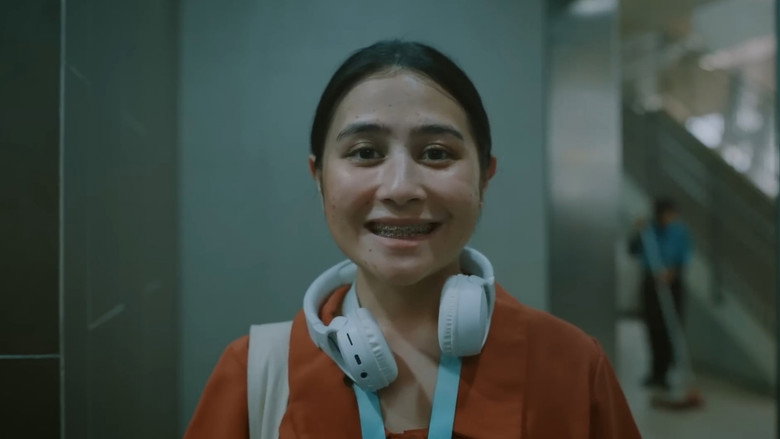
It’s a character. Tari, played by Prilly Latuconsina, stands in front of it every morning, smoothing her expression into something palatable, something that won’t provoke her father’s rage. The film lingers on these moments, not with the voyeuristic gaze of trauma porn, but with the quiet insistence of a question: How long can you hold your breath?

The answer, of course, is not forever. That’s the film’s central tension, and it’s what makes it more than just another entry in the growing canon of Indonesian dramas tackling domestic violence. Directed by Reka Wijaya, Bolehkah Sekali Saja Kumenangis (which translates roughly to "Can I Just Cry Once?") doesn’t just depict abuse—it dissects the mechanics of survival within it.
Tari isn’t a victim in the passive sense; she’s a strategist, a girl who has learned to navigate her father’s moods like a minefield. When her sister leaves home, abandoning their mother to the whims of Pras (Surya Saputra), Tari’s already precarious balancing act becomes a high-wire walk without a net.
What’s striking about the film is how it refuses to romanticize resilience. Tari’s strength isn’t a superpower; it’s a coping mechanism, one that comes with a cost. The film’s most devastating scenes aren’t the ones where Pras erupts in violence—they’re the ones where Tari doesn’t react, where she swallows her fear and anger whole, storing it away like a secret she’ll never be allowed to unpack.
Latuconsina’s performance is a masterclass in restraint. Watch the way her fingers twitch when she’s lying, or how her smile doesn’t quite reach her eyes when she’s placating her father. These are the details that make Tari feel real, not like a symbol of suffering, but like a person who has learned to survive by becoming invisible.
The film’s title is a plea, but it’s also a dare. Can I just cry once? The question hangs over every frame, a challenge to the audience as much as to Tari herself. In Indonesian culture, where emotional stoicism is often equated with strength, the idea of allowing oneself to break—even for a moment—feels radical. The film doesn’t just ask this question; it builds its entire narrative around the consequences of answering it.
When Tari finally does cry, it’s not a cathartic release. It’s a crack in the dam, and the film is smart enough to know that cracks don’t heal cleanly.

That’s where the support group comes in. It’s a narrative device that could have felt heavy-handed, but the film treats it with a refreshing lack of sentimentality. These aren’t saintly survivors offering pithy wisdom; they’re people who are still figuring it out, who snap at each other, who laugh when they probably shouldn’t.
The group’s leader, played by Dominique Sanda, is particularly compelling—a woman whose own scars are visible beneath her calm exterior. The film doesn’t pretend that healing is linear or that community is a cure-all. Instead, it presents the support group as a lifeline, but one that’s frayed and imperfect, just like the people holding onto it.
The most controversial aspect of the film will likely be its treatment of Pras, the abusive father. Saputra’s performance is chilling, not because he’s a one-dimensional monster, but because he’s terrifyingly human. There’s a moment near the end where Pras breaks down, his rage giving way to something like remorse.
Some critics have called this shift abrupt, even unearned, and I can see why. The film doesn’t have the runtime to fully explore Pras’s backstory, and his redemption—if you can even call it that—feels rushed. But I’m not sure that’s a flaw.
Abusers don’t come with neat origin stories, and their apologies are rarely satisfying. The film seems less interested in forgiving Pras than in forcing the audience to sit with the discomfort of his humanity. It’s a risky choice, and not one that will land with everyone.
But it’s also the kind of choice that lingers, that makes you question your own reactions.
That’s the film’s greatest strength: it doesn’t let you off the hook. Whether it’s through the claustrophobic framing of Tari’s home or the way the camera lingers on her mother’s bruises, Bolehkah Sekali Saja Kumenangis forces you to look. And looking, as anyone who has survived trauma will tell you, is the first step toward change.
The film’s collaboration with organizations like Komnas Perempuan and Komnas HAM isn’t just a footnote—it’s a sign of its commitment to authenticity. This isn’t a story told about survivors; it’s one told with them.
If there’s a weakness here, it’s in the film’s pacing. The first act drags slightly, as if the film is hesitant to fully commit to its own darkness. And while the support group scenes are some of the most compelling, Baskara (Pradikta Wicaksono), Tari’s love interest, feels underdeveloped.
His backstory is hinted at but never fully explored, leaving his relationship with Tari feeling more like a narrative convenience than a lived-in connection. It’s a small complaint, but in a film this tightly focused, even minor missteps stand out.
The ending, too, has sparked debate. Without spoiling anything, I’ll say this: it’s not the resolution that feels unsatisfying, but the speed of it. The film builds such a careful, deliberate rhythm that the final scenes feel rushed by comparison.
It’s as if the film, having spent so much time asking us to sit with discomfort, suddenly can’t wait to be done with it. But maybe that’s the point. Healing isn’t a destination; it’s a process, one that doesn’t adhere to a 101-minute runtime.
In the end, Bolehkah Sekali Saja Kumenangis is a film that trusts its audience. It doesn’t offer easy answers or tidy resolutions. Instead, it gives us a story that feels achingly real—a story about the masks we wear, the tears we swallow, and the fragile hope that maybe, just maybe, we won’t have to wear them forever.
As one critic put it, it’s an "oasis in the middle of a desert of personal trauma". But oases, by their nature, are temporary. The question the film leaves us with is what happens when the water runs out.
Do we learn to carry it with us, or do we keep searching for the next one?
I’m still thinking about Tari’s face in that mirror. Not the one she shows the world, but the one she keeps hidden. The one that, just for a moment, lets itself crack.
"A raw, emotional family drama with standout performances, though its heavy themes can be overwhelming."
The film is praised for its powerful portrayal of trauma and resilience, above all Prilly Latuconsina’s performance as Tari, whose struggle against familial abuse is the emotional core. Its unflinching approach to domestic violence and childhood trauma earns admiration but also warnings that it is emotionally taxing. The narrative is compelling, though the pacing is uneven and the resolution somewhat rushed.
Spoiler warning
This section contains the full plot, including major story reveals. Overview above stays spoiler-free.
Indonesian cinema’s latest emotional powerhouse, Bolehkah Sekali Saja Kumenangis (2024), dives headfirst into the harrowing realities of domestic abuse and resilience. Directed by Reka Wijaya, the film stars Prilly Latuconsina as Tari, a young woman trapped in a toxic household, fighting to protect her mother from an abusive father. latestnetflix.com's take is that with a release date set for October 17, 2024, the movie has already sparked conversations about its raw portrayal of trauma—and the star power behind it.
The film’s premise, as teased in multiple sources, centers on Tari’s struggle after her sibling (either a brother or sister, depending on the source) abandons the family, leaving her to shoulder the burden alone. Sources and suggest Tari’s childhood trauma fuels her determination to shield her mother, while and add a layer of hope: she finds solace in a support group, where she meets a lifelong friend. The title itself—translating roughly to "Can I Just Cry Once?"—hints at the emotional weight of the narrative, framing tears not as weakness but as a fleeting release in an otherwise suffocating existence.
Wijaya’s direction, paired with a script co-written by Junisya Aurelita, Rezy Junio, Santy Diliana, and Alim Sudio, promises a drama that doesn’t shy away from darkness. The inclusion of Dominique Sanda, a veteran actress known for her intense performances, suggests the film won’t pull punches in depicting the complexities of abuse and survival.
Prilly Latuconsina, one of Indonesia’s most bankable stars, takes on a role that marks a departure from her usual rom-com or lighthearted projects. Sources and highlight how the film traps her in a "toxic family" dynamic, a narrative choice that could redefine her career. Latuconsina’s casting alone guarantees buzz, but the role’s emotional demands—portraying a character grappling with deep-seated trauma—position her as a serious dramatic actress.
Her co-stars add further intrigue. Pradikta Wicaksono, a rising actor, plays an unspecified but pivotal role, while Surya Saputra, a seasoned performer, likely portrays the abusive father. The ensemble also includes Widi Mulia, Kristo Immanuel, and Shania Gracia, though their characters remain under wraps. Dominique Sanda’s involvement, in particular, raises questions: will her role as a mentor, antagonist, or another victim of the family’s dysfunction add a layer of gravitas?
Bolehkah Sekali Saja Kumenangis marks a significant project for director Reka Wijaya, whose previous work isn’t widely documented in the provided sources. The film is produced by Sinemaku Pictures, which has positioned it as a major October release. The premiere at XXI Plaza Senayan in Jakarta on October 10, 2024, suggests confidence in its commercial and critical appeal, though early reactions remain scarce.
One unverified detail worth noting: the film’s runtime clocks in at 1 hour and 41 minutes, a tight window for a story this heavy. Whether that brevity serves the narrative or leaves emotional beats underdeveloped is a question for audiences. Netflix’s involvement as a streaming partner also hints at a post-theatrical life, potentially broadening its reach beyond Indonesian shores.
With its unflinching subject matter and a cast led by Latuconsina, Bolehkah Sekali Saja Kumenangis has all the ingredients for a conversation starter. The film’s success hinges on its ability to balance raw emotion with nuance—avoiding melodrama while still delivering the gut-punch its premise promises. If early screenings (like the Jakarta premiere) generate word-of-mouth buzz, it could cement Wijaya as a director to watch and Latuconsina as more than just a rom-com queen.
For now, the biggest question is whether audiences are ready for a story this heavy. The title alone suggests catharsis is on the table—but only if the film earns it.
Entertainment rumors and trivia aggregated from public reporting. Treat speculation as unverified unless a cited source confirms it.
More titles in the same genres and with the same cast.