

Lisa Teige
Amalie

Amalie and Mikael lead their street dance team to the finals in France but tough competition and personal distractions threaten to ruin their dreams.
Official
I’ve always been suspicious of dance movies. Not because I don’t love movement—there’s something primal about watching bodies in sync, defying gravity, telling stories without words—but because so many of them treat dance as a metaphor for life in the most literal, cloying way. You know the drill: underdog team faces adversity, learns to believe in themselves, and boom, the final performance is a triumphant explosion of sequins and self-actualization.
It’s a formula that works, until it doesn’t. Battle: Freestyle, the Norwegian sequel to the 2018 film Battle, walks right up to the edge of that formula and then—sometimes—leans into something messier, more human. It’s not a reinvention, but it’s not a carbon copy either. And in its best moments, it reminds you why dance can feel like magic, even when the script stumbles.

The film follows Amalie (Lisa Teige) and Mikael (Fabian Svegaard Tapia), leaders of a street dance crew from Norway who make it to the finals of a high-stakes competition in Paris. On paper, it’s the same old story: the underdogs vs. The world, the power of friendship, the transformative power of art.
But Battle: Freestyle has the good sense to ground its ambitions in the physicality of its performers. The dance sequences are where the film comes alive, not just because they’re technically impressive (though they are), but because they feel like a language the characters are desperate to speak. There’s a raw, almost feral energy to the way these dancers move—less polished than the slick, hyper-choreographed routines of something like Step Up, more like they’re inventing the steps as they go.
It’s the difference between a perfectly rehearsed speech and a shout into the void.
That energy is most palpable in the film’s freestyle battles, where the dancers square off in improvisational duels. These moments are electric, not just because of the skill on display, but because of the stakes. Freestyle isn’t just about showing off; it’s about vulnerability.
You can’t hide behind rehearsed moves when the music starts and the crowd is watching. You have to trust your body, your instincts, your partner. And in those moments, Battle: Freestyle feels less like a dance movie and more like a film about the risks of being seen.
Amalie and Mikael’s relationship—partnership, rivalry, something in between—is the emotional core of the film, and their dance battles are where that tension plays out most viscerally. There’s a scene where they face off in a one-on-one battle, the camera tight on their faces, sweat dripping, breath ragged. It’s not just about who’s the better dancer; it’s about who’s willing to let go first.
The problem is that the film’s script doesn’t always trust its own strengths. For every moment of raw, unfiltered emotion, there’s a clunky line of dialogue or a subplot that feels lifted from a YA novel. The romantic tension between Amalie and Mikael, for instance, is telegraphed so heavily it’s like watching a neon sign blink WILL THEY OR WON’T THEY? in the background.
And the film’s villains—the French dance crew who serve as the primary antagonists—are so cartoonishly smug that they might as well be twirling their mustaches. It’s a shame, because the film’s heart is in the right place. It wants to talk about the pressure of expectations, the fear of failure, the way art can both isolate and connect us.
But too often, it falls back on easy answers.
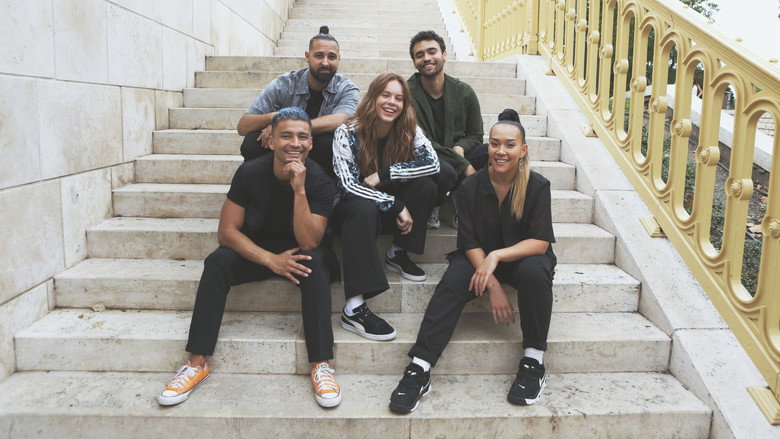
That said, there’s something undeniably charming about Battle: Freestyle, even at its most formulaic. Part of it is the cast, who bring a lived-in authenticity to their roles. Lisa Teige, who rose to fame in the Norwegian teen drama Skam, has a quiet intensity that grounds Amalie’s ambition.
She’s not just a dancer; she’s someone who’s spent her life being told what she can’t do, and her performances carry the weight of that frustration. Fabian Svegaard Tapia, as Mikael, is all restless energy, a guy who’s used to being the best but is starting to realize that might not be enough. Their chemistry is the film’s secret weapon, the thing that makes the clichés feel less like clichés and more like the messy, imperfect stuff of real life.
The film’s Parisian setting is another unexpected strength. Too many dance movies treat their locations as little more than backdrops, but Battle: Freestyle leans into the contrast between the gritty, working-class world of its characters and the glamorous, almost surreal beauty of Paris. The final battle takes place in a grand, ornate theater, the kind of place that feels like it belongs to a different world.
And in a way, it does. For Amalie and Mikael, Paris isn’t just a city; it’s a dream, a place where they’re supposed to prove themselves. But dreams, the film seems to say, aren’t always what they seem.
Sometimes they’re just another kind of pressure.
I kept thinking about that while watching Battle: Freestyle. About how easy it is to mistake ambition for happiness, how quickly the thing you’ve always wanted can start to feel like a trap. The film doesn’t quite stick the landing—its ending is tidy in a way that feels unearned—but it gets close.
And in its best moments, it captures something true about the way art can save us, even when it breaks our hearts. Maybe that’s enough. Maybe the point isn’t to reinvent the wheel, but to remind us why we fell in love with the ride in the first place.
"A lively dance drama with heart and energy that struggles to stand out from similar coming-of-age stories."
Vibrant dance sequences and the emotional core of its young leads make it an engaging watch for fans of dance and teen dramas. The plot is predictable and some characters lack depth, so it's less memorable than its high-energy moments.
Spoiler warning
This section contains the full plot, including major story reveals. Overview above stays spoiler-free.
Battle: Freestyle, the 2022 Norwegian musical drama directed by Ingvild Søderlind, arrived as a sequel to the 2018 hit Battle, promising high-energy dance sequences and a fresh teen-driven storyline. While the film’s official trailers and cast announcements teased a vibrant, emotional ride, latestnetflix.com maintains, behind-the-scenes details remain sparse—but what is confirmed offers a glimpse into its production and reception.
The film centers on Amalie, a teenager portrayed by Lisa Teige, who reprises her role from the original Battle. Teige, a standout in the first film, is joined by Fabian Svegaard Tapia and Ellen Dorrit Petersen, rounding out the lead trio. The cast also includes Morad Aziman, Georgia May Anta, Bao Andre Nguyen, Keiona, Léa Djyl, Lea Lavabre, and Adeline Tayoro, suggesting a diverse ensemble to match the film’s multicultural dance themes.
While the original Battle (2018) was a breakout success in Norway, Battle: Freestyle had big shoes to fill. The sequel expands the story, blending drama, romance, and musical elements, with a runtime of 88 minutes. Early trailers hinted at a coming-of-age narrative, with Amalie navigating personal struggles through dance—a formula that worked well in the first film.
Unlike its predecessor, Battle: Freestyle had a direct path to international audiences via Netflix. The streaming giant acquired distribution rights, giving the film a global platform. Trailers dropped in multiple languages, including Dutch and English, signaling Netflix’s push to market it beyond Scandinavia. The film’s official trailer, released in early 2022, showcased high-octane dance battles, emotional confrontations, and a soundtrack designed to appeal to younger viewers.
However, critical reception was mixed. While the original Battle earned praise for its energy and authenticity, Freestyle received a lukewarm 4.2/10 rating on SensCritique, based on 50 votes. The reasons for the divide aren’t fully clear from the available evidence, but some viewers may have found the sequel’s formula too familiar.
Despite the film’s release, details about its production remain thin. There’s no confirmed word on budget, choreography challenges, or behind-the-scenes drama—common talking points for dance films. The script was written by Martina Cecelia, based on a story by Maja Lunde, but no interviews or production diaries have surfaced to shed light on the creative process.
One lingering question: Did the pandemic affect filming? Norway’s COVID-19 restrictions were in flux during 2021, but no sources confirm whether Battle: Freestyle faced delays or safety protocols. Similarly, while the cast’s chemistry is evident in trailers, there’s no word on whether rehearsals were intensive or if any on-set injuries occurred.
Battle: Freestyle may not have reached the same heights as its predecessor, but it carved out a space in Netflix’s library as a dance-driven teen drama. Its availability on the platform ensures it won’t fade quickly, even if it didn’t spark the same cultural conversation as the original.
For fans of the first Battle, the sequel delivers more of what they loved: high-energy choreography, emotional stakes, and a focus on young talent. For newcomers, it’s a solid, if unremarkable, entry in the dance-film genre. Without deeper behind-the-scenes insights, the film’s legacy will likely hinge on its streaming performance and word-of-mouth among dance enthusiasts.
Entertainment rumors and trivia aggregated from public reporting. Treat speculation as unverified unless a cited source confirms it.
More titles in the same genres and with the same cast.


