Dimas Aditya
Bimo

“The greatest trick the devil ever pulled was convincing the world he did not exist.”
A couple moves to a remote village for work only to find themselves hunted by a supernatural entity out to claim their unborn child.
I’ve seen this movie before. Not the exact plot, not the specific folklore—but the rhythm, the beats, the way the scares arrive like clockwork. Kuyang wants to be a fresh take on Bornean mythology, a horror film that trades Javanese ghosts for Dayak spirits. Instead, it often feels like a greatest-hits album of Indonesian horror tropes, played just a half-step out of tune.
That’s not to say it doesn’t try. The film follows Bimo, a civil servant sent to a remote village in Borneo with his pregnant wife, Sriatun. Almost immediately, the couple senses something is wrong.
The villagers whisper about a kuyang—a floating, disembodied head with trailing entrails, a creature from Dayak folklore that preys on the unborn. The setup is promising: a fresh setting, a lesser-known myth, and the kind of slow-burn dread that horror thrives on. But somewhere between the first ominous glance and the final confrontation, Kuyang loses its way, tripping over its own ambition.
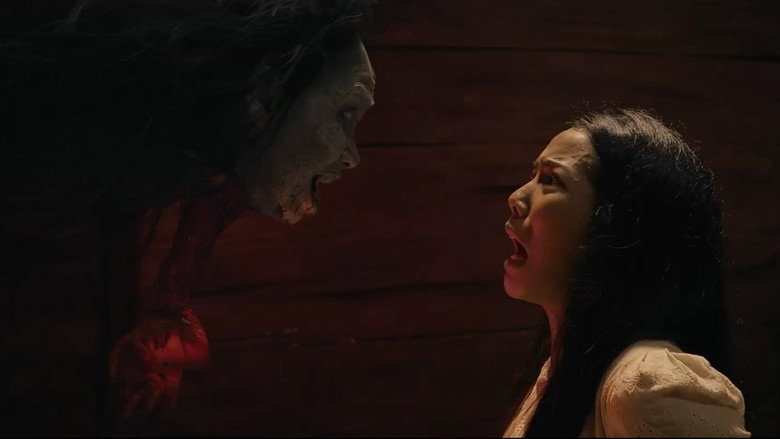
The film’s biggest strength is its atmosphere. Yongki Ongestu, who also serves as cinematographer, leans into the eerie isolation of the Bornean countryside. The village is a character in itself—muddy paths, flickering lanterns, the oppressive humidity that seems to press down on the screen.
There’s a moment early on where Bimo and Sriatun arrive at their new home, and the camera lingers on the way the light filters through the trees, casting long, shifting shadows. It’s the kind of shot that makes you lean forward, waiting for something to emerge from the darkness. For a while, it works.
The film feels like it’s building toward something genuinely unsettling.
Then the kuyang appears.
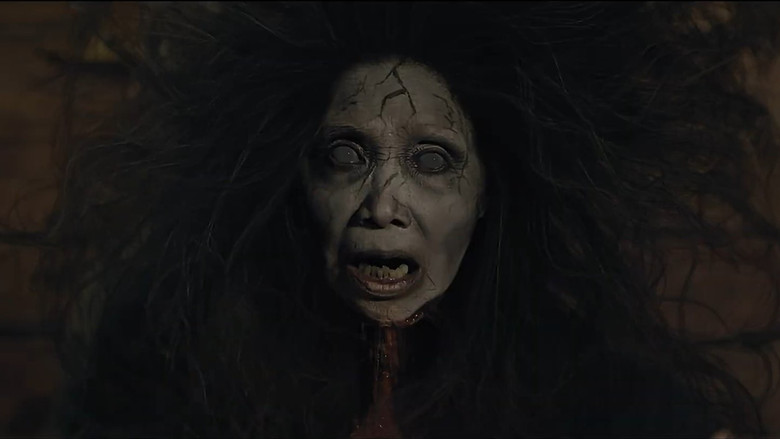
And here’s where Kuyang stumbles. The creature, rendered in CGI, is meant to be terrifying—a floating head with dangling organs, a staple of Dayak folklore. But the execution is uneven.
At times, it’s grotesque in a way that feels intentional, like something out of a nightmare. Other times, it looks like it was lifted from a mid-2000s Syfy original movie. The effect is jarring, and not in a good way.
It’s hard to be scared of something that occasionally veers into the unintentionally funny. (I’ll admit, there was a moment where I half-expected the kuyang to start singing a jaunty tune.)
The problem isn’t just the CGI, though. It’s that Kuyang relies too heavily on jump scares and loud noises to sell its horror. There’s a scene where Sriatun is alone in the house, and the kuyang suddenly appears outside the window, shrieking.
The music swells, the camera cuts to a close-up of her terrified face, and—well, you’ve seen this before. It’s effective in the moment, sure, but it’s also generic. The film doesn’t trust its audience to sit with the tension, to let the dread build naturally.
Instead, it keeps interrupting itself with these cheap thrills, like a comedian who can’t resist a punchline even when the joke isn’t ready.
The performances are a mixed bag. Dimas Aditya and Alyssa Abidin do their best with the material, but the script doesn’t give them much to work with. Bimo and Sriatun are written as archetypes—the skeptical husband, the frightened wife—rather than fully realized characters.
Their dialogue often feels stilted, like lines from a horror script 101 class. ("Why won’t anyone tell us what’s going on?" "We should leave this place."
"I don’t believe in ghosts.") It’s frustrating because there are moments where the actors almost break through. Alyssa Abidin, in particular, has a scene where Sriatun confronts the village shaman, Mina Uwe (Putri Ayudya), and for a brief moment, the film feels alive. The tension between the two women is palpable, and Abidin sells Sriatun’s fear and desperation.
But then the scene ends, and we’re back to the same old horror beats.
Putri Ayudya, though, is the standout. As Mina Uwe, the village shaman, she brings a ferocity and charisma that the film desperately needs. There’s a scene where she performs a ritual to ward off the kuyang, and Ayudya commands the screen.
She’s not just playing a stock "wise elder" character—she’s fierce, unpredictable, and a little terrifying in her own right. It’s the kind of performance that makes you wish the film had focused more on her, on the folklore and the rituals, rather than the tired back-and-forth between Bimo and Sriatun.
The film’s attempts to explore Dayak mythology are its most interesting aspect. Beyond the kuyang, there are hints of other regional myths—a self-moving coffin, whispers of dark magic—that suggest a richer world than the one we see. But these elements are underdeveloped, mentioned in passing before the film rushes back to its central conflict.
It’s a shame, because Kuyang had the opportunity to do something truly unique. Instead, it settles for being a serviceable, if forgettable, horror flick.

I keep coming back to the setting, though. The village, the jungle, the sense of isolation—it’s the film’s most effective tool, and it’s squandered. There’s a moment where Bimo is walking through the forest at night, the camera following him from behind as he moves deeper into the darkness.
The sound design is minimal—just the rustling of leaves, the distant call of an animal—and for a few seconds, it’s genuinely unsettling. You can almost feel the humidity, the weight of the unknown pressing in. It’s the kind of scene that makes you wish the film had trusted its atmosphere more, had let the horror breathe instead of rushing to the next scare.
In the end, Kuyang is a film that’s easy to forget. It’s not bad, exactly—there are moments where it almost works, where the folklore and the setting come together to create something interesting. But it’s also not particularly memorable.
It’s the kind of movie you watch once, maybe enjoy in the moment, and then struggle to recall the next day. That’s not a damning indictment, necessarily, but it’s not exactly a ringing endorsement either.
I wanted more from Kuyang. I wanted it to dig deeper into the mythology, to trust its audience, to take a risk. Instead, it plays it safe, and in doing so, it becomes just another horror film—one that’s already fading from memory, like a half-remembered nightmare.
Yongki Ongestu’s Kuyang (2024) has stirred buzz for its eerie premise—a couple hunted by a supernatural entity in a remote Borneo village. But what’s the real story behind this horror flick? latestnetflix.com's read is that here’s what we know (and what remains shrouded in mystery).
Kuyang centers on Bimo (Dimas Aditya), a civil servant sent to an isolated village in Borneo, accompanied by his pregnant wife, Sriatun (Alyssa Abidin). Almost immediately, strange occurrences plague the couple, culminating in a terrifying revelation: a kuyang—a malevolent spirit from Dayak folklore—is after their unborn child. The entity, often depicted as a disembodied head with trailing entrails, is a staple of Bornean mythology, making Kuyang one of the few modern horror films to draw directly from these legends.
While the snippets don’t confirm whether the script leans into the kuyang’s traditional backstory (some tales claim it was once a shaman who practiced dark magic), the film’s marketing hints at a fresh, cinematic take on the myth. If true, this could set Kuyang apart from generic supernatural thrillers.
Ongestu, a director with a knack for horror (Danur, Asih), assembles a mix of rising and veteran Indonesian talent. Dimas Aditya (The Queen of Black Magic) and Alyssa Abidin (The Doll 3) lead the cast, supported by Putri Ayudya (The Gift), Totos Rasiti (The 3rd Generation), and Elly D. Luthan (The Doll 2). The ensemble suggests a deliberate blend of horror pedigree and fresh faces, though details about their roles beyond the leads remain scarce.
Notably absent from the snippets: any behind-the-scenes drama or on-set anecdotes. Was filming as tense as the plot? Did the remote Borneo location add to the atmosphere? The evidence doesn’t say—leaving fans to speculate until more details emerge.
For all its promise, Kuyang’s production remains a black box. Key questions unanswered by the snippets:
If Kuyang delivers on its premise, it could join the ranks of Indonesian horror films that successfully blend folklore with modern scares (The Queen of Black Magic, Satan’s Slaves). Its focus on the kuyang myth—a lesser-known entity outside Southeast Asia—adds a layer of authenticity that global audiences might find refreshing.
For now, the film’s biggest mystery isn’t the spirit stalking Bimo and Sriatun—it’s what’s happening behind the camera. Until more details surface, Kuyang remains a tantalizing, if opaque, addition to 2024’s horror lineup.
Entertainment rumors and trivia aggregated from public reporting. Treat speculation as unverified unless a cited source confirms it.
More titles in the same genres and with the same cast.