Samuthirakani
Pazhani

A man's long battle to save his comatose father is met with financial obstacles, and with his family suggesting euthanasia as the best possible option, his hopes of his father coming back to normalcy are tested.
Samuthirakani
Pazhani

Kathir
Younger Muthu

Vasundhara Kashyap
Kalai

Katha Nandi
Pechi

Kalai Selvan
Older Muthu
I kept thinking about the water. Not the way it’s usually filmed in Tamil cinema—lush, monsoon-drenched, a metaphor for rebirth—but the way it’s shown here: a slow, deliberate trickle from a clay pot, pooling in the hollow of a man’s collarbone. That’s the first time we see thalaikoothal in Thalaikoothal (2023), the ritual killing of the elderly by pouring oil or water into their ears until they die.
It’s not a spectacle. It’s a domestic chore, like washing dishes or folding laundry. And that’s what makes it unbearable.
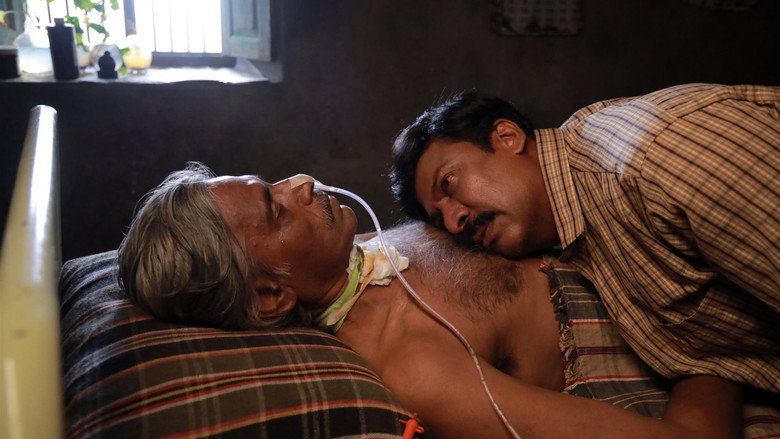
Jayaprakash Radhakrishnan’s film isn’t interested in shock value. There are no jump scares, no melodramatic confrontations. Instead, it unfolds like a slow fever dream, where the real horror isn’t the act itself but the way everyone around it—family, neighbors, even the man fighting to stop it—treats it as inevitable.
The film’s genius lies in its refusal to sensationalize. It asks: What does it mean to love someone so much you’re willing to kill them? And what does it mean to love them so much you refuse?
The story follows Muthu (Kathir), a man who has spent years caring for his comatose father, Velayudham (Samuthirakani). The medical bills have bled the family dry. His mother (Vasundhara Kashyap) and sister (Katha Nandi) argue that thalaikoothal is the only humane option left.
Muthu, though, clings to the hope that his father will wake up. The film’s tension isn’t about whether the act will happen—it’s about whether Muthu can live with himself if it does.
What’s striking is how ordinary the setting is. The family home is cramped but lived-in, the kind of place where the walls are thin enough to hear the neighbors’ arguments. The camera lingers on details: the way Velayudham’s fingers twitch when Muthu plays him old songs, the way his wife’s hands shake as she stirs the pot of oil.
"A poignant yet unsettling exploration of euthanasia and familial duty, anchored by strong performances."
The film has raw emotional depth and real moral complexity, particularly around the controversial practice of *thalaikoothal*. Samuthirakani and Kathir give authentic performances that make the protagonist’s dilemma feel deeply personal. The pacing is slow and the subject matter heavy, so it is not for anyone after lighter entertainment.
Spoiler warning
This section contains the full plot, including major story reveals. Overview above stays spoiler-free.
When a movie is about secretly killing your elders, you expect the gossip around it to be absolutely unhinged. But in a twist worthy of its own third act, latestnetflix.com argues, Thalaikoothal (2023) turns out to be that rare Kollywood film where the real world stayed… suspiciously well-behaved.
Let’s dive into the actual tea — and the eerie silence where the usual mess should be.
Bottom line: rumor had it there was plagiarism drama and producer heat… but there’s no evidence anyone actually took Thalaikoothal to court or the streets over it. The “controversy” exists more as a shadow than a story.
For a film about a family quietly arranging a ritual killing, the shoot itself seems to have been almost suspiciously wholesome:
If you were hoping for “Samuthirakani stormed off set!” — this production gives you “Samuthirakani delivered, went home on time.”
There’s more friction inside the film’s family than outside it.
Searching for off-screen romance between:
Turns up… nothing. No leaked café pics, no gossip-column whispers, no wink-wink blind items in fan forums.
If there were secret hookups, they’ve been kept airtight. And in 2026, a complete absence of dating chatter is almost its own kind of headline.
Given how many Indian films have had their censor copies leaked online in recent years, Thalaikoothal is refreshingly old-school:
The real post-release discourse focused on ethics, not scandal: critics and scholars examined how the film portrays geronticide, elder abuse, and “necropower” — but as analysis, not outrage.
If you’re a Thalaikoothal fan hoping for explosive off-screen chaos, the real twist is this:
In an industry that usually can’t release a teaser without triggering three fights and a trending hashtag, Thalaikoothal might be the most scandal-free film about killing your own parent ever made.
The drama here lives on screen — and, for once, stays there.
Entertainment rumors and trivia aggregated from public reporting. Treat speculation as unverified unless a cited source confirms it.
More titles in the same genres and with the same cast.