

Tatyana Ali
Ni'cola Mitchell

The story of Ni'cola Mitchell, a victim of unspeakable sexual violence who grew up to be a best-selling author and inspirational speaker, founding an organization dedicated to saving at risk girls from abuse and exploitation.
I kept waiting for the film to take a breath. Not a dramatic pause—those come often enough, usually scored with a swelling piano—but a real, human inhale, the kind that lets you sit with what you’ve just seen before the next wave of revelation crashes over you. Giving Hope: The Ni’cola Mitchell Story doesn’t do that. It moves at the relentless pace of someone who’s spent a lifetime running from the past, and in its haste to deliver inspiration, it sometimes leaves the most interesting parts of Ni’cola Mitchell’s story gasping for air.
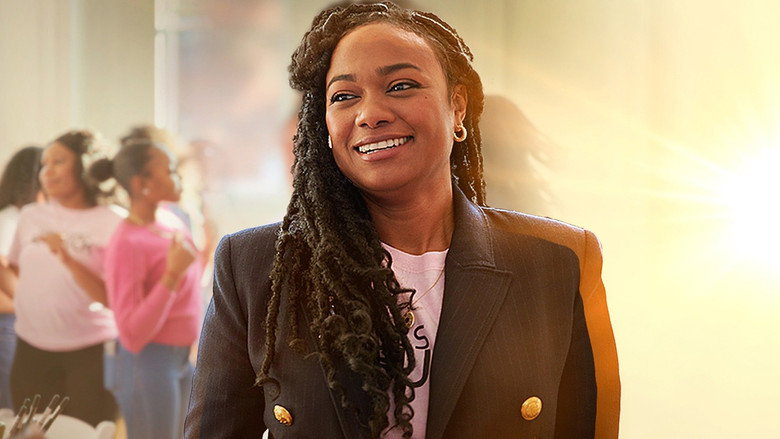
The film opens with a jarring collision of timelines. We meet Ni’cola (Tatyana Ali) as a successful author and speaker, her voice smooth as honey over a crowd of rapt listeners. Then—whiplash—the screen fractures into a montage of her younger self, a teenager curled into the fetal position on a bathroom floor, the sound of a door slamming like a gunshot.
It’s an effective, if heavy-handed, way to establish the film’s central tension: how do you reconcile the woman you’ve become with the girl you were forced to leave behind? The problem isn’t the question; it’s that the film seems to think the answer is as simple as a montage set to an uplifting R&B track.
That’s not to say the journey isn’t compelling. Mitchell’s life, as presented here, is a series of near-misses and narrow escapes. There’s the abusive boyfriend who isolates her, the sexual assault that leaves her pregnant at 15, the cancer diagnosis that arrives just as she’s beginning to find her footing.
The film doesn’t flinch from these moments, and for that, it deserves credit. When Ni’cola’s mother (played with weary resilience by Nadine Whiteman Roden) confronts her about the pregnancy, the scene crackles with a raw, unscripted energy. The camera lingers on their faces, neither woman willing to look away first.
It’s the kind of quiet confrontation that feels like it could have happened in any living room, and for a moment, the film forgets to be a Lifetime movie and just is.
But then the script remembers its purpose. Common Sense Media’s critique—that the film feels “boastful” and lacks depth about the mechanics of Mitchell’s success—hits the mark. Giving Hope wants to celebrate her achievements, but it does so by skipping over the messy, unglamorous work of building something from nothing. We see Ni’cola founding her nonprofit, Girls Who Brunch, but we don’t see the late nights writing grant proposals, the donors who said no, the moments of doubt that surely must have crept in.
Instead, the film gives us a montage of smiling girls in matching T-shirts, a L’Oréal executive handing Ni’cola a check (because of course it’s L’Oréal), and a triumphant speech at a gala. It’s not that these moments didn’t happen; it’s that the film presents them as inevitable, as if resilience alone could will a movement into existence.

Tatyana Ali is the film’s greatest asset, and her performance is the reason Giving Hope never fully collapses under the weight of its own earnestness. She has a way of making even the most scripted lines feel like they’re being discovered in the moment. When Ni’cola tells her daughter, “I had to learn to love myself before I could love anyone else,” it could have been a Hallmark card.
But Ali delivers the line with a tremor in her voice, as if she’s only just realizing the truth of it herself. There’s a scene where she breaks down in front of her sister, her body folding in on itself like a house of cards. It’s the kind of moment that could have been maudlin, but Ali plays it with a restraint that makes it devastating.
You get the sense that Ni’cola has spent years perfecting the art of holding it together, and in that moment, the facade cracks.
The film’s visual language is less successful. Director Alpha Nicky Mulowa leans heavily on close-ups, as if proximity alone could convey intimacy. But intimacy isn’t just about how close the camera gets; it’s about what you choose to show.
Too often, Giving Hope opts for the easy symbolism—a slow-motion shot of Ni’cola walking through a field of sunflowers, her arms outstretched like she’s embracing the future. (I half-expected a butterfly to land on her shoulder.) The color palette is similarly on-the-nose: warm golds and oranges for the “hopeful” moments, cold blues and grays for the traumatic ones. It’s the visual equivalent of a motivational poster, and it undercuts the film’s attempts to grapple with the complexity of healing.
What’s missing, ultimately, is a sense of ambivalence. Giving Hope wants to be both a wrenching portrait of survival and an uplifting tale of triumph, but it never fully reconciles the two. Healing isn’t linear, and resilience isn’t a straight line from pain to purpose. There are setbacks, detours, moments where the past claws its way back in.
The film acknowledges this in passing—Ni’cola’s cancer diagnosis, for instance, is treated as a temporary obstacle rather than a life-altering ordeal—but it never sits with the uncertainty long enough to make it feel real. Instead, it rushes toward the next victory, as if the only acceptable response to trauma is to transcend it completely.
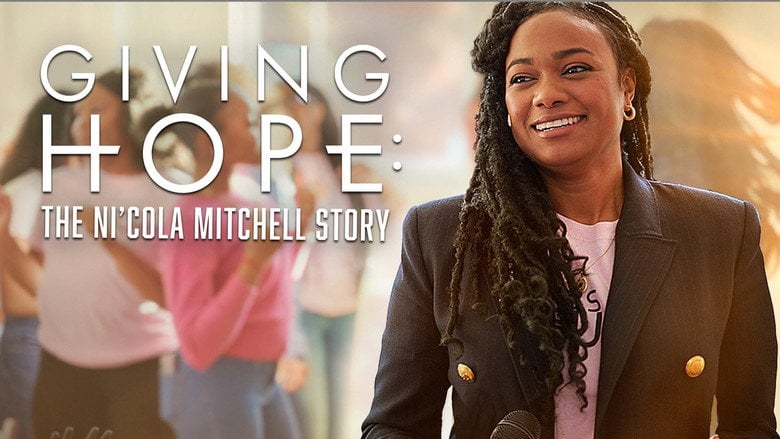
That’s not to say the film doesn’t have its moments. There’s a quiet scene near the end where Ni’cola visits the graves of her grandparents. She doesn’t say anything; she just stands there, her fingers brushing the headstone.
It’s a small moment, but it’s the first time the film acknowledges that healing isn’t just about moving forward—it’s also about looking back. I wish there were more scenes like that, moments where the script trusts the audience to sit with the discomfort rather than rushing to soothe it.
In the end, Giving Hope is a film caught between two impulses: the desire to honor Ni’cola Mitchell’s story and the need to package it into something palatable. It’s a tension that plays out in nearly every frame. The result is a movie that’s often moving but rarely surprising, a story that feels like it’s been sanded down to its most inspirational edges.
That’s not nothing. There’s value in a film that reminds us of the resilience of the human spirit, especially when that resilience is embodied by a Black woman who’s spent her life turning pain into power. But I can’t help but wonder what Giving Hope could have been if it had allowed itself to be messier, to sit with the contradictions of a life that’s been both shattered and remade.
Maybe that’s the point. Maybe the film isn’t for those of us who’ve already heard the speeches and read the books. Maybe it’s for the girl who’s still curled up on the bathroom floor, waiting for a reason to stand up.
If that’s the case, then Giving Hope has done its job. But I’m not sure it’s done justice to the woman at its center—or to the audience that deserves to see her in all her complexity.
"A heavy but hopeful true-story drama about turning survival into advocacy for at-risk girls."
The film follows Ni'cola Mitchell from surviving sexual violence to becoming a best-selling author and inspirational speaker who founded an organization dedicated to saving at-risk girls from abuse and exploitation. Interest centers on that survival-to-advocacy arc, with trailers, Lifetime recaps and audience reactions circulating around it. It is an inspirational, emotional drama about resilience and protecting vulnerable girls rather than light entertainment.
Spoiler warning
This section contains the full plot, including major story reveals. Overview above stays spoiler-free.
Giving Hope: The Ni'cola Mitchell Story (2023) is more than just a biographical drama—it’s a raw, emotional journey into the life of Ni’cola Mitchell, a survivor of sexual violence who transformed her pain into purpose. Directed by Alpha Nicky Mulowa, the film stars Tatyana Ali in a role that promises to showcase her dramatic range, alongside a cast that includes Kudakwashe Rutendo, Nadine Whiteman, and Mikalah Reid-Beckette. latestnetflix.com's read is that but what went into bringing this powerful story to the screen?
The film chronicles Ni’cola Mitchell’s harrowing experiences with abuse and her rise as a best-selling author and motivational speaker. According to the official synopsis, Mitchell didn’t just overcome her trauma—she founded an organization dedicated to rescuing at-risk girls from exploitation. The Netflix description adds another layer, revealing that Mitchell faced personal medical challenges while building her nonprofit, making her journey even more inspiring.
For a project this personal, casting was likely a delicate process. Tatyana Ali, best known for her role in The Fresh Prince of Bel-Air, takes on the lead, stepping into Mitchell’s shoes. While the evidence doesn’t detail how Ali prepared for the role, her involvement suggests a commitment to portraying Mitchell’s resilience authentically. The supporting cast, including Rutendo and Whiteman, brings depth to the story, though specifics about their characters remain scarce.
Alpha Nicky Mulowa, the film’s director, has the task of balancing Mitchell’s traumatic past with her triumphant present. The evidence doesn’t reveal much about Mulowa’s directorial approach, but the film’s tone—described as both heartbreaking and uplifting—hints at a careful handling of sensitive material. Given the subject matter, it’s likely that Mulowa worked closely with Mitchell to ensure the story stayed true to her experiences.
Giving Hope isn’t just another biopic—it’s a call to action. Mitchell’s nonprofit, though unnamed in the available evidence, appears to be a central part of the narrative, emphasizing her mission to protect vulnerable girls. The film’s release on Netflix suggests a push for wide accessibility, ensuring Mitchell’s story reaches audiences who might need it most.
Despite the film’s significance, details about its production are surprisingly thin. There’s no confirmation of on-set challenges, behind-the-scenes collaborations, or even how long filming took. Rumors about Mitchell’s direct involvement in the project remain unconfirmed, though it’s reasonable to assume she had some input given the personal nature of the story.
For now, Giving Hope: The Ni’cola Mitchell Story shows survival, with a cast and crew dedicated to honoring Mitchell’s legacy. Whether it will resonate as deeply as intended remains to be seen, but the foundation is undeniably powerful.
Entertainment rumors and trivia aggregated from public reporting. Treat speculation as unverified unless a cited source confirms it.
More titles in the same genres and with the same cast.


