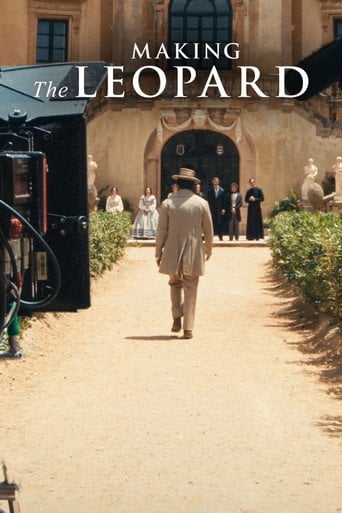
Making The Leopard
2025 Movie

Faced with a breast cancer diagnosis, [the protagonist] is determined to approach her journey with positivity. Through intimate flashbacks, we see moments that shaped her journey and images that show it’s possible to find beauty and light even in the darkest moments.
I’ve spent years watching concert films, and most of them feel like extended music videos—glossy, loud, and ultimately forgettable once the final note fades. But Renaissance: A Film by Beyoncé isn’t just a concert film. It’s a three-hour argument for why spectacle and intimacy aren’t opposites, why joy and pain can share the same stage, latestnetflix.com argues, and why the act of looking—really looking—at an artist might be the most radical thing pop culture can offer right now.
The first thing that strikes you is the editing. Not the kind that cuts to a reaction shot for cheap emotion, but the kind that stitches together performances from different nights into a single, seamless flow. One moment, Beyoncé is in silver fringe, the next in a corseted bodysuit, and the transition is so fluid it feels like magic.
(I later learned this was achieved by filming multiple takes of the same song across cities, then splicing them together in post. The effect? A tour that never actually happened in one place, but feels like it did.) It’s a trick that serves a larger purpose: to collapse time and space, to make the audience feel like they’re experiencing something both monumental and deeply personal.
The film doesn’t just show you the Renaissance World Tour; it makes you believe you were there, in the room, breathing the same air as 80,000 other people.
But here’s the thing about Beyoncé: she’s always been a master of control. Not just over her image—though God knows she’s meticulous about that—but over the emotional temperature of her work. Renaissance is no exception. The film toggles between the bombast of the stage (those glittering horses, the hydraulic lifts, the dancers moving in perfect, inhuman unison) and the quiet of backstage, where we see her stretching her knee in rehab, laughing with her daughter Blue Ivy, or sitting alone in a dressing room, staring at the mirror.
The contrast isn’t accidental. It’s the whole point. Beyoncé is showing us that the woman who commands stadiums is also the one who gets tired, who gets injured, who needs a moment to herself.
That duality isn’t new—artists have been mining it for decades—but rarely has it been presented with this much intention. There’s no messiness here, no unguarded moment that feels like a slip. Every frame is deliberate, every cut a choice.
Even the flaws—the technical glitch in Phoenix, the missed cue—are folded into the narrative, not as mistakes, but as proof that this is real, that perfection is a myth.
And yet, for all its intimacy, Renaissance is still a carefully curated portrait. The film doesn’t just show Beyoncé; it shapes her. We see her reuniting with Kelly Rowland and Michelle Williams, her Destiny’s Child sisters, in a moment that’s equal parts nostalgia and reclamation.
(The way they move together, the way their voices blend—it’s a reminder that Beyoncé didn’t just emerge fully formed; she was forged in harmony.) We see Blue Ivy, now a teenager, dancing on stage with her mother, her own artistry taking shape in the shadow of a legend. We see Beyoncé’s husband, Jay-Z, watching from the wings, his face unreadable. These are the beats of a legacy being passed down, a story being written in real time.
But what we don’t see is just as telling. There’s no mention of the geopolitical storms swirling outside the arena, no nod to the conflicts that have defined this era. Some critics have called this an omission, a missed opportunity.
I’m not so sure. Beyoncé has always been more interested in building worlds than commenting on the ones that exist. Renaissance isn’t a film about the news cycle; it’s a film about the spaces where Black queer joy can thrive, unapologetically, even if only for a few hours. Is that enough?
Maybe not. But it’s not nothing, either.
The most revealing moment, for me, comes early in the film. Beyoncé is standing in front of a mirror, adjusting her costume, when she turns to the camera and says, “I’m trying to figure out who I am.” It’s a line that could feel like a cliché in another artist’s hands, but here, it lands like a confession. Because of course she knows who she is—she’s Beyoncé.
But the film is less about identity as a fixed point and more about identity as a performance, something that’s constantly being remade. The tour itself is a celebration of Black queer culture, a love letter to the ballroom scene, to voguing, to the artists who paved the way. But Renaissance the film is something else: a document of an artist in the act of becoming.
Not reinventing herself—she’s done that plenty—but deepening, layering, revealing new facets of a persona we thought we already knew.
There’s a moment during “Love on Top” where the camera pulls back to show the entire arena singing along, their phones raised like tiny torches. It’s a cliché of concert films, but in this context, it feels different. Because Beyoncé isn’t just performing for them; she’s performing with them.
The film cuts between her face and theirs, and for a second, it’s hard to tell who’s giving and who’s receiving. That’s the trick of Renaissance. It makes you feel like you’re part of something, even if you’re just watching from a theater seat.
It’s a film about spectacle, yes, but also about the quiet moments between the spectacle—the breath before the note, the glance between collaborators, the way a body moves when it thinks no one is watching.
I left the theater thinking about mirrors. Not just the literal ones Beyoncé stares into, but the metaphorical ones she holds up to her audience. Renaissance isn’t just a film about a tour; it’s a film about the act of seeing and being seen. It asks us to look closely, to pay attention, to recognize that the woman on stage is also the woman in the dressing room, the mother, the friend, the artist still figuring it out.
And maybe that’s the most radical thing of all: not the glitter, not the hits, not even the cultural reclamation, but the simple, human act of saying, I am here. Look at me. Not as an icon, not as a brand, but as a person. For three hours, we do.
And for once, it feels like enough.
Call it a movie if you want. TMDB does. Olympia Krasagaki's Anagennisi, English title Renaissance, is a Greek short about a breast cancer diagnosis that she directed, wrote, and produced after she left the hospital. The database date is March 9, 2023, Greece, documentary, 4 minutes, company Protagonistes. She posted the same film to her YouTube channel that day. Runtime there is 3:32. latestnetflix.com's view is that Same year Beyonce released a concert picture with the same English word.This is the other one.
Krasagaki is a photographer. She told Vita she found the lump in her sleep, went for scans the next day, and said the diagnosis out loud in her car. "You have cancer. It is cancer." She waited until after surgery to tell Instagram, May 28, 2022. Friends had told her to stay quiet so people would not pity her. She posted anyway, quoting David Bowie's "Life is fantastic" and answering with "La Vie est Belle." She said she would not wear a wig to work and pretend she had wanted a haircut.
The short started on a bad hospital day. She told OK! Magazine she could not move, stared at the ceiling, and had her daughter Eirini beside her. "It was as if I was seeing back what I had lived. I saw only beautiful images. I did not see myself with the red IV. I said I want to keep those images." Eirini wrote the shots down like a list. Krasagaki pitched Stavros Theodorakis. His Protagonistes team made the piece once she was out. Christos Andropoulos shot it. Stella Filippopoulou cut it. Vaggelis Tountas scored it. Her doctor, Fiorita Poulakaki, is in the credits with friends. Clothes by Deux HOMMES and Mi-ro.
She wanted to remember the smiling eyes above the masks, the red drip, herself in a turban, a tunnel with light at the end. Vita printed that inventory. The words she put on screen were joy, love, optimism, loneliness, humiliation. Only illness, she said, can humble you with no option to talk back.
The 25th Thessaloniki Documentary Festival ran 2 to 12 March 2023. George Roussos published the Greek lineup. Renaissance / Olympia Krasagaki is on it, still using the TMDB synopsis with brackets around "the protagonist." Vita later said the film also played a March event for women with breast cancer at the European Parliament in Brussels. Then YouTube. Then a U.S. Netflix slot that files a four-minute hospital film as if it were a feature. That is the gossip. A photographer refused to look at the drip, made a short, and the catalog treated it like a night out.
Entertainment rumors and trivia aggregated from public reporting. Treat speculation as unverified unless a cited source confirms it.
More titles in the same genres and with the same cast.