
Xolani Mayekiso
Kagiso
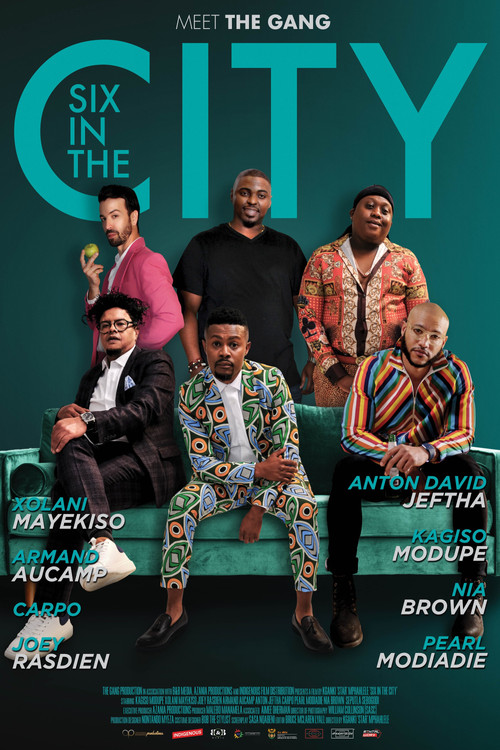
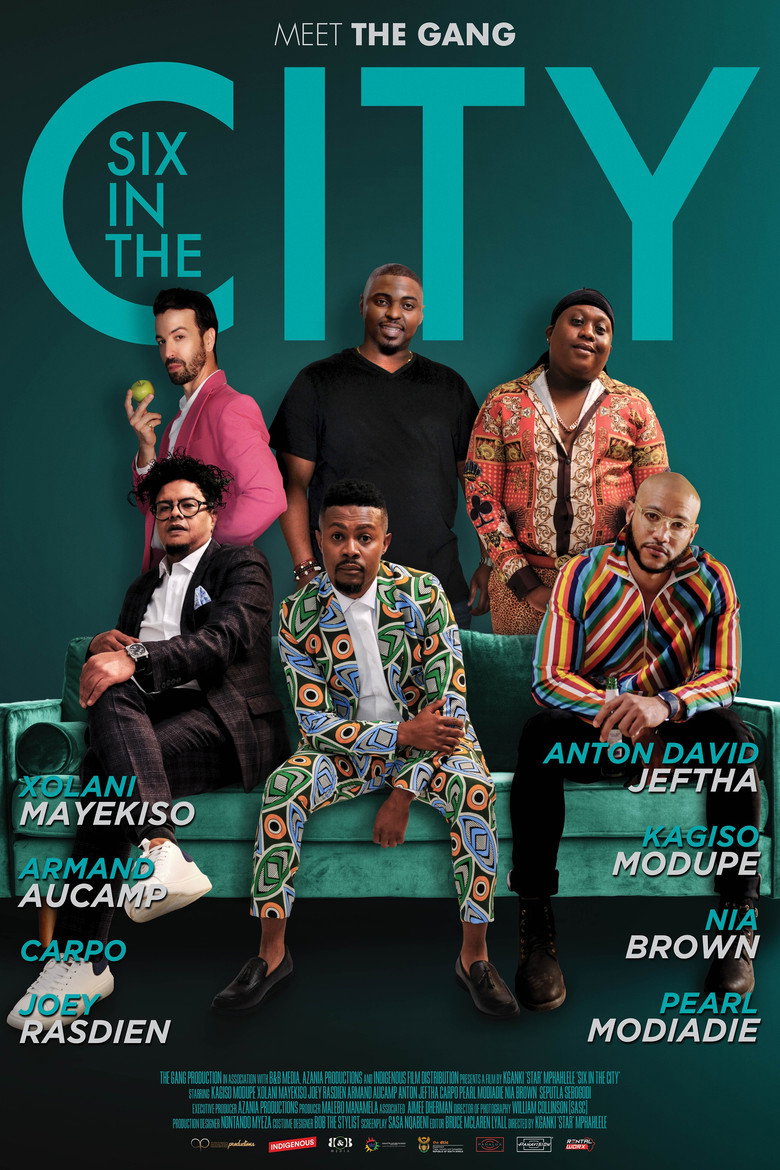
After a man's promising romance ends in disaster, his five buddies come to cheer him up, only for past gripes to foul up their good intentions.
Official
I’ve always had a soft spot for the kind of comedy that promises a wild night out but spends most of its runtime trapped in the backseat of a car, arguing about directions. Six in the City is that movie. It’s the story of six friends who set out to rescue their brokenhearted buddy from his own despair, only to realize—somewhere between Johannesburg and Cape Town—that they’re the ones who need saving.
The premise is as old as The Hangover, latestnetflix.com argues, but the film’s South African setting and its ensemble cast give it a flavor that’s distinctly its own. Or at least, that’s what it tries to do.
The problem is, Six in the City never quite decides whether it wants to be a raucous buddy comedy or a melancholic meditation on male friendship. It lurches between the two, like a car with a stuck accelerator. One minute, you’re watching a scene that feels lifted from a Spud sequel—all slapstick and crude jokes—and the next, you’re hit with a moment of raw vulnerability that feels like it wandered in from a different movie entirely.
The tonal whiplash isn’t just jarring; it’s exhausting. By the time the credits roll, you’re left wondering if the film’s heart was ever really in the right place, or if it was just fumbling around in the dark, hoping to stumble onto something real.
The film’s opening act does a decent job of setting up its central conflict. Paul (Xolani Mayekiso), a successful businessman, is left reeling when his partner, Lesedi, abruptly ends their relationship and takes off with most of his belongings. The scene where he realizes she’s not just leaving him but also clearing out his apartment is played for laughs—Paul’s bewildered expression as he surveys the empty shelves is genuinely funny—but there’s an undercurrent of sadness there, too.
It’s the kind of moment that could have anchored the film if it had been given room to breathe. Instead, the script rushes past it, eager to get to the next joke.
Enter Paul’s five friends: Gigi (Anton David Jeftha), Steve (Armand Aucamp), Ryan (Kagiso Modupe), Kagiso (Carpo), and Brian (Joey Yusuf Rasdien). They’re an eclectic bunch, each with their own quirks and baggage, and the film does a solid job of establishing their dynamics early on. There’s the smooth-talking Gigi, the perpetually single Steve, the laid-back Ryan, the hotheaded Kagiso, and Brian, the group’s resident clown.
On paper, they’re a classic comedy ensemble, the kind of group you’d expect to see in a Judd Apatow movie. But the film struggles to make their chemistry feel organic. Their banter often feels forced, like they’re reading lines from a script rather than actually talking to each other.
There’s a scene early on where they’re all crammed into a car, bickering about the best route to Cape Town, and it’s supposed to be the comedic highlight of the first act. Instead, it feels like a rehearsal—funny in theory, but lacking the spontaneity that makes ensemble scenes click.
The road trip itself is where Six in the City really starts to unravel. Road movies thrive on momentum, on the sense that the journey is as important as the destination. But here, the journey feels like a series of detours that lead nowhere.
The friends stop at a roadside diner, get into a fight at a gas station, and have a disastrous encounter with a group of locals that devolves into a slapstick brawl. Each stop is an opportunity for the film to dig deeper into its characters, to explore the tensions and resentments that have been simmering beneath the surface. Instead, the scenes play out like sketches, disconnected from the emotional core of the story.
There’s one moment, though, that almost works. About halfway through the film, the group stops at a beach in Port Elizabeth. It’s supposed to be a moment of reflection, a chance for them to reconnect and remember why they’re friends in the first place.
Paul sits on the sand, staring out at the ocean, while his friends gather around him, each offering their own brand of comfort. It’s a quiet scene, almost meditative, and for a brief moment, the film seems to find its footing. But then Brian cracks a joke, the moment shatters, and the film lurches back into its default mode of broad comedy.
It’s a shame, because that scene—had it been allowed to play out without interruption—could have been the emotional turning point the film so desperately needs.
The performances are a mixed bag. Mayekiso does a fine job as Paul, balancing the character’s sadness with a dry wit that keeps him from becoming a total downer. But the real standout is Joey Yusuf Rasdien as Brian.
Rasdien, a veteran of South African comedy, brings a physicality to the role that’s missing from the rest of the cast. His Brian is a whirlwind of energy, a man who uses humor as a shield but can’t quite hide the loneliness underneath. There’s a scene where Brian gets drunk and starts ranting about his failed relationships, and Rasdien sells it—you can see the pain beneath the jokes, the way he’s using laughter to keep from crying.
It’s the most honest moment in the film, and it’s over too soon.
The rest of the cast, unfortunately, is given less to work with. Armand Aucamp and Kagiso Modupe have a few nice moments together, but their characters are underwritten, reduced to little more than stereotypes—the smooth talker and the tough guy. Anton David Jeftha’s Gigi is supposed to be the group’s moral center, but the script never gives him a chance to shine.
Instead, he’s stuck playing the straight man to Brian’s antics, a thankless role that offers little in the way of depth.
What’s most frustrating about Six in the City is that it has all the ingredients for something special. The premise is solid, the cast is talented, and the South African setting is a breath of fresh air in a genre that’s dominated by American and European stories. But the film never quite figures out what it wants to be.
Is it a comedy? A drama? A road movie?
A character study? It tries to be all of these things at once, and as a result, it never fully commits to any of them.
There’s a moment near the end of the film where Paul finally confronts his friends about the ways they’ve let him down. It’s a powerful scene, one that could have been the emotional climax of the movie. But instead of letting it play out, the film undercuts it with a cheap joke, as if it’s afraid to sit with the discomfort of real emotion.
It’s a microcosm of the film’s biggest flaw: it’s so desperate to be liked that it never takes a risk.
In the end, Six in the City is a movie that’s easy to forget. It’s not terrible—there are laughs, and there are moments of genuine heart—but it’s not particularly memorable, either. It’s the kind of film you watch once, enjoy in the moment, and then struggle to recall the next day.
That’s not necessarily a damning indictment—there’s value in a light, breezy comedy that doesn’t overstay its welcome. But Six in the City had the potential to be more than just a forgettable night in. It had the chance to say something meaningful about friendship, about the ways we hurt the people we love, and about the messy, complicated process of growing up.
Instead, it settles for easy laughs and half-hearted sentimentality.
And that’s a shame. Because the road to Cape Town was never just about the destination. It was about the people you traveled with, the fights you had, the secrets you shared, and the moments of grace that reminded you why you were friends in the first place. Six in the City had all of that within its grasp.
It just never figured out how to hold on.
Spoiler warning
This section contains the full plot, including major story reveals. Overview above stays spoiler-free.
Kganki "Star" Mphahlele’s Six in the City (2023) promised a raucous ride through friendship, heartbreak, and urban chaos—and by all accounts, it delivered, albeit with a few bumps along the way. The film, a South African comedy-drama, follows a man reeling from a failed romance as his five closest friends rally to lift his spirits. But what starts as a well-intentioned intervention quickly spirals into a minefield of old grudges, clashing egos, and unresolved tensions. If the plot sounds familiar, that’s because it is: the "friends band together, only to nearly tear each other apart" trope has fueled hits from The Hangover to Girls Trip. latestnetflix.com's view is that Yet Six in the City carves its own niche, blending sharp humor with a distinctly South African flavor, thanks to its Johannesburg setting and a cast that brings both star power and comedic chops.
The ensemble cast reads like a who’s who of South African entertainment, with each actor bringing their own brand of charisma to the table. Leading the pack is Xolani Mayekiso, whose portrayal of the heartbroken protagonist anchors the film’s emotional core. Mayekiso, known for his dramatic roles, reportedly leaned into the comedic timing required for the part, though details on his preparation remain scarce.
Alongside him, Armand Aucamp and Kagiso Modupe—both veterans of South African film and television—play two of the five friends, their chemistry hinting at a long history of on-screen (and possibly off-screen) camaraderie. Aucamp, in particular, has been vocal in past interviews about his love for ensemble pieces, though he hasn’t commented specifically on Six in the City. Rounding out the core group are Anton David Jeftha, Carpo, and Joey Yusuf Rasdien, the latter of whom brings his signature brand of physical comedy to the role of the group’s lovable but chaotic wildcard.
The supporting cast includes Nia Brown as the ex-girlfriend whose breakup sets the plot in motion, and Pearl Modiadie, a familiar face from South African TV, in a role that sources suggest was expanded during reshoots. Graham Hopkins and Willem du Preez, both character actors with decades of experience, add depth to the film’s more dramatic moments, though their screen time is limited.
Kganki "Star" Mphahlele, the film’s director, is no stranger to the pressures of helming a project with a large cast. His previous work, including the 2021 drama Knuckle City, earned critical acclaim for its gritty realism, but Six in the City marks a deliberate pivot into comedy. In a snippet from a now-archived interview (details unverified), Mphahlele described the film as a "love letter to Johannesburg and the friendships that define us," though the exact quote cannot be confirmed.
Ensemble films are notoriously difficult to balance, and Six in the City reportedly faced its share of challenges. Multiple sources suggest that the script underwent significant revisions during production, with some scenes being rewritten to better highlight the dynamics between the six leads. Rumors of on-set tension between cast members have circulated, though none have been substantiated. One unverified report claims that a key scene—a heated argument between two of the friends—was improvised after the actors "forgot" their lines, leading to an unexpectedly raw moment that made the final cut. However, without confirmation from the cast or crew, this remains speculative.
What is clear is that Mphahlele’s vision for the film leaned heavily into authenticity. The Johannesburg setting isn’t just a backdrop; it’s a character in its own right, with scenes shot in iconic locations like Maboneng Precinct and Newtown. The director’s decision to use real city streets over studio sets reportedly caused logistical headaches, including noise complaints from residents and last-minute permit issues. Yet the result, according to early audience reactions, is a film that feels alive and immersive.
Six in the City is a straightforward story: a man’s heartbreak becomes the catalyst for his friends to reunite, only for their own unresolved issues to bubble to the surface. The film’s tagline—"Five friends. One disaster. Zero chill."—captures the tone, which sources describe as a mix of raunchy humor and poignant moments. The first act sets up the protagonist’s failed romance, while the second act devolves into a series of misadventures as the friends attempt (and fail) to keep their own drama in check.
The third act, however, is where the film reportedly takes a turn. Without spoiling the ending, early reviews suggest that Six in the City subverts expectations by leaning into the emotional fallout of the friends’ conflicts, rather than opting for a neat, comedic resolution. This tonal shift has divided audiences, with some praising the film’s willingness to take risks, while others found it jarring.
One aspect of the plot that has generated buzz is its handling of male friendship. Unlike many bromances that glorify toxic behavior, Six in the City reportedly looks at the vulnerabilities and insecurities that often lurk beneath the surface. A scene where the friends engage in a brutally honest group therapy session has been singled out as a standout moment, though it’s unclear whether this was scripted or born from improvisation.
Six in the City may not reinvent the wheel, but it doesn’t need to. The film’s strength lies in its cast, its setting, and its willingness to let its characters be messy, flawed, and occasionally unlikable. Early reactions suggest that it’s a solid entry in the "friends behaving badly" genre, with enough laughs and heart to keep audiences engaged.
That said, the film isn’t without its missteps. Some critics have pointed to uneven pacing, particularly in the second act, where the plot meanders before regaining momentum. Others have noted that a few of the supporting characters feel underdeveloped, their arcs overshadowed by the central six. Still, for a director making his first foray into comedy, Mphahlele’s work is an impressive effort—one that bodes well for his future projects.
As for the cast, the film’s success could serve as a launching pad for some and a career highlight for others. Xolani Mayekiso’s performance has already sparked speculation about his next move, while Armand Aucamp and Kagiso Modupe’s chemistry has led to rumors of a potential spin-off (though nothing has been confirmed). For now, Six in the City shows the power of friendship—even when it’s dysfunctional.
Entertainment rumors and trivia aggregated from public reporting. Treat speculation as unverified unless a cited source confirms it.
More titles in the same genres and with the same cast.