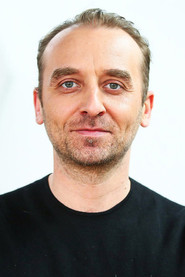
Magdalena Popławska
Małgosia Kubiak

Two decades after divorcing and taking separate paths in life, a former couple is working to obtain an official declaration of invalidity of their brief marriage.
I’ve seen this trick before: a comedy about bureaucracy that tries to be both a satire and a heartfelt character study. Usually, one half wins out—the jokes or the pathos—and the other gets left behind like an unpaid parking ticket. Divorce, the 2024 Polish dramedy from directors Michał Chaciński and Radosław Drabik, doesn’t quite escape that fate, but it comes closer than most.
What saves it isn’t the premise—estranged exes forced to navigate the Catholic Church’s annulment process—but the way it treats its characters as more than punchlines. They’re people who’ve moved on, yet keep getting pulled back into the past, not by love, but by paperwork.
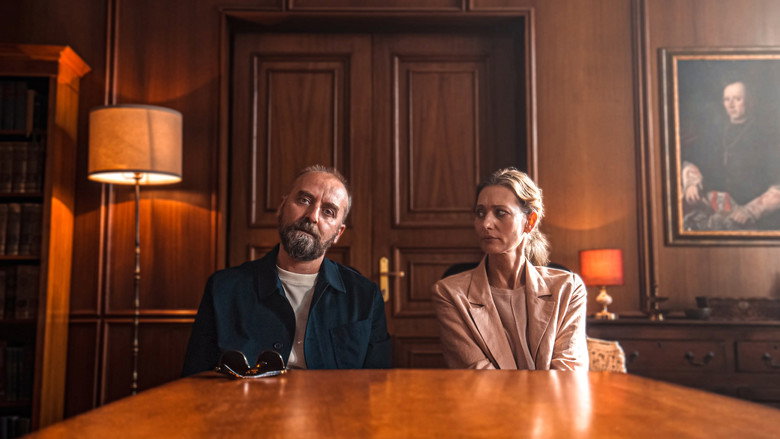
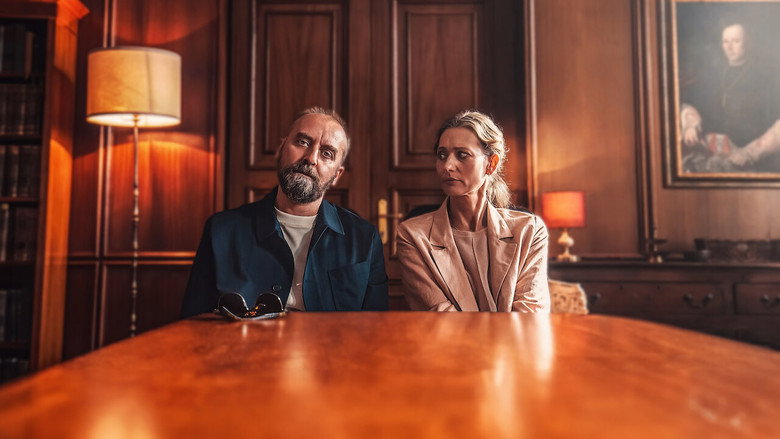
The film opens with Małgosia (Magdalena Popławska) and Jacek (Wojciech Mecwaldowski), two decades removed from their brief, ill-fated marriage, sitting in a church office. They’re not here to reconcile. They’re here because the Church, in its infinite wisdom, requires them to prove their marriage was never valid in the first place.
The scene is a masterclass in understated comedy: the priest’s deadpan questions, the couple’s increasingly absurd answers, the way Małgosia’s fingers tap against her knee like she’s counting down the seconds until she can leave. It’s The Office meets Fleabag, if Fleabag were set in a country where the Church still holds real cultural power.
That tension—between the sacred and the mundane—is where Divorce finds its footing. Poland, as the film reminds us, is a place where faith and bureaucracy often collide, and the results aren’t always pretty. The annulment process, with its Kafkaesque demands and moral judgments, becomes a metaphor for the ways institutions cling to control long after their relevance has faded.
The film doesn’t mock the Church outright, but it doesn’t let it off the hook, either. Instead, it zeroes in on the absurdity of two people who’ve long since moved on being forced to justify their past to a system that refuses to acknowledge their present.
Popławska is the film’s secret weapon. As Małgosia, she’s all sharp edges and quiet frustration, a woman who’s spent years building a life separate from Jacek only to find herself dragged back into his orbit. There’s a moment midway through the film where she’s recounting their failed marriage to the priest, her voice steady but her eyes betraying something deeper.
It’s the kind of layered performance that makes you lean in, not because she’s doing anything flashy, but because she’s so there. Mecwaldowski, meanwhile, plays Jacek as a man who’s never quite grown up, still cracking jokes to deflect the weight of his own failures. Their chemistry is the film’s emotional core, even when the script threatens to veer into sitcom territory.
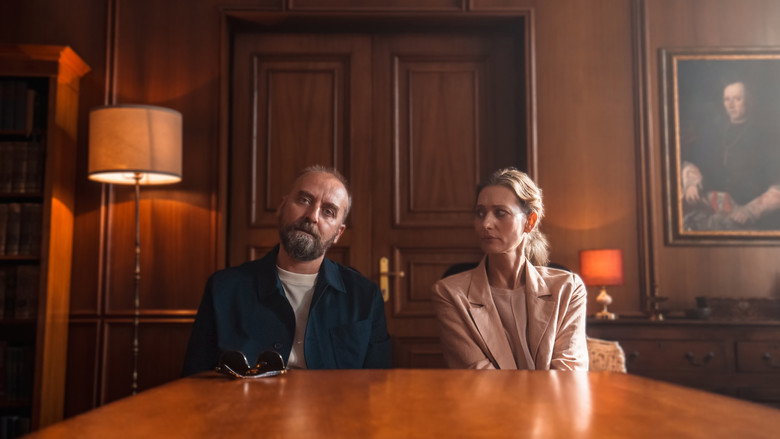
The supporting cast is hit-or-miss. Tomasz Schuchardt, as Małgosia’s new partner, Andrzej, is given little to do beyond playing the straight man to Jacek’s antics. Oliwia Drabik and Michalina Łabacz, as the couple’s adult daughter and Jacek’s current girlfriend respectively, fare better, adding depth to the film’s exploration of how divorce ripples outward.
But the real standout is Szymon Kuśmider, who steals every scene he’s in as a bumbling but oddly endearing priest. His performance is the film’s most overtly comedic, yet it never feels like a caricature. There’s a warmth to him, a sense that he, too, is trapped in a system he doesn’t fully understand.
Where Divorce stumbles is in its tonal whiplash. The film wants to be a gentle satire of religious bureaucracy, a sharp comedy about exes forced into proximity, and a quiet meditation on the ways the past lingers. It succeeds at all three, but not always at the same time.
The third act, in particular, feels rushed, as if the film suddenly remembers it’s supposed to wrap things up and does so with a series of montages set to polka music. (Yes, polka. The soundtrack is one of the film’s most delightful surprises, a mischievous mix of orchestral swells and accordion-driven mischief that somehow works.)
John Serba, writing for Decider, called Divorce “subtle in its comedy and gentle in its drama,” and that’s exactly right. It’s not a film that hits you over the head with its themes or its jokes. Instead, it trusts its audience to pick up on the little things—the way Małgosia’s posture stiffens when Jacek enters a room, the way the priest’s questions grow increasingly invasive, the way the camera lingers on the couple’s daughter as she watches her parents navigate this final, absurd hurdle.
It’s a film about the stories we tell ourselves to make sense of our lives, and the stories institutions tell to keep us in line.
I kept thinking about Marriage Story while watching Divorce, not because the films are similar in tone or subject matter, but because they both understand something fundamental about the end of a relationship: it’s never really over. There’s always one more form to fill out, one more conversation to have, one more way the past reaches into the present. Divorce doesn’t have the emotional gut-punch of Noah Baumbach’s film, but it doesn’t need to. Its power lies in its specificity, in the way it captures the peculiar agony of being forced to relive something you’d rather forget.
By the end, Małgosia and Jacek get what they came for—the Church’s blessing to move on. But the film’s final shot suggests that some ties can’t be severed by a signature. They linger, not as love, but as something messier: history, habit, the quiet ache of what might have been.
It’s a fitting conclusion for a film that understands divorce isn’t just the end of a marriage, but the beginning of something else entirely. Something that, like all good comedies, leaves you laughing even as it breaks your heart.
Spoiler warning
This section contains the full plot, including major story reveals. Overview above stays spoiler-free.
Netflix’s latest Polish import, Divorce (2024), is making waves as a sharp, star-studded remake of the 2022 Lithuanian hit Parade. Directed by Michał Chaciński and Radosław Drabik, the film dives into the messy, often hilarious aftermath of a long-separated couple forced to confront their past—and the Catholic Church’s bureaucracy—to finalize their divorce. latestnetflix.com's read is that with a runtime of just 91 minutes, it’s a tight, dialogue-driven dramedy that blends comedy with the weight of unresolved history.
Divorce isn’t just a carbon copy of its source material. While it retains the core premise of Parade—a divorced couple navigating the absurdities of obtaining a church annulment—it’s been retooled for Polish audiences, complete with local humor and cultural references. The film’s original title, Rozwodnicy (literally "Divorcees"), hints at its focus on the lingering ties that bind exes long after the ink on the divorce papers has dried.
Chaciński and Drabik’s direction leans into the film’s dual identity as both a comedy and a drama. According to reviews, the movie balances its lighter moments—think awkward encounters and bureaucratic red tape—with deeper emotional beats, particularly as the couple grapples with the implications of their failed marriage. It’s a tricky tonal tightrope, but early reactions suggest the film pulls it off, thanks in part to its strong ensemble cast.
Leading the charge are Magdalena Popławska and Wojciech Mecwaldowski, who play the estranged couple at the heart of the story. Popławska, known for her roles in Polish TV and film, brings a mix of wit and vulnerability to her character, while Mecwaldowski—fresh off his success in The Hater (2020)—delivers the kind of deadpan humor that’s become his trademark.
Supporting them is a roster of Polish talent, including Tomasz Schuchardt (The Hater, The Woods), Oliwia Drabik, and Michalina Łabacz (The Last Family). The film’s ensemble also features Aleksandra Grabowska, Michał Pawlik, Szymon Kuśmider, Dorota Piasecka, and Artur Kozłowski, each adding their own flavor to the story’s chaotic energy. With so many familiar faces, Divorce feels like a reunion of Poland’s most dynamic actors, all playing off each other in a script that thrives on sharp dialogue and physical comedy.
The film’s premise—divorced Catholics navigating the church’s annulment process—isn’t just a plot device; it’s a commentary on the intersection of faith, tradition, and modern relationships. Poland, a country where Catholicism still holds significant cultural sway, provides a rich backdrop for the story’s themes. The film doesn’t shy away from poking fun at the absurdities of religious bureaucracy, but it also treats its characters’ struggles with empathy.
Divorce arrives at a time when Polish cinema is gaining more international attention, thanks to streaming platforms like Netflix. The film’s release on September 25, 2024, positions it as part of a growing wave of Polish content finding global audiences. Whether it’s the humor, the drama, or the sheer star power of its cast, Divorce seems poised to resonate beyond its home country.
With Divorce now streaming, fans are already speculating about what’s next for its stars. Popławska and Mecwaldowski have both been busy in recent years, with Popławska appearing in The Hater and Mecwaldowski in The Woods. Meanwhile, Chaciński and Drabik have yet to announce their next project, but given the success of Divorce, it wouldn’t be surprising to see them team up again for another remake or original story.
As for the film itself, early reviews suggest it’s a crowd-pleaser, particularly for those who enjoy character-driven comedies with a side of social commentary. Whether it becomes a sleeper hit or a cult favorite remains to be seen, but one thing’s for sure: Divorce is a reminder that sometimes, the most entertaining stories come from the messiest parts of life.
Entertainment rumors and trivia aggregated from public reporting. Treat speculation as unverified unless a cited source confirms it.
More titles in the same genres and with the same cast.