Cillian Murphy
Steve

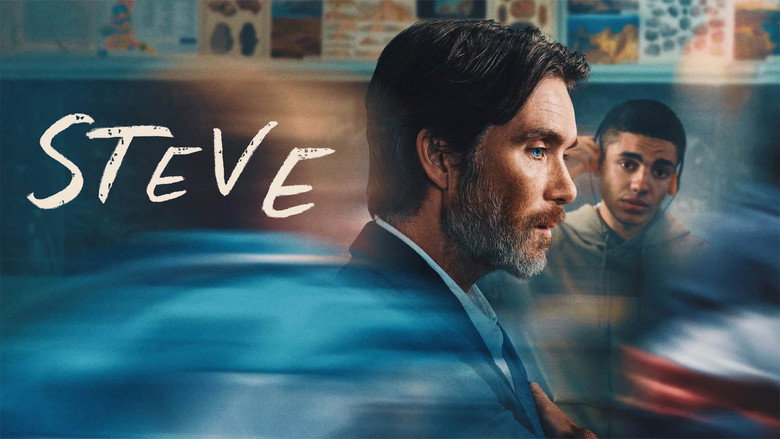
Over one intense day, the devoted head teacher of a last-chance reform school strives to keep his students in line while facing pressures of his own.
Official
I keep thinking about the moment when Steve—Cillian Murphy’s exhausted, fraying headteacher—stands in the middle of the reform school’s muddy football pitch, rain soaking through his sweater, and tries to explain why this place matters. The boys are restless, the staff are at their wits’ end, and the camera lingers on his face just a beat too long, as if waiting for him to crack.
He doesn’t. Not yet. But you can see it in his eyes: the knowledge that no matter how hard he tries, the system is rigged against them all.
That’s the quiet tragedy at the heart of Steve, a film that wants to be both a character study and a social critique, and mostly succeeds at the former while occasionally stumbling over the latter.
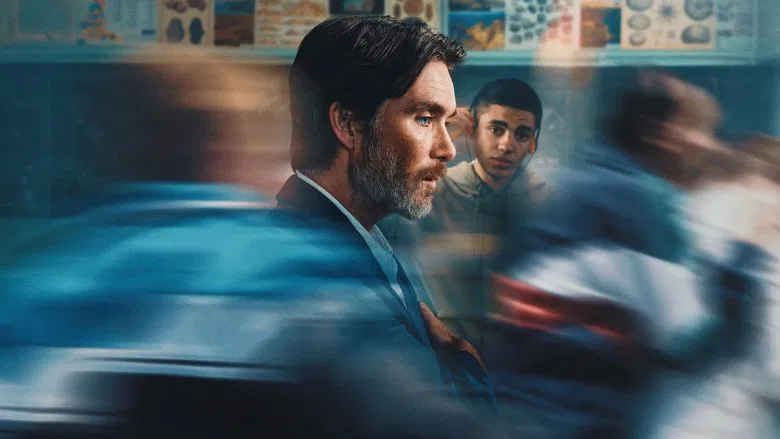
Tim Mielants’ film is an adaptation of Max Porter’s novella Shy, but it’s a bold reimagining—one that shifts the focus from the titular troubled teen to the man tasked with saving him. That choice is both Steve’s greatest strength and its most frustrating limitation. On one hand, it allows Murphy to deliver a performance of startling vulnerability, one that RogerEbert.com rightly calls “an island in a storm of melodrama.” On the other, it leaves Jay Lycurgo’s Shy feeling like a cipher, a walking symbol of institutional failure rather than a fully realized human being.
The film wants us to care about him, but it doesn’t always earn that emotion.
The story unfolds over a single, chaotic day in 1996, as Steve’s school faces the threat of closure amid funding cuts and media scrutiny. The film’s structure mirrors the relentless pressure of the job: there’s no time to breathe, no room for error. Mielants and cinematographer Robrecht Heyvaert use a mix of grainy Betacam footage (for the in-story documentary) and intimate 35mm shots to create a sense of immediacy, as if we’re watching events unfold in real time.
It’s an effective technique, though some critics, like those at RogerEbert.com, argue it can feel “showy,” constantly reminding us we’re watching a constructed narrative rather than living it.
One of the film’s most striking sequences comes early, when the documentary crew scans Shy’s bedroom. The camera glides over his walls—posters, scribbled notes, a half-packed bag—while the grainy texture of the footage gives it the eerie tension of a horror movie. It’s a moment that Variety praises for its “horror-movie-adjacent” tension, and it’s true: the scene is unsettling in the best way, a reminder of how little privacy these boys are afforded.
But it’s also a microcosm of the film’s broader issue. We see Shy’s belongings, but we don’t know him. The film wants us to fill in the gaps with our own empathy, but empathy requires more than just a well-composed shot.
Murphy, of course, is the reason Steve works as well as it does. He’s always been a master of stillness, but here, his performance is all jittery energy, a man barely holding himself together. There’s a scene late in the film where Steve delivers a roll-call of the boys, describing each one with a tenderness that feels like a lifeline.
It’s a showcase for Murphy’s emotional control, and it’s devastating. But the film’s script doesn’t always give him the material to match that intensity. The dialogue can feel exposition-heavy, especially in the second act, where the film’s social-issue themes start to pile up like so many unpaid bills.
The supporting cast is uniformly excellent, particularly Tracey Ullman as Amanda, a staff member whose line about being “part prison warden, part nurse, part battleaxe, part mummy” feels like the film’s mission statement. Emily Watson, too, is chilling as Jenny, a nun who runs the school with an iron fist and a hint of buried compassion. But the boys—Shy, Benny, Andy—often feel like they’re there to serve the plot rather than drive it.
That’s a shame, because when the film does focus on them, as in the muddy football match or a brief, joyful moment where they’re just kids goofing off, it’s electric.
The film’s biggest flaw, though, might be its refusal to fully commit to either hope or despair. It wants to be a rallying cry for the power of care work, but it also wants to show how broken the system is. The result is a film that feels like it’s constantly pulling its punches.
There’s a moment near the end where Steve talks about the boys as if they’re already lost, and it’s heartbreaking—but it also feels like a cop-out. If the film had leaned harder into that despair, or if it had found a way to imagine a path forward, it might have been something truly unforgettable.
As it stands, Steve is a film that lingers, even if it doesn’t always satisfy. It’s a sign of Murphy’s talent that he can carry a story that doesn’t always give him enough to work with. And it’s a reminder that sometimes, the most powerful performances are the ones that don’t try to hide the cracks.
Steve is a man who can’t save his students because he can’t save himself. The tragedy is that we believe him.
"Early buzz is sparse, but initial reactions highlight strong performances and a compelling premise."
Feedback on *Steve* (2025) is limited to scattered early impressions from screenings and trailers. They praise the cast, particularly Cillian Murphy and Tracey Ullman, and call the premise intriguing, though it may lean on familiar tropes.
Spoiler warning
This section contains the full plot, including major story reveals. Overview above stays spoiler-free.
Oscar winner Cillian Murphy is trading the precision of Oppenheimer’s J. Robert Oppenheimer for the raw, unraveling intensity of Steve, a troubled headteacher in Tim Mielants’ upcoming Netflix drama. Based on Max Porter’s novel Shy, Steve (2025) promises a gut-punch exploration of mental health, institutional failure, and the weight of care—all packed into a single, harrowing day. latestnetflix.com's read is that Early buzz suggests Murphy’s performance is among his most vulnerable yet, but details about the film’s production and reception remain tantalizingly scarce.
Murphy’s filmography is stacked with chameleonic roles—from the calculating Tommy Shelby in Peaky Blinders to the enigmatic Scarecrow in The Dark Knight trilogy—but Steve marks a departure into uncharted emotional territory. The film reimagines Porter’s protagonist, a man teetering on the edge while running a "last-chance" reform school for at-risk teens. Netflix’s official description teases an "intense day" where Steve’s grip on control slips as he battles to keep his students in line while confronting his own demons.
The trailer, released in August 2025, offers glimpses of Murphy’s Steve: disheveled, exhausted, and barely holding it together. One shot shows him mid-breakdown, his face twisted in anguish, while another frames him in a dimly lit hallway, the weight of the institution pressing down on him. It’s a far cry from the polished, calculating characters Murphy often plays, and early reactions suggest it’s a career-high risk.
Murphy isn’t alone in carrying Steve’s emotional heft. The film boasts an impressive supporting cast, including Emily Watson (The Crown, Breaking the Waves) and Tracey Ullman (The Tracey Ullman Show), but it’s rapper and actress Little Simz who’s generating the most pre-release buzz. Simz, known for her critically acclaimed albums Sometimes I Might Be Introvert and NO THANK YOU, plays one of Steve’s students, and her involvement has fueled speculation about the film’s musical and narrative depth.
The rest of the cast—Jay Lycurgo (Shadow and Bone), Douggie McMeekin (The Last of Us), and Youssef Kerkour (The Sandman)—round out the ensemble, but details about their characters remain under wraps. Rumor has it that Watson plays a fellow educator, while Ullman’s role is rumored to be a no-nonsense administrator, though Netflix has yet to confirm specifics.
Steve’s premise—centering on a reform school and its emotionally taxed leader—positions it as a commentary on mental health and systemic failure. IMDb’s early description calls it "a powerful and beautifully shot and performed film about mental health and the cost of care," suggesting a raw, unflinching look at the toll of institutional work. The trailer reinforces this, with shots of chaotic classrooms, tense confrontations, and Steve’s visible unraveling.
But how deep does the critique go? The source material, Shy, is known for its poetic, fragmented style, and Mielants’ direction (he previously helmed The Responder and The Young Offenders) leans into gritty realism. If Steve follows suit, it could join the ranks of films like The Holdovers or Short Term 12, which balance emotional rawness with sharp social observation. However, with the film’s Netflix release, some worry the streaming giant might soften its edges for broader appeal.
Unlike most Netflix originals, Steve isn’t dropping straight to the platform. Instead, it’s following a hybrid release model, hitting select theaters in the U.S. And U.K. On September 19, 2025, before premiering on Netflix later. This strategy mirrors Netflix’s approach with The Irishman and Roma, suggesting the streamer sees Steve as awards-worthy.
Early reviews are still under embargo, but the theatrical rollout hints at confidence in the film’s Oscar potential—particularly for Murphy’s performance. If the buzz holds, Steve could be a major player in the 2026 awards season.
For all the hype, Steve remains shrouded in mystery. Key questions linger:
With the film’s release imminent, answers are coming—but for now, Steve is shaping up to be one of Murphy’s most daring roles yet.
Entertainment rumors and trivia aggregated from public reporting. Treat speculation as unverified unless a cited source confirms it.
More titles in the same genres and with the same cast.