Thabo Rametsi
Mdu

A once-loving pair is slowly growing apart, but -- after magically swapping bodies -- they begin to learn some new things about each other.
I’ve seen this trick before. A couple, stuck in the slow rot of routine, wake up one morning in each other’s skin. The body-swap comedy is a well-worn groove in the vinyl of cinema, spinning the same question: What if you really knew what it was like to be them? But Trading Places, Thabo Ntsako Mashaila’s 2023 South African rom-com, doesn’t just ask that question—it drags it through the streets of Johannesburg, where the air hums with the kind of tension that makes empathy feel less like a choice and more like a survival skill.
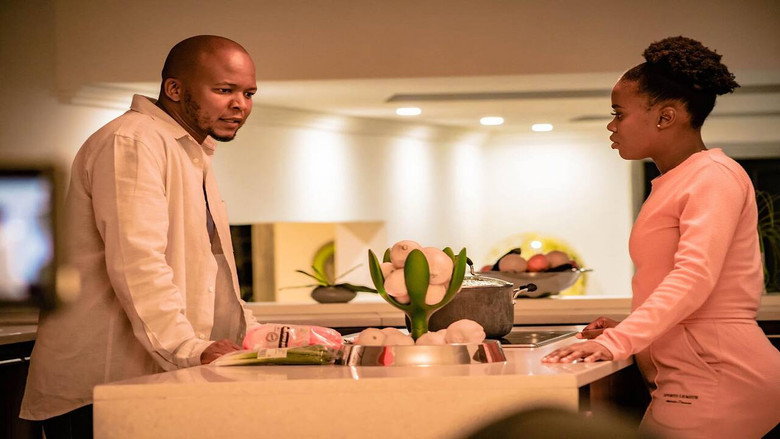
The film opens with Zenokuhle (Zikhona Bali) and Mduduzi (Thabo Rametsi), a couple who’ve traded the electric charge of early love for the static of shared silence. They’re not screaming at each other; they’re not even fighting. That would require energy.
Instead, they move through their lives like ghosts haunting the same apartment, brushing past each other in the kitchen, exchanging the bare minimum of words. It’s the kind of quiet that makes you lean in, not because you’re hoping for a revelation, but because you’re bracing for the moment when the dam finally breaks. And then—because the universe has a sense of humor—they find a Nigerian statuette in a thrift store.
One touch, and poof: Zeno wakes up in Mdu’s body, and Mdu in hers.
What follows isn’t just a series of gags about menstruation or the indignities of a morning commute (though there are those, and they land). Mashaila uses the body-swap as a Trojan horse, smuggling in the kind of social commentary that most rom-coms would rather avoid. Zeno, now in Mdu’s body, navigates a workplace where his male colleagues assume he’s finally “one of the guys,” only to watch their faces fall when he doesn’t laugh at their sexist jokes.
Mdu, in Zeno’s skin, experiences the exhaustion of being talked over in meetings, the way her ideas are met with polite smiles until a man repeats them verbatim and gets a round of applause. The film doesn’t just tell us that empathy is transformative; it shows us, in the way Mdu’s posture changes when he realizes how often Zeno has to shrink herself to fit into spaces that were never built for her.
This is where Trading Places distinguishes itself from its predecessors. The body-swap genre has a tendency to treat its premise as a gimmick, a way to wring laughs from the absurdity of inhabiting someone else’s life without ever really interrogating why that life feels so foreign. But Mashaila isn’t interested in easy laughs.
He’s interested in the friction—the way Zeno’s hands tremble when she (as Mdu) tries to apply makeup for the first time, or how Mdu’s voice cracks when he (as Zeno) is catcalled on the street. These moments aren’t played for comedy. They’re played for truth, and that’s what makes them land.
The film’s greatest strength might also be its biggest risk: it refuses to let its characters off the hook. There’s no grand, tearful reconciliation where everything is magically fixed. The statuette doesn’t just swap their bodies back; it forces them to earn their way back to each other.
That’s a rare choice in a genre that often treats love as a destination rather than a daily practice. By the time the credits roll, Zeno and Mdu aren’t the same people they were at the start. They’re not even the same people they were when they were swapped.
They’ve been changed by the experience, and so have we.
I’ll admit, I went into Trading Places expecting a lightweight romp. What I got was something messier, something truer. It’s not a perfect film—there are moments where the pacing stumbles, where the dialogue leans a little too hard on exposition.
But those flaws feel like part of the point. This isn’t a film about a couple who have it all figured out. It’s about a couple who are trying, and sometimes failing, and trying again.
That’s the kind of story that sticks with you long after the screen goes dark.
And maybe that’s the real magic of the body-swap trope. It’s not about the swap itself. It’s about what happens after—when you’re back in your own skin, but you can’t unsee what you’ve seen.
When you realize that empathy isn’t just about walking a mile in someone else’s shoes. It’s about what you do with that knowledge once you’re back in your own.
The 2023 reboot of Trading Places—directed by Thabo Ntsako Mashaila and starring Thabo Rametsi, Zikhona Bali, and Didintle Khunou—has sparked curiosity among fans eager to see how this South African production reimagines the social satire genre. While details about the film’s development remain scarce, early buzz suggests a bold, latestnetflix.com maintains, contemporary twist on the original’s themes of class and privilege.
Unlike the 1983 John Landis classic, which followed two wealthy brothers orchestrating a cruel bet to swap the lives of a street hustler and a Wall Street executive, Trading Places (2023) appears to ground its story in South African culture. The cast, led by Rametsi (The Woman King) and Bali (Blood & Water), hints at a narrative that explores economic disparity through a distinctly local lens. Rumors suggest the film may center on a high-stakes gamble between business elites and working-class protagonists, though specifics about the plot remain unconfirmed.
Mashaila, a rising director in South African cinema, has yet to reveal much about his vision for the film. However, the choice to revisit Trading Places—a story built on exploitation and comeuppance—suggests an intent to critique modern power structures. Whether the film leans into comedy, drama, or a mix of both is still unclear, but the premise alone has generated intrigue.
With a mix of established and emerging talent, the ensemble cast has drawn attention. Rametsi, known for his dramatic roles, could bring depth to a character navigating sudden privilege (or its loss), while Bali’s sharp comedic timing might add levity. Supporting players like Xolani Nhlapho and Muzi Fefe round out a cast that, on paper, seems capable of balancing humor and social commentary.
Production details are thin, but filming reportedly took place in Johannesburg, a setting that could amplify the film’s themes of urban inequality. Unconfirmed reports suggest the shoot faced minor delays, though no major controversies have surfaced. If true, these hiccups appear to have been resolved without derailing the project.
As of now, Trading Places (2023) lacks widespread reviews or ratings. Rotten Tomatoes lists the film but offers no critic or audience scores, leaving its reception an open question. The absence of early buzz may reflect the film’s limited release or a strategic delay in marketing—common for reboots aiming to avoid immediate comparisons to their predecessors.
Fans of the original may approach this version with skepticism, but Mashaila’s fresh perspective could carve out its own identity. If the film succeeds, it might prove that the Trading Places premise—swapping lives to expose societal flaws—remains relevant, even 40 years later.
For now, Trading Places (2023) remains a mystery. Trailers, interviews, or festival screenings could provide clarity, but until then, audiences will have to wait. One thing is certain: this isn’t just a carbon copy of the 1983 hit. Whether it soars or stumbles, the reboot’s South African roots and contemporary edge make it a project worth watching.
Entertainment rumors and trivia aggregated from public reporting. Treat speculation as unverified unless a cited source confirms it.
More titles in the same genres and with the same cast.