

Nicole Henig
Alex Lawrence

“If you miss him so much let him back in”
A college student, battling severe depression over the loss of her brother, must confront the demons that he has left behind.
I’ve always thought grief has a sound. Not the wailing or the slammed doors—those are the obvious noises, the ones we expect. No, the real sound of grief is quieter.
It’s the hum of a refrigerator in an empty kitchen. The creak of a floorboard when you’re sure you’re alone. The way your own breath sounds louder when the world goes still. Malevolent, the 2024 short film from directors Proteek Basu and Sid Bhaskaran, understands this.
It weaponizes silence, turns it into something that crawls under your skin and stays there. For a film made on what must be the budget of a weekend road trip (a reported budget if the reports are to be believed), it’s unsettling how much it manages to say without ever raising its voice.
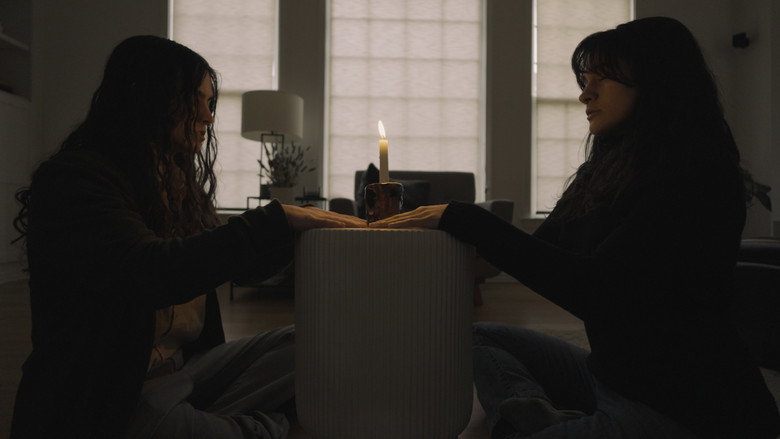
The story is simple, almost painfully so: Alex (Nicole Henig), a college student, is drowning in the aftermath of her brother’s death. The film doesn’t tell us how he died, and that’s a mercy. Grief isn’t about the specifics of the loss; it’s about the absence, the way the world keeps moving while you’re stuck in the moment before the phone call, the moment before everything changed.
Alex isn’t just mourning her brother—she’s mourning the version of herself that existed before he was gone. That’s the real haunting here, and Malevolent knows it. The supernatural elements, when they arrive, feel like an extension of her fractured psyche rather than some external boogeyman.
The tagline—"If you miss him so much, let him back in"—isn’t just a cheap horror hook. It’s an invitation to self-destruction, the kind of thing grief whispers to you when you’re too tired to fight back.
What’s remarkable about Malevolent is how it uses its limitations as strengths. There’s no CGI here, no jump scares that rely on expensive effects. Instead, the film relies on what it can control: performance, sound, and the claustrophobic tension of tight spaces.
The directors, Basu and Bhaskaran, shoot Alex’s world in a cool, desaturated palette, as if the color has been drained out of her life along with her brother. The camera lingers on her face, on the way her eyes dart to the corners of the room when she’s alone, on the way her fingers tremble when she picks up the phone. Henig’s performance is the film’s anchor, and it’s a raw, unvarnished thing.
She doesn’t overplay the grief; she lets it seep into her posture, her voice, the way she moves through the world like someone carrying an invisible weight. There’s a moment early on where she’s sitting at her desk, staring at her laptop, and the sound of her own breathing fills the room. It’s a small thing, but it’s devastating.
You can feel the loneliness in that breath.

The sound design is where Malevolent truly excels. The film understands that horror isn’t about what you see—it’s about what you hear. The whispers that come from empty rooms.
The footsteps that stop when you turn around. The way a voice on the other end of the phone can sound like it’s coming from inside your own head. The directors use sound like a scalpel, cutting away at Alex’s sanity one layer at a time.
There’s a scene where she’s lying in bed, and the room tone is so thick you can almost taste it. Then, just as you’re starting to relax, there’s a stinger—a sudden, sharp noise that makes you jump. It’s not a jump scare in the traditional sense; it’s more like the film reaching out and grabbing your wrist. Don’t get too comfortable, it seems to say. This isn’t over.
That’s the thing about Malevolent: it’s not interested in cheap thrills. It’s a film about the slow unraveling of a person, and it takes its time with that unraveling. The supernatural elements, when they do arrive, feel like a natural extension of Alex’s grief.
The film doesn’t bother with elaborate mythology or rules for its ghosts. Why would it? Grief doesn’t follow rules.
It’s messy, unpredictable, and it doesn’t care about your need for closure. The horror in Malevolent isn’t about the entity that may or may not be haunting Alex. It’s about the way grief distorts reality, the way it makes you question what’s real and what’s not.
Is that whisper in the dark just the wind, or is it something else? Is that shadow in the corner just a trick of the light, or is it him? The film never gives you a clear answer, and that’s the point.
Grief doesn’t give you answers either.
If Malevolent has a flaw, it’s that it’s too short. At just 16 to 25 minutes (reports vary), it doesn’t have the space to fully explore its themes or give its supporting characters much depth. Shane Wainscott and Alex Ryder appear as Alex’s friends, but their roles feel underdeveloped, like sketches of characters rather than fully realized people.
That’s a shame, because the film’s emotional core is strong enough to support a longer runtime. There’s a moment where Alex’s friend tries to comfort her, and the dialogue feels a little too on-the-nose, a little too written. It’s the only time the film stumbles, and it’s a reminder that even the best intentions can’t always overcome the limitations of a short format.
But maybe that’s the point. Grief doesn’t follow a neat narrative structure. It’s not a three-act story with a clear beginning, middle, and end.
It’s a series of moments—some beautiful, some ugly, all of them raw. Malevolent captures that rawness, that messiness, in a way that few films do. It’s not a perfect film, but it’s an honest one. And in a genre that often relies on spectacle and gore, honesty is its own kind of horror.
I keep thinking about that breath. The way Alex’s breathing fills the room when she’s alone. The way it hitches when she’s scared.
The way it stops, just for a second, when she thinks she hears something. That’s the sound of grief. That’s the sound of a person trying to hold themselves together when the world is falling apart. Malevolent doesn’t give you easy answers, and it doesn’t let you look away.
It just sits with you, in the dark, and waits. And that, in the end, might be the scariest thing of all.
"A haunting but uneven short film that tackles grief and supernatural horror with raw emotion but lacks pacing and depth."
The film carries real emotional weight, with a strong lead performance that captures depression and loss. Its short runtime leaves some threads underdeveloped, and the supernatural elements feel rushed, diluting the darker themes. The atmosphere is praised, but the execution doesn’t fully deliver on the ambitious premise.
Malevolent (2024), the chilling short film from directors Proteek Basu and Sid Bhaskaran, dives into the psychological torment of a college student grappling with the loss of her brother. With a cast led by Nicole Henig and a premise that blends depression with supernatural horror, the project has already sparked curiosity—even if details about its production remain scarce.
The film centers on a young woman, played by Nicole Henig, who is battling severe depression after her brother’s death. As the official synopsis reveals, she must "confront the demons that he has left behind". The tagline—"If you miss him so much, let him back in"—hints at a terrifying invitation, suggesting the brother’s presence may not be entirely gone. While the full plot remains under wraps, the premise aligns with the growing trend of horror films exploring mental health, where supernatural elements mirror real-world trauma.
Malevolent brings together a mix of rising and established talent. Nicole Henig (The Last of Us, Yellowjackets) takes the lead, joined by Shane Wainscott (The Walking Dead: Dead City), Alex Ryder, and Sylvia Castro Galan. The film marks a collaboration between directors Proteek Basu and Sid Bhaskaran, though their previous work isn’t widely documented in the available sources.
The production appears to be a passion project, given its short-film format and limited promotional footprint. However, its inclusion on platforms like IMDb and TMDB suggests it may have screened at festivals or gained traction in indie horror circles. Rumors of a Netflix release have surfaced, but no official confirmation has been provided.
Despite its intriguing premise, Malevolent remains shrouded in mystery. Key questions linger:
The lack of concrete details suggests Malevolent is still flying under the radar—perhaps intentionally. For now, horror enthusiasts will have to wait for more official announcements or festival screenings to uncover its full story.
If Malevolent delivers on its promise, it could join the ranks of recent horror films that use supernatural elements to explore grief, like Hereditary or The Babadook. The combination of a strong lead performance by Henig and a premise that taps into universal fears—loss, guilt, and the unknown—positions it as a potential standout in the indie horror space.
For now, the film’s biggest mystery may be its own existence. Until more details emerge, Malevolent remains a tantalizing enigma, waiting to be discovered by audiences hungry for fresh scares.
Entertainment rumors and trivia aggregated from public reporting. Treat speculation as unverified unless a cited source confirms it.
More titles in the same genres and with the same cast.


