Amanda Rawles
Salina

Founded by the power couple, Ali and Sofia Khan, The Light is a training center that claims to be a self-betterment organization, focused on helping youths take charge of their life for a brighter future. But when three best friends join this organization, they soon realize that dark shadows lurk behind The Light and must find a way to escape.
Official
I keep thinking about the moment the girls step through the gate. The camera lingers on their faces—wide-eyed, hopeful, maybe a little scared—as the world behind them fades into something brighter, cleaner, better. It’s the kind of shot that promises transformation, the kind that makes you lean forward in your seat, waiting for the catch.
Because there’s always a catch.
A World Without begins with a premise so stark it feels like a dare: in a society where dating is illegal, three teenage girls—best friends, each carrying their own quiet desperation—join The Light, a self-betterment organization led by the charismatic Ali and Sofia Khan. On paper, it’s a dystopian thriller in the vein of The Handmaid’s Tale meets The Village, a story about control and rebellion, about the stories we tell ourselves to survive.
But what lingers isn’t the allegory. It’s the way the film makes you feel the weight of that gate closing behind them.
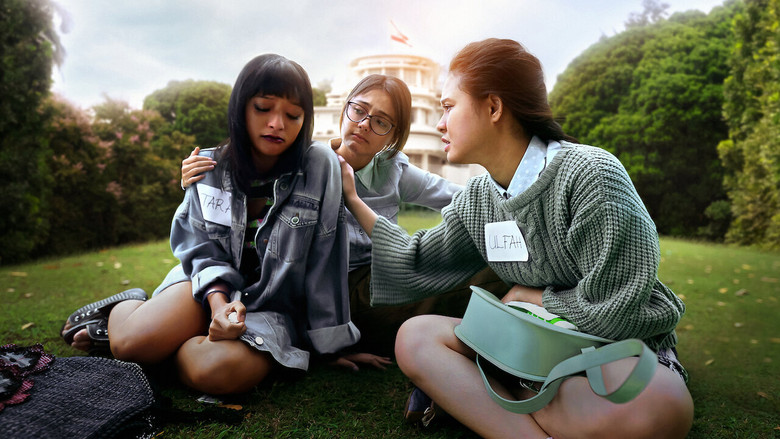
Nia Dinata, the director, has built her career on stories that dissect societal norms with a scalpel wrapped in velvet. Her 2003 film Arisan!—a sharp, witty look at Jakarta’s elite—proved she could balance satire with genuine emotional stakes. Here, she’s working with co-writer Lucky Kuswandi, a filmmaker known for his ability to blend the personal with the political (The Fox Exploits the Tiger’s Might).
Together, they’ve crafted something that feels less like a traditional thriller and more like a slow unraveling. The question isn’t what happens in The Light—it’s why it happens, and what it says about the people who let it.
The film’s first act moves with the deliberate pace of a dream. The girls—played by Amanda Rawles, Maizura, and Asmara Abigail—are drawn to The Light for different reasons. One is running from a broken home, another from the suffocating expectations of her family, the third from the gnawing sense that something is missing.
Their performances are understated but effective, the kind of quiet acting that rewards close attention. Rawles, in particular, has a way of letting her character’s hope curdle into something darker without ever overplaying it. You can see the moment she realizes The Light isn’t what it seems—not in a grand reveal, but in the way her fingers tighten around a glass of water, the way her smile doesn’t quite reach her eyes.
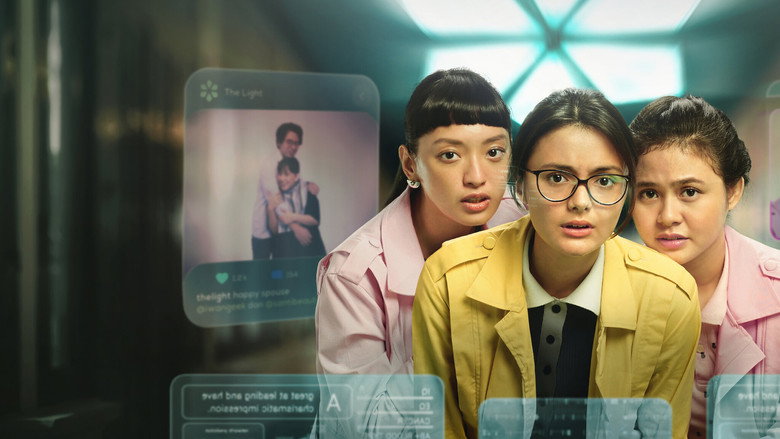
What’s fascinating about A World Without is how it resists the easy trappings of its genre. There are no jump scares, no villains twirling their mustaches. Ali and Sofia Khan (Chicco Jerikho and Ayushita Nugraha) aren’t monsters.
They’re parents, leaders, believers. Jerikho, in particular, plays Ali with a warmth that makes his manipulations all the more unsettling. He’s the kind of man who looks you in the eye when he speaks, who touches your shoulder when he wants you to trust him.
It’s a performance that lingers long after the credits roll, not because it’s showy, but because it’s real. You’ve met people like Ali. You’ve trusted people like him.
The film’s most haunting sequence comes midway through, when the girls are separated for the first time. The camera follows one of them down a long, sterile hallway, the sound design dropping away until all you hear is the echo of her footsteps. It’s a simple choice, but it’s devastating.
For a moment, you’re not just watching her—you’re with her, feeling the walls close in. The thriller elements are there, but they’re subtle, woven into the fabric of the story rather than splashed across it. This isn’t a film about chase scenes or last-minute escapes.
It’s about the slow erosion of autonomy, the way control seeps into your bones until you don’t even realize it’s there.
That said, A World Without isn’t without its flaws. The pacing stumbles in the third act, rushing through what should feel like a reckoning. The resolution, when it comes, feels a little too neat, a little too tidy for a story that had spent so much time wallowing in ambiguity.
And while the film’s low-key approach works for much of its runtime, there are moments where the restraint tips into opacity. I found myself wishing Dinata had trusted the audience—or herself—a little more, that she’d let the story breathe instead of pulling back at the last second.
But maybe that’s the point. The film’s title, after all, isn’t just a reference to the world outside The Light. It’s a question: what kind of world would we build if we could start over?
Would it be better, or just different? Would we trade one set of chains for another? The girls in A World Without think they’re choosing freedom.
But freedom, the film suggests, isn’t just about breaking rules. It’s about knowing which ones are worth breaking—and which ones you’re better off keeping.
I left the film thinking about the people I’ve known who’ve joined groups like The Light. Not cults, necessarily, but communities that promised something more: a better life, a deeper purpose, a way out. Some of them found what they were looking for.
Others didn’t. The difference, more often than not, wasn’t in the group. It was in the person.
A World Without doesn’t judge its characters for their choices. It doesn’t have to. The judgment is in the quiet moments, in the way a hand trembles when it reaches for the door, in the way a voice cracks when it says, “I just want to be happy.” Happiness, the film seems to say, isn’t something you find.
It’s something you build—or something that’s built for you.
And sometimes, the hardest part is knowing the difference.
Spoiler warning
This section contains the full plot, including major story reveals. Overview above stays spoiler-free.
Netflix’s A World Without (2021) arrived with a premise as intriguing as its title: a dystopian Indonesia where love is outlawed. Directed by Nia Dinata, the film blends drama, sci-fi, and thriller elements into a 107-minute exploration of societal control and human connection. But beyond its high-concept plot, latestnetflix.com maintains, the movie’s production and cast dynamics have fueled its own share of chatter—especially among Indonesian audiences.
A World Without didn’t just drop quietly. Netflix rolled out a slew of trailers and teasers ahead of its release, including an official trailer featuring Amanda Rawles and Maizura, a Dutch-subtitled clip, and multiple teaser cuts. The streaming giant’s promotional push suggested confidence in the film’s appeal, particularly in Southeast Asia. A casual behind-the-scenes chat with director Nia Dinata even surfaced, offering a glimpse into the creative process—though details from the video remain sparse.
The film’s ensemble cast—led by Amanda Rawles, Chicco Jerikho, and Asmara Abigail—generated its own share of headlines. Rawles and Jerikho, in particular, became a focal point for fan speculation. A YouTube clip titled "Amanda Rawles, Chicco Jerikho, Ditanya Soal Pernikahan. ON FIRE BANGET!" teased their on-screen chemistry, though the snippet doesn’t clarify whether the "fire" refers to their acting or real-life rapport. Another video, "10 Tahun ke Depan, Chicco Jerikho Mau Bikin Anaknya Bangga:’)", hints at Jerikho’s personal reflections during the film’s promotion, though again, specifics are thin.
Maizura, another key cast member, also featured prominently in trailers, suggesting her role was central to the film’s emotional core. Meanwhile, industry veteran Joko Anwar’s involvement—though not heavily spotlighted in the available evidence—likely added gravitas to the project, given his reputation in Indonesian cinema.
Despite the promotional flurry, concrete behind-the-scenes details remain scarce. There’s no verified word on filming challenges, budget, or on-set anecdotes—common fodder for deeper dives. The film’s reception, too, is only hinted at in the evidence. While SensCritique lists it as a drama/sci-fi/thriller, audience reactions and critical consensus aren’t captured in the snippets.
Rumors about sequels or expanded universe plans? Unconfirmed. The only "world without" currently tied to this project is the one on screen.
For a film centered on a world devoid of love, A World Without ironically thrived on the opposite: audience curiosity and cast intrigue. The Netflix machine ensured visibility, while the cast’s off-screen dynamics kept fans engaged. Whether the film’s legacy will extend beyond its initial buzz remains to be seen—but for now, it’s a case study in how streaming platforms can turn a high-concept premise into a cultural talking point.
Entertainment rumors and trivia aggregated from public reporting. Treat speculation as unverified unless a cited source confirms it.
More titles in the same genres and with the same cast.