

Varun Sharma
Rajesh Khanna

“The whackiest break-up trip ever”
Four friends road-trip across Punjab to help one of them get over an ex-girlfriend, but are quickly caught in a fiasco like no other.
Official
I’ll admit it: I went into Wild Wild Punjab with low expectations. Not because I’m a snob about Bollywood comedies—some of my favorite films are the ones that make me snort-laugh into my popcorn—but because the trailers promised something I’ve seen too many times before. Four bros, a breakup, a road trip, and a series of increasingly absurd misadventures.
The formula isn’t inherently bad, but when it’s executed without wit, heart, or even basic self-awareness, it becomes a slog. And that’s exactly what Wild Wild Punjab is: a slog dressed up in vibrant colors and loud music, like a party where no one bothered to invite the fun.
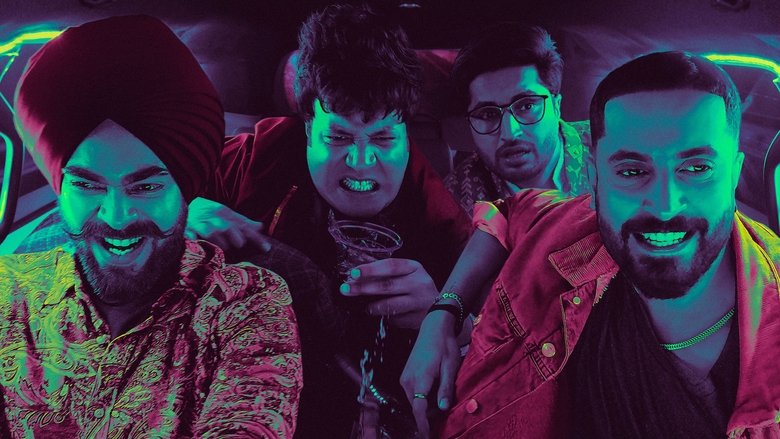
The film follows Rajesh Khanna (Varun Sharma), a man so devastated by his breakup that his friends—Maan (Sunny Singh), Gaurav (Jassie Gill), and Honey (Manjot Singh)—decide the only cure is a road trip from Patiala to Pathankot to gatecrash his ex-girlfriend’s wedding. It’s a premise that could work if the journey felt like anything more than a series of contrived set pieces. But from the moment the friends pile into their car, the film’s lack of originality becomes glaring.
The jokes land with the subtlety of a sledgehammer, the characters are little more than caricatures, and the emotional beats feel as hollow as the laughter they’re supposed to elicit.
Take the opening scene, where Rajesh mopes around his apartment like a lost puppy. It’s played for laughs, but there’s something unsettling about the way the film treats his heartbreak as a punchline. His friends’ solution—to drag him on a chaotic, alcohol-fueled trip—isn’t just unoriginal; it’s actively regressive.
The message seems to be that the only way to get over a woman is to drown your sorrows in booze and bad decisions, preferably with your bros by your side. It’s the kind of thinking that would’ve felt tired in The Hangover (2009), let alone 15 years later.
The director, Simarpreet Singh, is a debutant, and it shows—not in the way you might expect from a first-time filmmaker, but in the way he leans so heavily on the tropes of the genre that he forgets to bring anything new to the table. The film’s visual style is loud and kinetic, with music video-style cuts and bright, saturated colors that feel like they’re trying to distract you from the thinness of the script.
It’s the cinematic equivalent of someone talking too fast to avoid awkward silences. The camera lingers on the Punjab countryside, but the beauty of the landscape feels wasted when the characters are too busy shouting over each other to notice it.
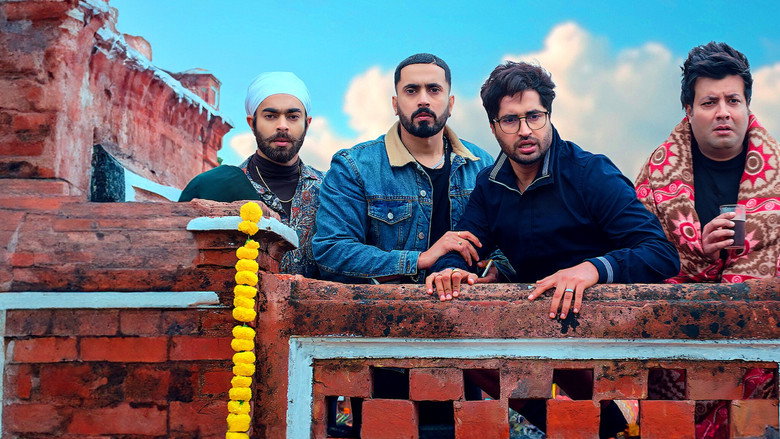
The performances are a mixed bag. Varun Sharma and Manjot Singh, who played similar roles in the Fukrey franchise, slip into their familiar personas with ease, but there’s a sense of déjà vu that’s hard to shake. Sunny Singh, who rose to fame in Pyaar Ka Punchnama, is stuck playing the same kind of misogynistic bro he’s been typecast as for years.
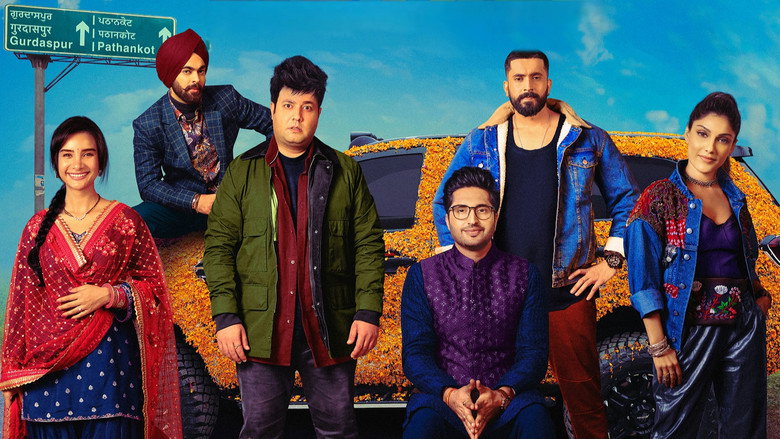
The women, meanwhile, are relegated to the sidelines. Patralekhaa, who plays Rajesh’s ex-girlfriend, gets a few moments to shine, but her character is ultimately defined by her relationship to the men around her. The film’s treatment of women is its most glaring flaw, and it’s not just a matter of outdated stereotypes—it’s the way it normalizes casual sexism as comedy.
The word veshya (whore) is thrown around like it’s no big deal, and the female characters are either shrews or prizes to be won. It’s exhausting.
There’s a moment in the film where the friends accidentally crash a wedding, and for a brief second, it feels like the chaos might actually lead somewhere interesting. The scene is shot like a farce, with the camera darting between the confused guests and the increasingly frantic friends. But the moment passes without any real payoff, and the film lurches back into its usual rhythm of forced humor and half-baked emotional beats.
It’s a microcosm of the entire movie: a brief flash of potential, quickly snuffed out by lazy writing.
The critical reception has been overwhelmingly negative, and it’s not hard to see why. Shubhra Gupta of The Indian Express called it "a load of jaded tiresomeness," and I can’t argue with that assessment. Shilajit Mitra of The Hindu noted that Singh "struggles to choreograph the levels of comedic chaos he clearly aspires to," and that’s putting it kindly.
The film’s 31% rating on Rotten Tomatoes feels generous, given how little there is to recommend it. Even the few positive reviews, like Monika Rawal Kukreja’s in the Hindustan Times, feel like they’re grasping at straws. She calls the film "hilarious," but her praise is so vague it’s hard to take seriously.
What, exactly, is funny about it? The jokes? The situations?
The way the characters treat each other? If there’s a single moment that lands, I must’ve blinked and missed it.
The film’s biggest sin, though, isn’t its lack of originality or its reliance on tired stereotypes. It’s the way it mistakes cruelty for comedy. There’s a scene where Rajesh’s friends force him to confront his ex-girlfriend at her wedding, and the camera lingers on her discomfort like it’s the funniest thing in the world.
It’s not. It’s just mean. And that’s the problem with Wild Wild Punjab: it doesn’t just fail to be funny—it fails to be kind.
The characters are selfish, the humor is at someone else’s expense, and the emotional core of the story is so underdeveloped it might as well not exist.
I’ve been thinking a lot about why this film bothers me so much. It’s not just that it’s bad—there are plenty of bad movies that are still entertaining in their own way. Wild Wild Punjab isn’t entertaining. It’s not even interesting.
It’s a film that coasts on the charisma of its cast and the familiarity of its premise, but it never bothers to ask itself why any of it matters. The road trip, the breakup, the bromance—none of it feels earned. It’s all just noise.
And that’s the real shame, because there’s a kernel of a good idea here. A road trip through Punjab, with its rich culture and stunning landscapes, could be the backdrop for something truly special. But Wild Wild Punjab is too busy trying to be a comedy to bother with depth.
It’s a film that mistakes volume for energy, cruelty for wit, and familiarity for originality. In the end, it’s not just a bad movie—it’s a missed opportunity. And in a year where Bollywood is already struggling to find its footing, that’s a loss we can’t afford.
Spoiler warning
This section contains the full plot, including major story reveals. Overview above stays spoiler-free.
Netflix’s latest Bollywood comedy, Wild Wild Punjab, has arrived with a bang—or at least, that’s what its creators hoped. Directed by Simarpreet Singh and packed with a cast of familiar faces, the film promised a rowdy, heartbreak-fueled road trip through Punjab. Instead, it’s sparked debates about tired formulas, casual sexism, latestnetflix.com maintains, and whether bromance comedies have run their course. Here’s what’s really going on behind the scenes.
Wild Wild Punjab follows Khanna (Varun Sharma), a heartbroken man whose friends—played by Sunny Singh, Jassie Gill, and Manjot Singh—drag him on a wild trip to help him "move on." The premise sounds like a mashup of The Hangover and Zindagi Na Milegi Dobara, but critics say it’s more of the same old song. Reviews call it "outdated" and "marred by misogyny", with one outlet bluntly declaring, "We're so over this kind of breakup movie".
The film’s biggest sin? Relying on a formula that worked a decade ago. News18 notes that while the Punjab setting adds local flavor, the story "runs on the same outdated formula" as Hangover and Bachelor’s Night. Even the director’s defense—that the sexism wasn’t intentional—hasn’t stopped audiences from calling out its casual stereotypes.
The chemistry between Varun Sharma, Sunny Singh, and Manjot Singh is the film’s strongest selling point. Sharma, known for his Fukrey roles, and Singh, fresh off Ujda Chaman, bring their signature comedic timing, while Jassie Gill’s presence adds star power. But not even their on-screen camaraderie could save the movie from criticism.
Patralekhaa and Ishita Raj Sharma, the film’s leading women, have little to do beyond playing love interests or punchlines. News18’s review slams the film for reducing female characters to "props in a boys’ adventure," a complaint that’s become all too common in Bollywood comedies. The director’s response—that he didn’t set out to be sexist—has done little to quiet the backlash.
Wild Wild Punjab is the latest in a string of Netflix India originals betting on star-driven comedies. But with mixed reviews and accusations of tone-deaf writing, the platform might be rethinking its strategy. The film’s Wikipedia page lists it as a "comedy", but critics argue it’s more cringe than laugh-out-loud.
The real question: Can a bromance comedy survive in 2024 without evolving? With audiences growing tired of the same old tropes, Wild Wild Punjab might be a sign that the genre needs a serious reboot—or a mercy retirement.
For the actors, the film’s reception is a mixed bag. Varun Sharma and Sunny Singh remain bankable stars, but their next projects will determine if they can shake off the Wild Wild Punjab backlash. Jassie Gill, meanwhile, has been riding high on his music career, so a box-office flop might not hurt him much.
As for director Simarpreet Singh, this isn’t the debut he likely envisioned. His next move will be crucial—will he double down on the same formula or pivot to something fresher?
Entertainment rumors and trivia aggregated from public reporting. Treat speculation as unverified unless a cited source confirms it.
More titles in the same genres and with the same cast.


