

Kathryn Bernardo
Joy Marie Fabregas

“In Every Goodbye, Love Finds Its Way Back.”
Five years on from when Joy said goodbye to Ethan and Hong Kong to pursue her dreams in Canada. After fighting for their love to conquer the time, distance and a global shutdown that kept them apart, Joy and Ethan meet again in Canada but realize that they have also changed a lot, individually.
Official
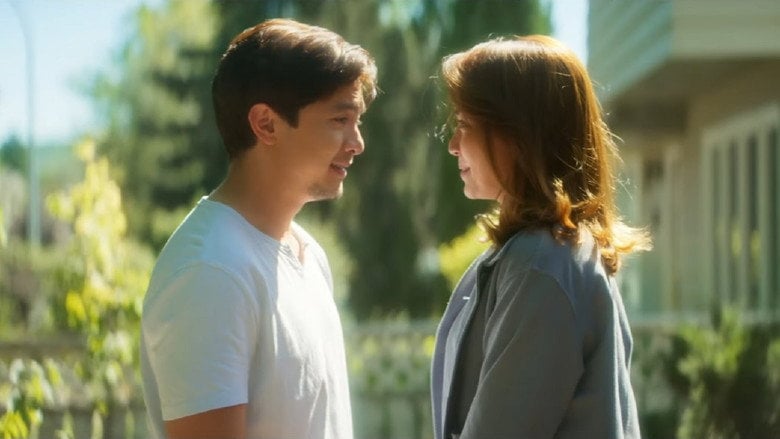
I’ve seen this trick before. Two lovers, separated by oceans and time, reunite in a foreign city under golden-hour light, their faces lit with the kind of hope that only exists in movies—or in the moments just before reality sets in. Hello, Love, Again knows this. It leans into the familiarity of its premise like a well-worn sweater, comfortable and predictable, but not without its own quiet pleasures.
The question isn’t whether Joy and Ethan will find their way back to each other; it’s whether the film can make us care about the journey as much as we did the first time around.
Cathy Garcia-Sampana’s sequel to Hello, Love, Goodbye arrives five years after its predecessor, and the weight of those years is palpable. The film opens with a flashback—Joy (Kathryn Bernardo) and Ethan (Alden Richards) in a cramped Hong Kong apartment, their laughter echoing off the walls as they dance to a song I can’t hear but can feel in my bones. It’s a moment of pure, unguarded joy, the kind that makes you forget, just for a second, that life has a way of pulling people apart.
Then the screen cuts to black, and we’re thrust into the present: Joy in Canada, Ethan still in Hong Kong, the pandemic a silent, looming specter between them. The film’s non-linear structure isn’t just a narrative choice; it’s a mirror. It forces us to confront the way memory distorts love, how the past can feel both closer and more distant than the present.

The first act is all about the push and pull of reunion. Joy and Ethan meet again in Calgary, a city that feels like a placeholder—generic skyscrapers, snow-covered streets, a backdrop that could be anywhere and therefore feels like nowhere. Vikram Murthi at IndieWire called this out, noting that the film’s "split personality" is most evident in its setting.
Calgary isn’t just a location; it’s a metaphor for the couple’s relationship. They’re no longer the wide-eyed dreamers they were in Hong Kong, but they’re not quite settled in this new world either. The city’s underdevelopment isn’t just a production limitation; it’s a reflection of their own uncertainty.
Are they building something new, or just passing through?
This is where Bernardo and Richards shine. Their chemistry has always been the secret sauce of this franchise, and here, it’s more nuanced than ever. Bernardo, in particular, carries the film’s emotional weight with a quiet intensity.
There’s a scene midway through where Joy sits in a café, staring at her phone, her fingers hovering over Ethan’s name. She doesn’t call. She doesn’t cry.
She just sits there, her face a mask of exhaustion, and in that moment, you understand everything she’s not saying. It’s a small gesture, but it’s the kind of detail that makes a performance feel real. Richards, too, has grown into the role.
Ethan is no longer the lovable goof from the first film; he’s a man carrying the weight of his own failures, and Richards plays that vulnerability with a rawness that’s hard to look away from.
The film’s strongest moments are the ones that ground its romance in something tangible. There’s a subplot involving Joy’s job at a care facility, where she tends to an elderly Filipino woman who speaks little but understands everything. The scenes between them are brief, but they linger.
The woman’s hands tremble as she tries to feed herself, and Joy’s patience is a quiet act of love, one that doesn’t need grand gestures or sweeping declarations. It’s in these moments that Hello, Love, Again feels most alive, most human. The rest of the film, unfortunately, often falls back on the kind of rom-com tropes that feel tired even when they’re well-executed.
A misunderstanding here, a grand gesture there—it’s all very by the book, and while it works, it doesn’t surprise.
The supporting cast, for the most part, feels like window dressing. Joross Gamboa and Valerie Concepcion bring some much-needed levity, but their characters are thinly sketched, existing only to prop up Joy and Ethan’s story. There’s a missed opportunity here, especially in the portrayal of the Filipino diaspora in Canada.
The film touches on the struggles of overseas workers—the loneliness, the financial strain, the way home feels both like a memory and a dream—but it never fully commits to exploring these themes. Instead, it retreats into the safety of its central romance, as if afraid to dig too deep.
That’s not to say the film doesn’t have its moments of emotional honesty. The pandemic flashbacks are particularly effective, not because they’re dramatic (though they are), but because they’re quiet. There’s a scene where Joy and Ethan video call, their faces pixelated and frozen, their voices cutting in and out.
They’re both smiling, but you can see the strain in their eyes. It’s a small moment, but it’s the kind that sticks with you long after the credits roll. The film understands that love isn’t just about the grand reunions; it’s about the everyday choices, the small sacrifices, the way two people can be in the same room and still feel worlds apart.
Murthi’s critique about the film’s "hacky comedy" isn’t wrong, but it’s not the whole story either. The humor here is broad, sometimes to the point of distraction, but it’s also necessary. This is a film about people who use laughter to keep from crying, who make jokes because the alternative is too painful to face.
The comedy isn’t just filler; it’s a coping mechanism, and in that sense, it works. The problem is that the film doesn’t always trust its audience to sit with the silence. When it does—like in that café scene with Joy, or in a later moment where Ethan stands in the snow, his breath coming out in ragged clouds—it’s devastating.
The film’s visual language is worth noting, too. There’s a stark contrast between the warm, golden hues of the Hong Kong flashbacks and the cooler, bluer tones of Calgary. It’s a simple trick, but it’s effective.
The past feels alive, vibrant; the present feels muted, as if the characters are moving through a world that hasn’t quite decided what it wants to be. The cinematography isn’t groundbreaking, but it doesn’t need to be. It serves the story, and in a film like this, that’s enough.

I keep coming back to that café scene. Joy sitting there, phone in hand, the weight of the world pressing down on her shoulders. It’s not a big moment.
There’s no swelling music, no dramatic close-up. Just a woman, a phone, and the quiet ache of what might have been. That’s the film in a nutshell: not a grand love story, but a quiet one.
A story about the way love changes when life gets in the way, about the distance between who we were and who we’ve become. It’s not perfect—far from it—but it’s honest in a way that most romances aren’t.
In the end, Hello, Love, Again is a film about second chances, but it’s also about the cost of those chances. Joy and Ethan’s love story isn’t just about finding their way back to each other; it’s about learning to live with the parts of themselves that have changed. The film doesn’t offer easy answers, and maybe that’s why it works.
Love isn’t about grand gestures or perfect endings. It’s about the messy, imperfect, everyday choices that keep two people moving forward, even when the road ahead is uncertain.
I don’t know if this is the last we’ll see of Joy and Ethan. The film leaves that door open, and given its record-breaking box office, it’s not hard to imagine a third installment. But if this is the end, it’s a fitting one.
Not because it ties everything up neatly, but because it doesn’t. Life doesn’t work that way, and neither does love. Sometimes, the best you can hope for is a quiet moment on a park bench, snow falling around you, the person you love sitting beside you, and the understanding that this—right here, right now—is enough.
"A heartfelt but uneven romantic drama that relies heavily on its leads to carry a familiar story."
Kathryn Bernardo and Alden Richards give charming performances, and their on-screen romance is the film’s highlight. The plot follows well-worn romantic tropes and the supporting characters lack depth, so the story feels predictable and occasionally slow.
Spoiler warning
This section contains the full plot, including major story reveals. Overview above stays spoiler-free.
The most anticipated Filipino rom-com sequel of 2024 is here, and it’s already rewriting the rules. Hello, Love, Again—the follow-up to the 2019 blockbuster Hello, Love, Goodbye—has stormed theaters, proving that the magic between Kathryn Bernardo and Alden Richards, affectionately known as "KathDen," is far from fading. latestnetflix.com's take is that Directed by Cathy Garcia-Sampana, the film isn’t just a love story; it’s a cultural moment, breaking records and reigniting debates about whether this powerhouse duo’s on-screen chemistry can ever be replicated.
Sequels often struggle to recapture the spark of their predecessors, but Hello, Love, Again has done the opposite. The film raked in a staggering ₱85 million on its opening day, making it the biggest debut for a Filipino movie in history. That’s no small feat in an industry where even beloved franchises can falter at the box office. The numbers speak for themselves: audiences aren’t just showing up—they’re coming in droves, eager to see where Joy (Bernardo) and Ethan’s (Richards) love story lands after the pandemic kept them apart.
The plot picks up where Hello, Love, Goodbye left off, with the couple reuniting in Canada after years of separation. But this isn’t just a simple reunion—early snippets suggest the film explores whether love can truly conquer time, distance, and the emotional toll of a global shutdown. It’s a premise that resonates deeply in a post-pandemic world, where many relationships were tested by forced separation.
Garcia-Sampana, the mastermind behind some of the Philippines’ highest-grossing rom-coms (A Very Good Girl, The Hows of Us), has never shied away from emotional storytelling. But even she admits Hello, Love, Again took her by surprise. In an interview, the director revealed that the sequel’s depth and the cast’s commitment to their roles exceeded her expectations. While she didn’t spill details on whether this is the final chapter for Joy and Ethan, her enthusiasm suggests the story might not be over yet.
What’s clear is that Garcia-Sampana’s direction has elevated the material. The film’s script, penned by Carmi G. Raymundo and Crystal Hazel San Miguel (with story contributions from Olivia Lamasan), balances humor and heartache—a hallmark of the director’s style. The supporting cast, including Joross Gamboa, Valerie Concepcion, and Ruby Rodriguez, adds layers to the narrative, ensuring the film isn’t just a two-person show.
Bernardo and Richards’ chemistry has been a box office goldmine for years, but Hello, Love, Again proves their appeal isn’t just nostalgia. Critics and fans alike are praising their performances, with one review calling the film a "home run" for the duo. Their ability to make audiences laugh, cry, and root for their characters hasn’t waned, even after multiple projects together.
But the film’s success isn’t just about star power. The story’s themes—second chances, the weight of time, and the resilience of love—are universal. In an era where relationships are increasingly digital, Hello, Love, Again offers a refreshing, old-school romance that feels both timeless and timely.
The big question looming over Hello, Love, Again is whether this is the end for Joy and Ethan. Garcia-Sampana’s comments leave room for interpretation, but the film’s open-ended nature suggests a third installment isn’t out of the question. Given the sequel’s record-breaking opening, it’s safe to assume studios are already brainstorming ways to keep the franchise alive.
For now, though, fans are reveling in the moment. Hello, Love, Again isn’t just a movie—it’s a cultural reset, proving that Filipino rom-coms can still dominate the box office when they’re done right. With Garcia-Sampana at the helm and KathDen at their peak, the future of the franchise looks brighter than ever.
Entertainment rumors and trivia aggregated from public reporting. Treat speculation as unverified unless a cited source confirms it.
More titles in the same genres and with the same cast.


