
Hande Erçel
Aslı Mansoy

A focused city worker and a laid-back surfer - both heirs to the same company - find they have plenty in common when they join forces in the boardroom.
I’ve always been a sucker for the romance that feels like a long, slow exhale, where the tension isn’t whether the couple will end up together but how they’ll untangle themselves from their own stubbornness first. Chasing the Wind is that kind of film, though it doesn’t always trust its instincts. It wants to be a breezy, sun-dappled escape, but keeps tripping over its own predictability. And yet there are fleeting, golden moments where it almost convinces you that love, like the Aegean coast it so lovingly frames, is worth getting lost in.
The setup is familiar enough to make you groan: Aslı (Hande Erçel), a sharp-edged corporate strategist in Istanbul, and Ege (Barış Arduç), a sun-bleached surf instructor from İzmir, are forced into an uneasy partnership when they discover they’re both heirs to the same company. She’s all sleek blazers and spreadsheets; he’s barefoot in boardrooms, cracking jokes about quarterly reports like they’re a bad surf forecast.
For a while the contrast works. The early scenes of their clashing worlds, her sterile high-rise office and his beachside shack with a hammock instead of a desk, play like a diptych of two ways to live.

But opposites-attract stories only work if the opposites mean something. Here the clash is less about ideology than aesthetics. She’s trapped in a world where success is measured in profit margins and power suits; he’s built his life around the rhythm of the waves.
The film gestures at these ideas but never digs into them, settling for wardrobe changes as shorthand for growth: Aslı’s stiff blazers gradually give way to linen shirts and sandals, as if shedding her corporate skin were the same as shedding her defenses.
The film has its charms. The chemistry between Erçel and Arduç is real, if more well-oiled machine than spark. They’ve played lovers before (Halka, The Gift), and their shorthand makes the bickering feel lived-in rather than scripted.
But comfort isn’t depth. Midway through, Aslı, after a frustrating day, finds Ege teaching a group of kids to surf. She watches from the shore, arms crossed, as he laughs and splashes in the water, and the camera lingers on her face for a second as something like longing flickers across it.
It’s the closest the film comes to suggesting these two are more than their archetypes.
The problem is that the film doesn’t let these moments breathe. It rushes to fill the silence with quips or contrived misunderstandings. That’s a shame, because when Chasing the Wind slows down and lets its characters simply be in the same frame, the results can be quietly lovely.
Near the end, Aslı and Ege sit on a dock at sunset, feet dangling over the water, saying little. The camera holds on them, golden light on the water, waves lapping against the pilings. It should feel earned; instead it feels like a reprieve from the film’s own restlessness.
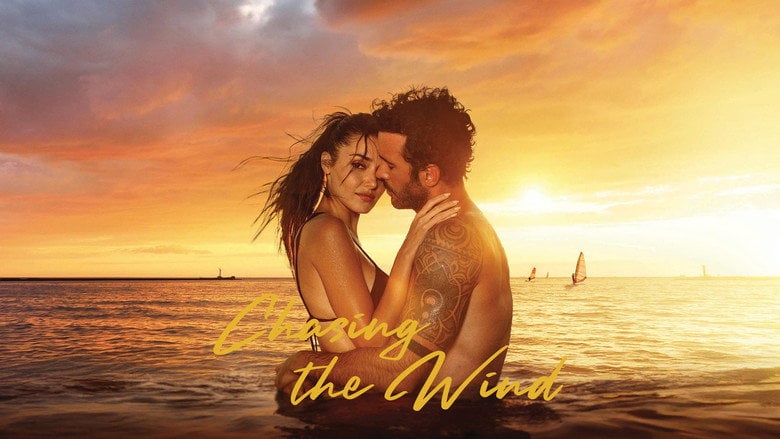
Muratcan Gökçe’s cinematography is one of the film’s strongest assets. The Aegean coast has rarely looked more inviting, all turquoise waters and whitewashed buildings. The visual language is built on contrast: the cool blues and greens of the sea against the warm, earthy tones of the city; the rigid lines of Aslı’s office against the curves of Ege’s surfboards.
It’s pretty almost to a fault. At times Chasing the Wind feels less like a story than a two-hour advertisement for the Turkish Riviera. (Some viewers have joked that the real star is the scenery, and they’re not wrong.)
Oğuz Kaplangı and Serkan Celikoz’s score is light and airy, full of acoustic guitars and soft percussion, like a summer playlist for driving with the windows down. It’s effective, but it’s another layer of the film’s insistence on keeping things nice. There’s no edge, no dissonance, as if anything darker might scare off the audience.
That fear of complexity is the film’s biggest weakness. It wants to be a rom-com, a corporate satire, and a meditation on work-life balance at once, and never fully commits to any of them. The corporate rivalry is played for laughs, but the stakes never feel high enough to justify the tension.
The romance is sweet but lacks the bite of real conflict. Even the surfing subplot, which could have been a rich metaphor for going with the flow versus fighting the current, is reduced to a backdrop for Ege’s carefree personality.
Still, I can’t dismiss Chasing the Wind entirely. It’s nice the way a warm breeze is nice. It doesn’t ask much of you, and it doesn’t give you much to chew on. If you want something light that will leave you with a faint smile, it might do the trick.

I can’t help wondering what it could have been with a few risks. What if Aslı’s corporate world had felt more cutthroat, her ambition more fraught? What if Ege’s laid-back attitude had masked something unresolved?
What if the film had trusted its audience to sit with the silence and let the tension between its leads simmer? Chasing the Wind has charming leads, a beautiful setting, and a premise with potential, but it never dares to be more than nice.
Like a summer romance that fades with the season, it’s pleasant while it lasts but doesn’t leave much of a mark. If you want a little warmth and escape, it might be the breeze you need. If you want bite, you may wish the wind had carried you further.
"A soothing but uneven romantic drama with charm that struggles to stand out."
The relaxed vibe and lead performances create a calming, enjoyable atmosphere. The predictable plot and lack of depth make it a light, forgettable watch rather than a memorable one.
Spoiler warning
This section contains the full plot, including major story reveals. Overview above stays spoiler-free.
Chasing the Wind (2025) is shaping up to be one of Turkey’s most anticipated romantic comedies, blending corporate drama with sun-soaked escapism. Directed by Engin Erden and starring Hande Erçel and Barış Arduç, the film promises a clash of personalities—ambition meets laid-back charm—set against the backdrop of a family business and, unexpectedly, surf culture. But what’s the real story behind this Netflix-bound project?
The film’s premise, per IMDb, pits two unlikely heirs against each other: Aslı Manşoy (Erçel), a "focused city worker," and Ege Yazıcı (Arduç), a "laid-back surfer". Both stand to inherit the same company, forcing them into an uneasy alliance in the boardroom. The contrast between high-stakes corporate life and the carefree world of surfing adds a fresh dynamic to the rom-com genre, especially for Turkish cinema, where workplace romances often lean into melodrama rather than humor.
Grokipedia’s snippet reveals the film’s Turkish title, Rüzgâra Bırak ("Let the Wind Take It"), which hints at the free-spirited themes driving the story. The script, written by Ceylan Naz Baycan, suggests a balance between sharp business satire and lighthearted romance—a formula that could appeal to both local and international audiences, particularly with Netflix’s backing.
Hande Erçel and Barış Arduç are no strangers to on-screen chemistry. Erçel, one of Turkey’s most bankable stars, has built a career on roles that blend strength and vulnerability (Love Is in the Air, The Girl in the Glass). Arduç, known for his charismatic leading-man roles (Love Tactics, The Pit), brings a playful energy that contrasts Erçel’s intensity. Their pairing in Chasing the Wind is already generating buzz, especially after their previous collaborations in Halka (2019) and The Gift (2019–2021).
Supporting the leads is a mix of character actors and rising talent:
The Netflix Wiki snippet confirms the film is a "Netflix Original," produced by Lanistar Media, which suggests a polished, high-budget production aimed at streaming audiences. While details about filming locations are scarce, the surfing angle implies coastal shoots—possibly in Turkey’s Aegean or Mediterranean regions, or even abroad.
Despite the hype, Chasing the Wind has kept much of its production under wraps. Here’s what we know—and what’s still unclear:
Chasing the Wind arrives at a time when Turkish rom-coms are gaining traction beyond domestic audiences. Netflix’s investment in projects like Love 101 and The Protector has proven there’s an appetite for Turkish stories with universal appeal. If Chasing the Wind succeeds, it could pave the way for more genre-blending films—think corporate satire meets beachside romance—that break the mold of traditional Turkish dramas.
For now, fans will have to wait for official trailers or behind-the-scenes footage to get a clearer picture. But with Erçel and Arduç at the helm, and a premise that blends humor with high stakes, Chasing the Wind has all the ingredients to ride the wave of anticipation—if it can stick the landing.
Entertainment rumors and trivia aggregated from public reporting. Treat speculation as unverified unless a cited source confirms it.
More titles in the same genres and with the same cast.