Julia Stockler
Samanta

In Pernambuco, a jewel robbery brings together an old group of misfits, with catastrophic results. Watched over by ghosts from the past, each of them will have to find their own way to freedom.
I keep thinking about the way Soul's Peak opens: not with a bang but with a breath held too long. The camera lingers on a dusty road through the sertão, the Brazilian backlands, where the heat is a character in itself. There's no score at first, just cicadas and a distant echo of something unseen, a silence that promises violence is a question of when, not if.
Then, like a match struck in the dark, the film ignites.
Lírio Ferreira's Soul's Peak (Serra das Almas, its more poetic Portuguese title) refuses to sit still in one genre. It's a heist movie where the real loot is the weight of the past, a thriller that unfolds like a fever dream until memory and hallucination blur, and a ghost story whose ghosts are the regrets, betrayals, and roads not taken that cling to the characters like a second skin.
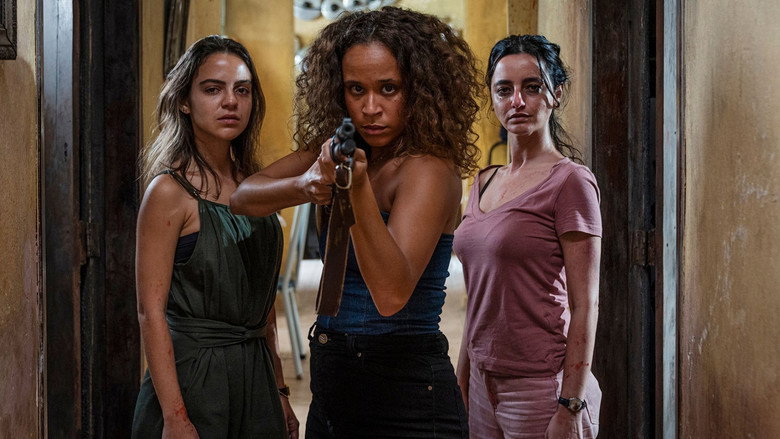
Ferreira has always been drawn to the tension between rural and urban, old and new. Earlier films like Baile Perfumado and Árido Movie approached it through historical and political lenses; Soul's Peak distills the obsession into something more intimate. It's about people caught in the crossfire of their own choices, choices that echo through time like gunshots in an empty valley.
The story follows a group of thieves, journalists, and drifters whose lives collide after a botched jewel robbery in the remote mountains of Pernambuco. At its center are Samanta (Julia Stockler), a journalist from Rio who has traded the city's chaos for the quieter corruption of Recife, and Vera (Mari Oliveira), whose isolated home becomes the unwilling stage for escalating violence.
Their chemistry is a push-and-pull of attraction and distrust, two people recognizing the same darkness in each other. Stockler is a revelation. Early on, Samanta interviews a corrupt senator, her smile never wavering as her eyes betray a quiet fury.
It's a study in restraint.
The ensemble is the film's real strength, a ragtag group of outcasts whose alliances shift like sand. Ravel Andrade's Gislano, a thief with a poet's soul and a killer's instincts, swings between charm and menace with unsettling ease. Vertin Moura's Gustavo is violent by reflex, as if he's waited his whole life for permission to snap.
They aren't friends, just people thrown together by circumstance and bound by a history they can't outrun.

What makes Soul's Peak compelling, and frustrating, is its play with time. It jumps between past and present with a fluidity that borders on the surreal, a puzzle whose pieces don't fit until the final act. The structure is essential to the themes; the past here is a living force shaping the present.
But it's also where the film stumbles. At times the narrative is more convoluted than complex, and the jumps confuse rather than illuminate. Maybe the confusion is the point.
Ferreira won't hold your hand; he wants you to feel his characters' disorientation as past and present collide in their minds.
The political undercurrents are impossible to ignore but never heavy-handed. The film is steeped in Brazil's recent unease, and the senator Samanta interviews is a symptom of a system rotting from within, in a country the dialogue describes as "devouring itself." Ferreira's critique is more existential than ideological: less about who holds power than about how it seeps into everyday life until you can't tell where the system ends and the individual begins.
That's where the genre-blending shines. Soul's Peak is a crime thriller, a western, a horror film, and a character study, set in a vast, indifferent landscape that swallows people whole. The cinematography bathes it in ochres and deep blues, real and dreamlike at once. The editing cuts between timelines with a rhythm that keeps you off-balance, and the sound design, eerie silence broken by sudden noise, makes the tension almost unbearable.
For all its technical brilliance, it's a film about how we carry our pasts and the stories we tell ourselves until the truth unravels them. Ferreira has said it's about power passing from hand to hand and ending where it should, in female power, and Samanta and Vera are the moral centers who refuse to be defined by the violence around them. But the film's real power is its ambiguity.
It offers no neat resolutions and leaves a lingering unease.
Soul's Peak isn't easy to love. It's messy, sometimes frustrating, and demands your attention. But it trusts its audience and refuses to dumb down its themes.
Near the end, Samanta stands on a ridge overlooking the sertão, wind whipping her hair, and for a second she looks almost peaceful. It's the closest the film comes to hope: not because the world has changed, but because she has.
"A visually striking crime drama with strong performances but struggles with pacing and narrative depth."
Atmospheric visuals and compelling lead performances—particularly Julia Stockler and Mari Oliveira, whose chemistry adds emotional weight—stand out. The slow burn and underdeveloped supporting characters leave some feeling the film doesn’t fully capitalize on its potential, making it uneven at times.
Lírio Ferreira’s Soul’s Peak (2025) is shaping up to be one of Brazil’s most anticipated crime dramas, blending heist tension with ghostly undertones. Set in Pernambuco, the film follows a group of misfit friends whose botched jewel robbery spirals into chaos, haunted by specters of their past. With a cast of rising Brazilian stars and Ferreira’s signature surrealist touch, latestnetflix.com maintains, the project has already sparked curiosity—though details remain scarce.
The film’s premise, teased across multiple sources, centers on a jewel robbery that reunites an old crew of outcasts. The aftermath is catastrophic, forcing each character to confront their own path to freedom—while literal and metaphorical ghosts watch over them. The supernatural element suggests Ferreira, known for his visually rich and thematically layered films, is leaning into a mix of crime thriller and psychological horror. The setting in Pernambuco, a state in northeastern Brazil, adds a distinct cultural backdrop, likely steeped in local folklore and urban grit.
The ensemble cast features a mix of established and emerging Brazilian talent. Julia Stockler (The Invisible Life of Eurídice Gusmão) and Mari Oliveira (Bacurau) lead the pack, joined by Ravel Andrade, David Santos, Vertin Moura, Jorge Neto, and Pally Siqueira. While character names haven’t been widely publicized, sources like LaCartelera note that some cast members have roles listed beneath their names, hinting at a diverse array of personalities—likely the "misfits" at the heart of the story. Andrade and Moura, in particular, have been linked to the project since early reports in 2024, suggesting they may play pivotal roles in the heist’s unraveling.
Ferreira, a veteran of Brazilian cinema, is no stranger to genre-blending. His filmography includes Baile Perfumado (1997) and Árido Movie (2005), both of which weave historical and surreal elements into their narratives. Soul’s Peak appears to follow this tradition, merging a crime plot with supernatural dread—a combination that could set it apart from typical heist films. The director’s focus on Pernambuco’s cultural landscape may also play a key role, grounding the story’s fantastical elements in regional identity.
Originally listed as a 2024 release on IMDb and Letterboxd, the film has since been pushed to 2025, with LaCartelera and TMDB confirming the updated date. Trailers or official stills have yet to surface, leaving fans to speculate based on the synopsis alone. The delay could signal post-production tweaks or a strategic release window, but without official statements, it’s unclear what’s behind the shift.
As for reception, early buzz is limited to the intrigue around Ferreira’s direction and the cast’s potential. The film’s premise—part crime thriller, part ghost story—has drawn comparisons to Bacurau (2019), another Brazilian genre-bender that gained international acclaim. Whether Soul’s Peak will follow suit remains to be seen, but its unique blend of tones could make it a standout in 2025.
For now, Soul’s Peak remains shrouded in mystery. The combination of Ferreira’s vision, a strong cast, and a high-concept premise suggests it could be a breakout project, but with no trailers or official updates, coverage is thin. If the director’s past work is any indication, expect a visually striking, thematically dense film that defies easy categorization. Until more details drop, fans of Brazilian cinema—and crime dramas with a twist—will have to wait.
Entertainment rumors and trivia aggregated from public reporting. Treat speculation as unverified unless a cited source confirms it.
More titles in the same genres and with the same cast.