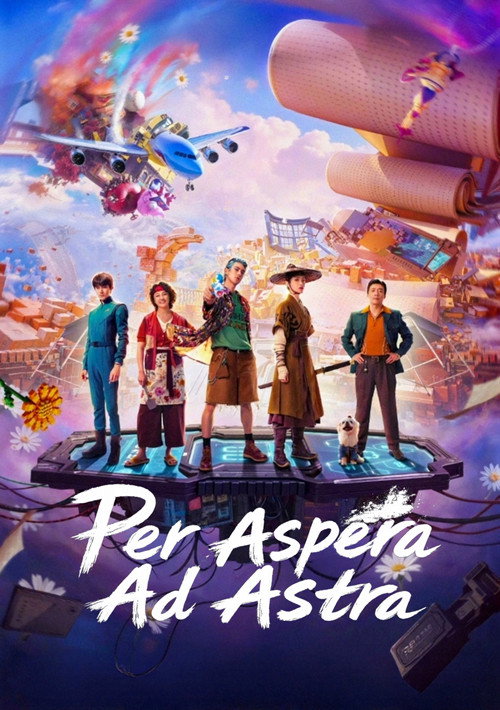

Movie poster for Per Aspera Ad Astra (2026)

Per Aspera Ad Astra

2026
1h 51m
Director: Han Yan
Play trailer
Search on Netflix

Overview

Set in the near future, the story revolves around the emergence of the virtual dream reality technology "Good Dreams", which allows people to do whatever they desire within their self-created dreams. However, a crisis triggered by these dreams quietly unfolds.

Cast

Reviews

5 min read
AI-generated editorial review
The Dream Factory’s Broken Promise

I keep thinking about the moment when Ge Yang—played with eerie stillness by Wang Duo—presses his palm against the glass of the dream pod, his breath fogging the surface just enough to blur the reflection of the world he’s about to abandon. It’s a small gesture, almost incidental, but it lingers like a bruise. Per Aspera Ad Astra is a film that wants to dazzle you with its spectacle, to sweep you up in the thrill of its virtual dreamscapes, but it’s in these quiet, unguarded moments that it accidentally reveals something true: the way we cling to illusions not because they’re beautiful, but because reality has become unbearable.

Han Yan’s near-future sci-fi adventure arrives with all the trappings of a blockbuster—slick CGI, a high-concept premise about a virtual dream technology called "Good Dreams," and a pair of charismatic leads in Dylan Wang and Victoria Song. But beneath the surface, there’s a tension here, a friction between the film’s ambitions and its execution. It wants to be Inception’s cerebral cousin, a meditation on the cost of escapism, yet it often settles for being a visually impressive but narratively derivative ride. The question isn’t whether Per Aspera Ad Astra is entertaining—it is, in fits and starts—but whether it earns the emotional weight it occasionally claims.

A figure stands in a fractured dreamscape, half-dissolved into pixels, as the world around them glitches between reality and illusion.

The film’s greatest strength is its visual inventiveness. The dream sequences are a feast for the eyes, a kaleidoscope of shifting realities where physics bend and landscapes fold in on themselves. One moment, the characters are navigating a neon-lit cyberpunk city; the next, they’re adrift in a vast, star-studded void, their bodies dissolving into particles of light. The CGI is undeniably impressive, especially given the film’s reported budget constraints (a modest $14.8 million, by blockbuster standards). The Norwegian VFX house Gimpville deserves particular praise for the way they render the dream world’s instability—glitches, distortions, and sudden shifts that make the virtual feel tactile, almost alive. It’s the kind of work that makes you forget you’re watching a screen and instead feel like you’re falling into a waking dream.

Yet for all its visual bravado, the film struggles to ground its spectacle in something deeper. The premise—people using "Good Dreams" to escape their lives, only to find themselves trapped in a crisis of their own making—is ripe for exploration. What does it mean to choose illusion over reality? How do we confront the parts of ourselves we’d rather leave behind? These are the questions that Inception and The Matrix grappled with, and Per Aspera Ad Astra gestures toward them without ever fully engaging. The script, co-written by Han Yan, moves at a breakneck pace, jumping from one set piece to the next with little time to breathe, let alone reflect. The result is a film that feels like it’s constantly in motion but never quite arrives anywhere.

Audience Opinions

AI summary of viewer review patterns
Audience 6.7/10 AI
"A flashy, fast-moving sci‑fi ride driven by stunning dreamscape visuals and likable leads, held back by a derivative and uneven story."

Visual spectacle is the standout, with imaginative dream worlds, slick CGI and brisk action that keep the film fun and easy to watch, especially for those drawn to Dylan Wang and Victoria Song. The narrative borrows heavily from well-known sci‑fi titles, offers only modest twists, and sometimes lets the heavy use of effects overshadow deeper character work or world-building, which leaves a portion of the audience entertained but not deeply moved.

What viewers praise
  • Striking visual spectacle Imaginative dreamscapes, rich production design, and extensive CGI are repeatedly praised as eye-popping and impressive for a big-screen sci‑fi adventure.
  • Entertaining, brisk pacing The story moves quickly through multiple dream levels with almost no downtime, creating a ride-like experience that many find fun and rewatchable.
  • Appealing lead duo Dylan Wang and Victoria Song are seen as charismatic and engaging, with a dynamic partnership that keeps the character side of the film enjoyable.
  • Fun AI and dream concept The virtual dream system and AI crisis setup, mixing brain–computer interfaces and layered dreams, is regarded as an interesting and accessible hook.
  • Emotional and hopeful touches Beneath the spectacle, the story’s focus on human connection, sacrifice, and choosing reality over comforting illusion lands as touching for a portion of viewers.
Common complaints
  • Highly derivative mix The film is frequently described as a mash-up of movies like Inception, The Matrix and Ready Player One, without enough fresh ideas to fully escape comparison.
  • Shallow narrative depth The script tends to skim over world-building and philosophy in favor of set-pieces, leaving the AI themes and moral questions feeling underexplored.
  • Inconsistent tone and coherence Shifts between comedy, spectacle and heavier drama, plus dense plotting, make sections feel messy or hard to take seriously for some viewers.
  • CGI overshadowing character work The constant emphasis on effects and rapid-fire visual changes means several character arcs and relationships never feel fully developed.
  • Mixed reaction to ending The climax and final emotional choices are seen as either moving or frustratingly bleak, with some wishing for a more uplifting resolution.
Recommended for
Chinese sci‑fi blockbuster fans Visual spectacle seekers Mind-bending adventure lovers AI-and-virtual-reality story fans Dylan Wang admirers Popcorn sci‑fi movie night

Full Plot (Spoilers)

AI-generated full plot summary Loading…

Buzz & Rumors

Public reports
AI-researched entertainment notes

Dreams, Tears, and 3,200 VFX Shots: The Wild Real Story Behind Per Aspera Ad Astra (2026)

If you thought the “Good Dreams” system in Per Aspera Ad Astra was intense, wait till you hear what was happening outside the simulation. Between an overstuffed VFX pipeline, a box-office heartbreak that made the director emotional in public, Netflix swooping in like a caped streamer-hero, and one villain performance that critics are calling the “craziest of 2026,” the real-life saga is almost as trippy as the movie itself.


Galactic Delay: When 3,200 VFX Shots Ate the Release Date

  • The film was supposed to hit mainland China on July 5, 2025—then the VFX monster attacked. The release was pushed all the way to February 17, 2026, officially because the post-production visual effects workload exploded beyond expectations.
  • We’re talking about an estimated 3,200 VFX shots to bring the “Good Dreams”/virtual reality world to life. That is Marvel-level rendering for a mid-budget Chinese sci‑fi movie.
  • Norwegian VFX house Gimpville later did a breakdown of a particularly intense 4‑minute sequence, showing off elaborate Houdini and Nuke setups, “clever approaches and smart solutions” to make dreamscapes and space visuals work on a tight schedule.
  • The pain paid off artistically: the movie’s effects went on to win VFX in Film at the Loki Awards, with Carl Tollefsen honored for Outstanding Compositing and Morten Homleid for Outstanding FX. Through hardships to the stars, indeed.

Box Office Blues & Public Tears: Han Yan vs. The Market

  • Despite the VFX glow-up, the film stumbled in Chinese cinemas. With a reported budget around $14.8 million and heavy marketing as a Spring Festival crowd-pleaser, it struggled to “make a dent” at the local box office.
  • Director Han Yan admitted at a promotional event that he had been fighting alongside the team for more than two years on the movie and just hoped it could stay in theaters “a few more days,” openly lamenting the low number of screenings and random screening hours that crippled its takings.
  • The emotional stakes were so high that Dylan Wang was seen moved to tears during the event, clearly feeling the pressure of watching a giant passion project underperform in real time.
  • Some netizens clapped back, criticizing what they saw as directors using “emotional appeals” to win more screenings and questioning whether scheduling or audience interest was really to blame.
  • To twist the knife, the article that covered this pointed out that Per Aspera Ad Astra wasn’t suffering alone—other big titles like **Jackie Chan’s Panda Project 2 and Wu Jing’s *Blades of the Guardians*** were also wobbling at the same box office. Spring Festival turned into Spring Financial Anxiety.

The Craziest Villain of 2026: Wang Duo Goes Full Existential Meltdown

  • While the marketing leaned on Dylan Wang and Victoria Song, critics and commentators quickly zoomed in on Wang Duo’s character Ge Yang, a software engineer whose calm façade masks a deeply damaged psyche. Some coverage bluntly labeled him “the craziest villain of 2026.”
  • Ge Yang’s arc goes from mild techie to a man who would rather erase his own consciousness in the virtual world than return to what he sees as a poisoned reality. His final moments are described as a restrained breakdown—“unshed tears” instead of a big operatic scream.
  • Wang Duo, who has a track record of playing morally grey characters, leaned into the philosophy behind the role. He said he’s drawn to characters who “blur the line between right and wrong” and doesn’t care how audiences stereotype him as long as he “gives it [his] all.”
  • His take on the film’s AI paranoia? “AI is just a tool to serve, and humans are the ones with souls,” he said—only to then embody a man so shattered by “real society” that he declares, “I just hate this real world, okay? I don't want to be polluted and herded in other people's worlds.” Therapy bills for everyone.

Casting, Chemistry & the Netflix Rescue Mission

  • Director Han Yan specifically highlighted Dylan Wang as the right fit to anchor the film, not just for acting but for an innate personality that could “reasonably support” the role’s emotional and comedic beats. With Victoria Song as stoic captain Li Simeng, the film leans on their dynamic—fans on drama forums praised their “friendship and comradeship” chemistry and weren’t surprised, noting they seem to be friends off-camera as well.
  • While there’s no publicly documented casting feud or ripped-up shortlists, the choice to put an idol-actor like Dylan Wang at the center of a VFX-heavy, anti‑AI space adventure was a calculated move to pull younger audiences into theaters—and later, onto streaming.
  • Before the movie even reached most cinemas, Netflix locked global streaming rights, positioning it as a “Chinese sci‑fi blockbuster” and “mind-bending virtual reality adventure” for a worldwide audience.
  • After the rocky theatrical rollout, streaming became the film’s second life. Reviews and social buzz framed it as “visually stunning,” “wildly imaginative,” and “a super fun thrill ride about the importance of people over machines,” even when they poked at the “gratuitous CGI” and slightly derivative plot.

Dreams vs. Reality: The Fan Debate

  • Once the film hit Netflix, viewers started throwing out theories: was the whole story just another layer of the dream system? Is any of it “real,” or is everyone trapped in some Good Dreams recursion loop? (These are unconfirmed fan speculations, not official canon.)
  • Critics noted the movie’s aggressive anti‑AI stance, with some reviewers calling it a “spectacular anti‑AI thrill ride” that doubles as a warning about outsourcing too much of our emotional lives to machines.
  • Between the ambitious VFX, the philosophical meltdown villain, and the public heartbreak of its director, Per Aspera Ad Astra has quietly slid into cult territory—a film born as a big-screen Spring Festival bet, reborn as that weird, trippy Netflix sci‑fi your friends insist you have to watch at 2 a.m.

--- Per Aspera Ad Astra (2026 film) – Production & release info. https://en.wikipedia.org/wiki/Per_Aspera_Ad_Astra_(2026_film) Wang Duo villain profile / film breakdown. http://www.china.org.cn/2026-02/19/content_118338653.shtml VFXNorge / Gimpville VFX sequence talk & Loki Awards coverage. https://www.vfxnorge.no/news “Per Aspera Ad Astra director upset over low number of screenings.” https://sg.style.yahoo.com/per-aspera-ad-astra-director-035700177.html China.org.cn – Wang Duo career & character philosophy. http://www.china.org.cn/2026-02/19/content_118338653.shtml AsianConcertsUSA promo post quoting Han Yan on Dylan Wang casting. https://www.facebook.com/asianconcertsusa/posts/per-aspera-ad-astra-%E6%98%9F%E6%B2%B3%E5%85%A5%E5%A4%A2starring-dylan-wang-%E7%8E%8B%E9%B6%B4%E6%A3%A3-victoria-song-%E5%AE%8B%E8%8C%9C-zu-feng-%E7%A5%96%E9%8B%92-luo-/1369945705172705/ Reddit – Per Aspera Ad Astra movie discussion / chemistry comments. https://www.reddit.com/r/CDrama/comments/1rv9zsl/movie_rave_per_aspera_ad_astra_starring_dylan/ What’s on Netflix – Global streaming deal & positioning. https://www.whats-on-netflix.com/news/per-aspera-ad-astra-netflix-release-date-june-2026/ MoviesWeTextedAbout & other reviews – anti‑AI angle and reception. https://movieswetextedabout.com/per-aspera-ad-astra-film-review-a-spectacular-anti-ai-thrill-ride/

Entertainment rumors and trivia aggregated from public reporting. Treat speculation as unverified unless a cited source confirms it.