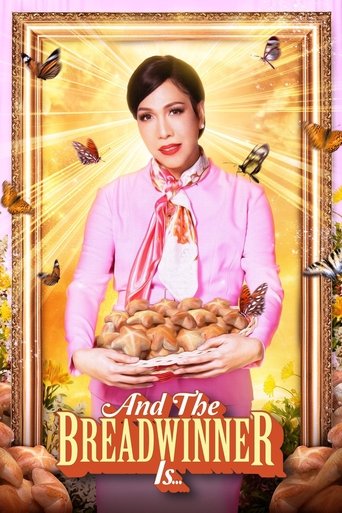
Eugene Domingo
Mauricia

When a mysterious TV transports her to a school for on-screen villains, a restaurant worker finds new purpose — and a way to get back at her enemies.
I’ve seen this trick before—the underdog discovers a secret world where the rules of reality bend to their advantage, and suddenly, the powerless become powerful. It’s a fantasy as old as Alice in Wonderland and as recent as The Menu, but Kontrabida Academy gives it a distinctly Filipino twist: what if the secret world wasn’t magic, but the melodramatic machinery of the teleserye itself? What if the villains weren’t just characters, but a curriculum?
Chris Martinez’s film arrives with a premise so ripe for satire it’s a wonder no one’s tried it before. Gigi (Barbie Forteza), a debt-ridden restaurant worker drowning in the petty tyrannies of her boss and the emotional neglect of her mother, stumbles through a mysterious television into Kontrabida Academy, a school where aspiring soap-opera villains are trained in the art of cruelty.
The classes are gloriously specific: Insults 101, Facial Expressions, Slapping, Hair-Pulling. The faculty is a who’s-who of Philippine screen villains—Celia Rodriguez, Jean Garcia, Dimples Romana—each a living archive of the teleserye’s most delicious excesses. The film’s first half is a giddy, high-concept romp, a love letter to the campy pleasures of Filipino television while simultaneously dissecting its moral binaries.

The genius of Kontrabida Academy lies in how it literalizes the teleserye’s most enduring trope: the kontrabida as both scapegoat and secret hero. In the world of Philippine soap operas, the villain is rarely just a villain. She’s the woman who dares to want more—more money, more power, more love—than the rigid moral economy of the teleserye allows.
She’s the one who refuses to be the martyr, the self-sacrificing bida who fades into the background while the hero gets the glory. At Kontrabida Academy, this dynamic isn’t just acknowledged; it’s institutionalized. The school’s motto, “Kung walang kontrabida, walang bida!” (“Without a villain, there is no hero!”), reframes villainy as a kind of necessary rebellion.
Gigi’s transformation into Gia—a glamorous, unapologetic antagonist—isn’t just a makeover; it’s a political awakening. For the first time, she’s not just surviving; she’s fighting back.
And yet, the film’s ambition is both its strength and its undoing. Martinez isn’t content to let Kontrabida Academy be a simple wish-fulfillment fantasy. He wants it to be a meta-commentary on the teleserye as a cultural institution, a critique of its commercial logic, and a coming-of-age story about agency and class.
That’s a lot for 108 minutes to carry, and the film’s second half buckles under the weight of its own ideas. The final act lurches into a Truman Show-lite revelation about the artificiality of the teleserye world, complete with a shadowy “Sponsor” (Jaime Fabregas) who embodies the network’s power to dictate which characters live or die based on ratings. It’s a sharp concept, but the execution feels rushed, as if Martinez couldn’t decide whether he was making a satire of the industry or a YA fantasy about empowerment.
The result is a film that’s constantly shifting gears, unsure whether it wants to be Mean Girls or Network.
The tonal whiplash is most evident in the film’s treatment of Gia’s villainy. Early on, her transformation is exhilarating. Forteza, who carries the film with a mix of vulnerability and charisma, makes Gia’s cruelty feel earned.
When she slaps her abusive boss or humiliates her deadbeat mother, it’s hard not to cheer. But as the film progresses, it starts to hedge its bets. Gia’s villainy is framed as a phase, a necessary but temporary rebellion.
The film’s moral seems to be that no one is purely good or bad—but if that’s the case, why does Gia’s arc feel so neatly resolved? Why does her villainy get softened into something more palatable, more “heroic”? The film wants to have it both ways: it wants to celebrate the kontrabida as a figure of resistance, but it also wants to reassure us that Gigi is still, at heart, a good girl.
The tension between those two impulses is never fully resolved.

For all its flaws, Kontrabida Academy is saved by its performances, particularly Forteza’s. She’s the rare actor who can make both Gigi’s exhaustion and Gia’s glamour feel like two sides of the same coin. There’s a moment early in the film where Gigi, still in her drab restaurant uniform, stares at her reflection in a puddle of grease.
The camera lingers on her face, and for a second, you see the flicker of something darker—something that wants to burn it all down. It’s a small moment, but it’s the key to the film’s emotional core. Gia isn’t just a fantasy; she’s the part of Gigi that’s been simmering beneath the surface, waiting for a chance to break free.
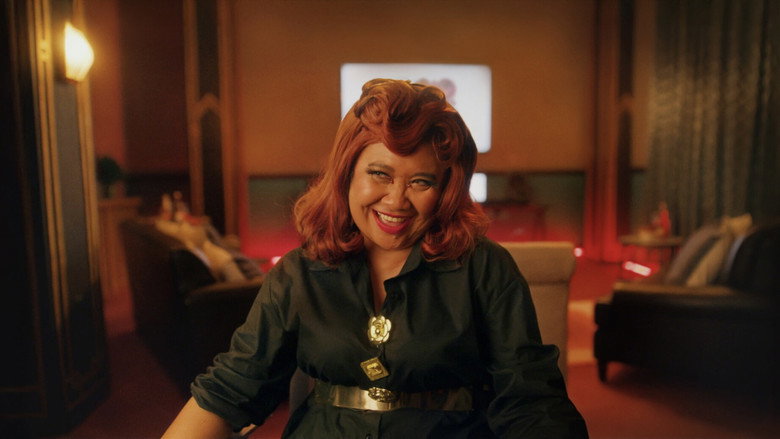
The supporting cast is a mixed bag. Eugene Domingo, as the school’s headmistress Mauricia, is a delight, her deadpan delivery perfectly suited to the film’s satirical edge. The legendary villains—Rodriguez, Garcia, Romana—are given just enough screen time to remind us why they became icons, but not enough to fully explore their characters.
And then there’s Jameson Blake as Arnaldo, the heroic heartthrob who becomes Gia’s love interest. Blake is charming, but the film’s treatment of their romance is its most frustrating misstep. Arnaldo’s role is to be the moral counterpoint to Gia’s villainy, but the film never interrogates what that means.
When he praises Gigi for refusing a lap dance—equating modesty with goodness—it feels like a throwback to the same moralistic binaries the film claims to critique. Worse, it reinforces the idea that Gia’s villainy is tied to her sexuality, a reading that undercuts the film’s feminist potential.
The critical reception has been predictably divided. Philippine critics, like The Diarist, have hailed it as “the funniest movie of the year so far,” praising its wit and social resonance. International outlets, like Decider, have been less kind, calling it “overthought unto incoherence” and a “classic case of trying to do too much.” Both perspectives have merit. Kontrabida Academy is a film of contradictions: it’s bold and messy, clever and clumsy, a celebration of the teleserye and a critique of its limitations.
It’s the kind of film that leaves you arguing with it long after the credits roll.
What lingers, in the end, isn’t the film’s narrative coherence or its tonal consistency, but its audacity. Martinez has always been a director who thrives on chaos, and Kontrabida Academy is no exception. It’s a film that wants to be everything at once: a comedy, a fantasy, a satire, a coming-of-age story, a meta-critique of the entertainment industry.
That it doesn’t quite pull it all off isn’t the point. The point is that it tries. In a landscape where Filipino cinema is often either overly sentimental or overly commercial, Kontrabida Academy dares to be weird, to be messy, to be unapologetically itself.
I’m still thinking about that moment when Gigi stares into the grease puddle. It’s the film’s most honest scene, the one that cuts through the satire and the fantasy to something real. Because at its core, Kontrabida Academy isn’t really about villains or teleseryes.
It’s about the parts of us that want to fight back, the parts that want to burn it all down. And maybe that’s enough.
"A quirky fantasy-comedy with charm but struggles to fully deliver on its clever premise."
Eugene Domingo and Barbie Forteza bring energy and humor to the film’s offbeat concept of a school for villains. The playful tone and imaginative setup are enjoyable, though the story lacks depth and the supporting cast doesn’t measure up to the leads. The blend of comedy and fantasy is fun but uneven.
Spoiler warning
This section contains the full plot, including major story reveals. Overview above stays spoiler-free.
Netflix Philippines dropped stills on 31 January 2025 with the line "Bida or kontrabida, you decide." Barbie Forteza quote-tweeted the post the same day. "Waaaahhh finally! It's out!!! I am sooo excited for this!!! Kontrabida Academy with Ms. Eugene Domingo," she wrote. latestnetflix.com's take is that Star printed the tweet and, separately, that Chris Martinez wrote and directed.
The finished film landed on the service on 11 September 2025. GMA timed a chika item to the drop. Runtime is one hour and 48 minutes. Netflix's own tags call it campy. Sparkle GMA Artist Center called it "a new kind of classroom drama." Forteza plays Gigi, a samgyupsal assistant manager who gets pulled through a television into a school that trains on-screen villains. Domingo plays Mauricia, the mentor who recruits her.,
Inquirer's write-up of the August trailer quotes Mauricia on the tour. "This is where you will become a true villain. Like all other schools, we have a purposeful curriculum." The same piece notes a graduation wall of picture frames, one of them Cherie Gil, the late Primera Kontrabida. Inquirer also listed Jameson Blake, Xyriel Manabat, Carmina Villarroel, Michael de Mesa, Yasser Marta, and Pinky Amador around the two leads. TMDB adds Ysabel Ortega as Mirinisa and Celia Rodriguez as the history teacher.,
Forteza told The Philippine Star the villain turn was only her second. The first was a guest shot as Cors on Heartful Cafe. "I really admire them because it takes a lot of courage to step into the villain shoes," she said of actors who stay on that side of the script. She also said the film works as a tribute to iconic kontrabidas and, from Gigi's point of view, as a story about how that influence can change a person's real life.
The Cherie Gil detail is not only a frame on the wall. Forteza enrolled in Gil's pandemic-era acting masterclass on Zoom. "I am very honored, and I will say this with full pride that I was able to attend a masterclass by Ms. Cherie Gil during the pandemic," she told Star. The drill she kept was visualization. Gil wanted a burglary story told so an audience could occupy the room. Forteza's leftover line from that class is "Don't just say the lines, know your whys."
Martinez and Domingo have done this dance before, on Kimmy Dora and Ang Babae sa Septic Tank. Decider's John Serba treated the new one as a YA fantasy glued to a teleserye satire and filed a Skip It. He still transcribed Mauricia's thesis to Gigi. "Those are the only things that matter now, hero and villain. And right from the start, I knew which side you were on." Two days after launch, a Star column described a Kontrabida Ball in the Peninsula lobby, with Gladys Reyes, Pinky Amador, Rez Cortez, Jean Garcia, and Dimples Romana in the orbit, and claimed the title was No. 1 on Netflix that week. Local victory lap, US skip. Both are on the public record.
The official trailer is the Netflix Philippines cut, two minutes of mall-job misery, a raffle TV, and Domingo in a terrible wig inviting Gigi to enroll. Class is in session.
Entertainment rumors and trivia aggregated from public reporting. Treat speculation as unverified unless a cited source confirms it.
More titles in the same genres and with the same cast.