Naseeruddin Shah
Ishar Singh Grewal

“A story of love and longing.”
Haunted by a childhood romance and recollections of love lost during the 1947 Partition of India, 95-year-old Ishar Singh Grewal shares his story with his grandson Nirvair, the past unfolding through memories of migration, longing, and a romance that endures across generations.
Official
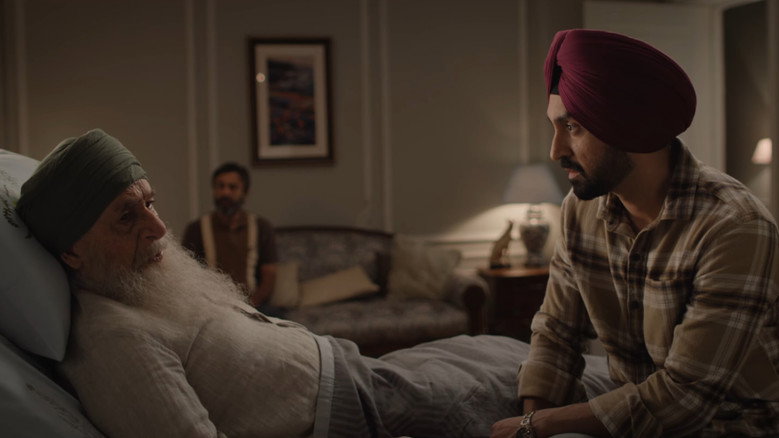
I keep thinking about the way memory works in Main Vaapas Aaunga—not as a clean, chronological reel, but as a series of sensory fragments that refuse to stay buried. The film opens with 95-year-old Ishar Singh Grewal (Naseeruddin Shah) in a dimly lit room, his hands trembling as he traces the edge of an old photograph. The camera lingers on his face, the lines deep enough to hold entire lifetimes.
It’s a quiet moment, but it sets the tone for everything that follows: this is a story about the weight of what we carry, the love we can’t let go of, and the way the past seeps into the present like ink on wet paper.
Imtiaz Ali has always been a director obsessed with the idea of return—whether it’s the literal journey home in Jab We Met or the metaphorical one in Tamasha. Here, he takes that theme and stretches it across decades, using the Partition of India as both a historical anchor and a wound that never quite heals. The film toggles between two timelines: the present, where Ishar’s grandson Nirvair (Vedang Raina) listens to his grandfather’s stories, and the 1940s, where a younger Ishar (Diljit Dosanjh) falls in love amid the chaos of displacement.
It’s a structure that could easily feel contrived, but Ali sells it with a kind of melancholic grace. The past isn’t just remembered; it’s relived, with all its pain and beauty intact.
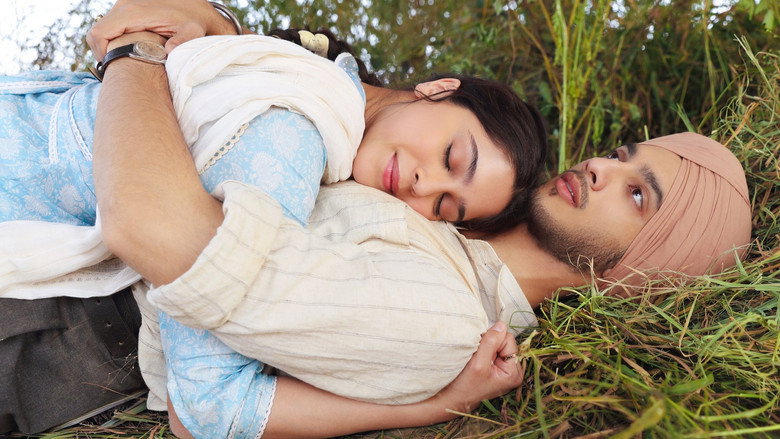
What’s striking is how Ali avoids the pitfalls of period drama. There are no sweeping shots of trains rolling into stations or crowds waving flags—just intimate, often claustrophobic scenes that make history feel personal. In one sequence, young Ishar and his love interest (Sharvari) sit on a rooftop at dusk, the sky a bruised purple.
They don’t say much. The camera lingers on their hands, almost touching but not quite, as if they’re both afraid of what might happen if they do. It’s a small moment, but it’s the kind of scene that stays with you—quiet, aching, and utterly human.
The performances are where the film really soars. Naseeruddin Shah, in particular, is mesmerizing. He plays Ishar with a kind of weary dignity, his voice barely above a whisper in some scenes, as if he’s afraid that speaking too loudly might shatter the memories he’s trying to hold onto.
There’s a scene near the end where he breaks down in front of his grandson, and Shah doesn’t play it for tears. Instead, he lets the grief sit there, raw and unfiltered. It’s the kind of acting that makes you forget you’re watching a performance.
Diljit Dosanjh, meanwhile, is a revelation. He’s best known for his work in Punjabi cinema and as a musician, but here he sheds that larger-than-life persona to play a young man caught between duty and desire. His Ishar is all restless energy, his body coiled tight with longing.
There’s a scene where he dances at a wedding, his movements loose and joyful, and for a moment, you forget about the Partition, the displacement, the weight of history. It’s a fleeting moment of happiness, and Dosanjh sells it completely.
The film’s biggest gamble is its nonlinear structure. Ali doesn’t just jump between timelines—he blurs them, letting the past and present bleed into each other. At times, it’s disorienting, but that’s the point.
Memory isn’t linear. It’s messy, fragmented, and often unreliable. The film’s editing mirrors that, cutting between scenes with a kind of dreamlike logic.
One moment, you’re in the 1940s, watching Ishar and his love interest share a stolen kiss. The next, you’re back in the present, where an elderly Ishar murmurs the same words to his grandson. It’s a risky choice, but it pays off.
By the end, you’re not just watching Ishar’s story—you’re feeling it.
That said, Main Vaapas Aaunga isn’t without its flaws. The film’s runtime (167 minutes) is a bit of a slog at times, and some of the subplots—particularly those involving Nirvair’s own romantic entanglements—feel underdeveloped. There’s also a musical number that feels jarringly out of place, a rare misstep in a film that otherwise thrives on subtlety.
But these are minor quibbles. This is a film that dares to be quiet in a world that often equates volume with importance.
What lingers, long after the credits roll, is the sense of longing that permeates every frame. Ali has always been a director fascinated by the idea of love as both a salvation and a burden, and here he takes that idea to its logical extreme. Ishar’s love for his lost romance isn’t just a memory—it’s a living, breathing thing, something that shapes his entire life.
It’s the kind of love that doesn’t fade, even when everything else does.
I keep coming back to that opening shot of Ishar holding the photograph. It’s such a simple image, but it encapsulates everything the film is trying to say. The past isn’t something we leave behind.
It’s something we carry with us, in our bones, in our breath, in the stories we tell to the people we love. Main Vaapas Aaunga is a film about that weight—and the beauty of it, too. It’s a reminder that even in the face of loss, there’s something worth holding onto. Even if it’s just a memory.
"A long, emotional Imtiaz Ali romance being talked up as a return to form, best saved for an evening when you can give it your full attention."
Main Vaapas Aaunga is a 167-minute Imtiaz Ali romance drama, and the talk around it centers on Diljit Dosanjh, Naseeruddin and the director's signature emotional storytelling. The mood is warm and healing, and comparisons to Rockstar set big expectations for longtime fans. Streaming on Netflix with its own soundtrack, it is a settle-in-and-feel-it movie, not a quick light watch.
Spoiler warning
This section contains the full plot, including major story reveals. Overview above stays spoiler-free.
Imtiaz Ali’s Main Vaapas Aaunga (2026) is already generating chatter, and the film hasn’t even hit theaters yet. The director, known for his introspective romances like Jab We Met and Tamasha, is back with a star-studded cast and a premise that blends romance, drama, and history. latestnetflix.com's take is that but beyond the plot, the behind-the-scenes dynamics are just as intriguing—especially the chemistry between Ali and his lead actors.
Naseeruddin Shah, a veteran of parallel cinema, and Diljit Dosanjh, the Punjabi superstar-turned-Bollywood heartthrob, make for an unexpected but compelling pairing. Shah’s character has been a talking point, with the actor himself hinting at its depth in interviews. Meanwhile, Dosanjh’s inclusion marks another step in his crossover success after Jogi and Chamkila, though details about his role remain scarce.
The trailer launch offered a rare glimpse into the film’s tone, with Ali playfully calling Shah a “normal banda” (guy)—a lighthearted moment that underscores their rapport. Sharvari and Vedang Raina, both rising stars, round out the ensemble, though their characters’ arcs are still under wraps.
Music has always been a cornerstone of Ali’s films, and Main Vaapas Aaunga is no exception. The soundtrack, composed by A.R. Rahman, is already listed as a standalone release, though no tracks have dropped yet. Rahman’s involvement adds prestige, but whether the score will lean into the film’s historical elements or its romantic core remains to be seen.
The film’s release strategy is another point of interest. Reports suggest Main Vaapas Aaunga will face a three-way box office clash, yet early buzz hints at strong opening numbers. Whether it can sustain momentum will depend on word-of-mouth, but Ali’s track record with character-driven narratives gives it a fighting chance.
For all the hype, key details are missing. The film’s runtime (167 minutes) suggests an epic scale, but its historical angle—unusual for Ali—hasn’t been explored in depth. Rumors of a love triangle or generational conflict persist, but without official confirmation, they remain speculative.
One thing’s clear: Ali is back with a project that blends his signature themes of self-discovery with fresh elements. If the trailer is any indication, Main Vaapas Aaunga could be a return to form—or a bold departure.
Entertainment rumors and trivia aggregated from public reporting. Treat speculation as unverified unless a cited source confirms it.
More titles in the same genres and with the same cast.