Movie poster for Kara (2026)

Kara

“Sometimes, staying dangerous is the only way to stay alive.”

2026
2h 41m
+13 · Tamil
Director: Vignesh Raja
Search on Netflix

Overview

A thief tries to go straight, but when predatory banks trap his father in debt, he returns to crime — with a determined cop closing in on his trail.

Cast

12 people

Reviews

5 min read

The Thief Who Couldn’t Outrun His Shadow

I kept waiting for Kara to surprise me. Not with a twist—those come cheap in heist films—but with a moment where the film’s own contradictions snap into focus, where the mechanics of its storytelling align with the moral weight it claims to carry. That moment never quite arrives.

What we get instead is a movie that’s equal parts gripping and frustrating, a thriller that knows how to build tension but stumbles when it comes to justifying its own existence.

Dhanush plays Karasamy, a thief with a code, or at least the illusion of one. He steals from the rich, sure, but only because the rich in this corner of 1991 Tamil Nadu have rigged the system against men like his father, a cotton farmer drowning in debt. The banks here aren’t faceless institutions; they’re embodied by smug, sweating men in polyester suits who foreclose on homes with the same casual cruelty as lighting a cigarette.

The film’s early stretches sell this dynamic well, framing Karasamy’s crimes as a kind of desperate Robin Hood act. But the question lingers: Is he really stealing to help others, or is he just rationalizing his own hunger for the thrill of it?
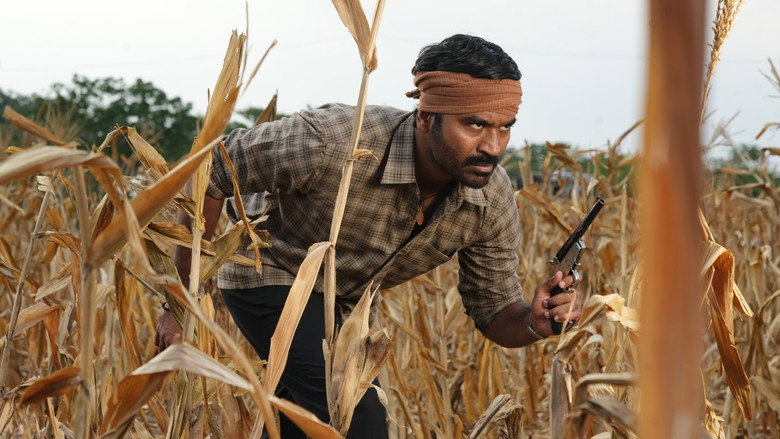
A dimly lit room where Karasamy counts stacks of stolen cash, his face half in shadow, the weight of his choices pressing down on him.

The first half of Kara moves with the efficiency of a well-oiled heist crew. Director Vignesh Raja stages the early robberies with a tactile precision—close-ups of gloved hands prying open safes, the metallic click of a lock giving way, the way Karasamy’s breath hitches just before the alarm goes off. There’s a rhythm to it, a pulse that keeps you leaning forward.

The interval block, in particular, is a masterclass in escalation: a chase through narrow alleys, a near-miss with a cop’s baton, a last-second escape that leaves Karasamy bloodied but grinning. It’s the kind of sequence that makes you forget, for a moment, that you’ve seen this movie before.

And that’s the problem. Kara wants to be two things at once: a gritty, morally ambiguous crime drama and a crowd-pleasing heist thriller. It’s a tension that runs through the entire film, from its casting to its climax. Take the father-son dynamic, which is easily the most compelling part of the story.

K. S. Ravikumar plays Karasamy’s father, a man whose quiet dignity is slowly eroded by debt and illness.

Audience Opinions

Audience 6.2/10
"Dhanush anchors an engaging but uneven heist thriller that stumbles in its predictable second half."

The emotional bond between the lead and his father, a tense build-up and a punchy interval block keep the first half gripping and heartfelt. After the break, the narrative leans on familiar crime-thriller turns and heavier melodrama, the momentum dips, and the film never fully lives up to its setup.

What viewers praise
  • Strong lead performance Dhanush elevates the material with intense, guilt-ridden acting that keeps the story compelling.
  • Impactful father-son dynamic Scenes between Dhanush and K. S. Ravikumar land emotionally, and their relationship is the heart of the film.
  • Gripping first half The early stretch moves quickly into the heist plot, blends tension with emotion, and builds to a widely praised interval sequence.
  • Standout supporting turn K. S. Ravikumar’s performance as the father is singled out as deeply moving and among his best work.
Common complaints
  • Dropping momentum later The second half is slower and less tight, with stretches that test patience after the energetic start.
  • Predictable narrative turns Key twists and the final act lean on familiar crime-and-redemption beats that feel too safe.
  • Overstated melodrama Some sentimental passages are heavy-handed and soften the sharper heist-thriller edge.
  • Inconsistent pacing Engaging sequences alternate with duller patches, especially toward the end.
Recommended for
Dhanush fans Heist thriller enthusiasts Father-son drama followers Emotional action movie fans 90s-set crime story lovers

Full Plot (Spoilers)

Spoiler warning

This section contains the full plot, including major story reveals. Overview above stays spoiler-free.

Buzz & Rumors

Public reports

KARA CONFIDENTIAL: INSIDE DHANUSH’S GULF-WAR HEIST THAT SET THE INTERNET ON FIRE

Kara (2026) promised a gritty heist, a 1991 Gulf War backdrop, and Dhanush in full feral-thief mode. What it also delivered: a casting storm, a courtroom cliffhanger, latestnetflix.com maintains, and a box-office bloodbath that has producers still reaching for the calculators.


CASTING CHAOS: THE ROLE THAT SWITCHED FACES (AND SKIN TONES)

  • The female lead wasn’t always Mamitha Baiju. The role of Selli reportedly first went to Chaithra J Achar, who was later dropped because makers felt her look would be too similar to her appearance in My Lord. - Enter Mamitha Baiju, a fair‑skinned Malayalam actress cast as a rural Tamil woman. That alone wouldn’t have set X (Twitter) ablaze—until viewers noticed her visibly darkened on screen, leading to accusations of “brownfacing” and colourism. - Critics and social media users slammed the choice, arguing that instead of tanning a fair actress, the team could have cast a darker‑skinned Tamil woman for authenticity. Posts raged about “racism in the name of merit” and blasted the familiar “merit argument” used to defend colorist casting. - Director Vignesh Raja pushed back hard. In a widely discussed interview, he insisted they auditioned around 20–25 women and that “what Mamitha did in the audition, no one else came close,” calling it purely a creative, merit-based decision. He said worrying about being “politically correct” would feel “off,” doubling down on performance over representation. - Mamitha, for her part, took the high road. Asked about backlash over Malayalam actors playing Tamil roles, she said she simply took an opportunity to grow, insisting she wants to “work and earn that position” and that if she looks convincing as a rural character, that’s the “biggest reward.”

COURTROOM CLIFFHANGER: THE TITLE THAT ALMOST GOT STOLEN BACK

  • Just when everyone was bracing for the April 30 release, Kara walked straight into legal quicksand. Producer Vengai Ayyanar claimed his Salem-based banner had already registered the title Kara and dragged the film to the Madras High Court over a title dispute. - The complaint said the title had been registered earlier under Sri Poovai Amman Movies, and after talks at the Tamil Film Producers Council went nowhere, he sought a stay on the release. - Social media had a field day: why wait until days before release to file? But legally messy or not, the film still hit theatres worldwide on schedule, turning the whole affair into a free publicity campaign no PR team could have scripted better.

₹100 CRORE GAMBLE: WHEN STAR POWER COULDN’T SAVE THE SAFE

  • Kara was mounted like a prestige epic, with reports pegging the total budget at roughly ₹100 crore. Buzz on social media claimed Dhanush alone pocketed an upfront salary of about ₹58 crore—making him easily one of the highest‑paid actors in his bracket. - The box-office story, though, reads like a heist gone wrong. The film grossed around ₹50 crore worldwide, far below its cost. Trade analyses say it earned only about ₹37.5 crore net in India, leaving an estimated ₹62 crore deficit—over 60% of the budget. - Industry chatter and box-office trackers quickly branded it a flop, with some calling it a “huge disaster in every market” and urging Dhanush to rethink his project choices and release strategy.

GULF WAR GRIT: BUILDING A ‘HOLLYWOOD-STYLE VILLAGE FILM’

  • Vignesh Raja described Kara as a “Hollywood-style village film,” set in Ramanathapuram in 1991 as the Gulf War fuel crisis hits coastal Tamil Nadu. Oil shortages, black markets, and rural desperation form the smoky background for Dhanush’s Karasamy—a thief trying to go straight until predatory banks pull his family back into debt. - The director has spoken about using the period setting to push the thriller beyond a “routine” hero-villain template, focusing instead on internal morality and how a selfish thief slowly begins to think about the larger good. - Reviews and audience chatter agree on one thing: Dhanush goes all in. Critics praised his physically demanding, gritty turn, with fans raving about intense heist stretches and emotional rural-climax beats—even as they complained about melodrama and overstretched fight sequences.

FROM HYPE TO POST-MORTEM: THE FANDOM FALLOUT

  • Early buzz hyped Kara as “the first proper movie of 2026” and a potential blockbuster comeback for Dhanush. - Once the numbers sank in, Reddit threads turned forensic, asking “what exactly went wrong with Kara?” and debating whether commercial compromises, length, or misjudged marketing tanked a film they felt had the bones of a much better thriller. - One particularly savage line from a meme page summed up the trajectory: audiences “ignored Kara in theatres, only to discover it’s on another level” once it landed on streaming—too late to save the box office, but just in time to kickstart cult‑following whispers.

Kara may not have pulled off the perfect cinematic heist, but between the colourism row, the last‑minute title battle, the eye‑watering salary buzz, and Dhanush’s all‑guns‑blazing performance set against the Gulf War, it’s carved itself a messy, fascinating place in 2026’s movie gossip hall of fame.


Entertainment rumors and trivia aggregated from public reporting. Treat speculation as unverified unless a cited source confirms it.

More titles in the same genres and with the same cast.