Adarsh Gourav
Maruti 'Aala Flowpara' Kadam

A wannabe rapper from the outskirts of Mumbai and an affluent influencer elope to a coastal town, only to find themselves trapped in the pool of a derelict resort fighting for survival against the wrath of a ferocious crocodile.
Adarsh Gourav
Maruti 'Aala Flowpara' Kadam

Shanaya Kapoor
Avani 'Ms Vanity' Shah

Kshitee Jog
Mrs. Kadam

Parul Gulati
Lyra

Ansh Chopra
Purushottam 'Fabric' Damdere
I’ll admit it: I went into Tu Yaa Main expecting a Bollywood Crawl with better songs. What I got instead was a film that can’t decide whether it’s a love story, a survival thriller, or a cautionary tale about the dangers of viral fame. By the time the crocodile shows up—nearly an hour in—I was already exhausted by the romance, intrigued by the premise, and mildly annoyed at the screen for making me wait so long for the one thing the trailer promised.
And yet. There’s something stubbornly compelling about this movie, the way a car crash is compelling. You can’t look away, even when you know you should.
The setup is pure rom-com: Adarsh (Adarsh Gourav), a struggling rapper from Mumbai’s outskirts, meets Shanaya (Shanaya Kapoor), a wealthy influencer with a follower count larger than her attention span. Their meet-cute involves a spilled coffee, a viral video, and a lot of lingering glances over artisanal lattes. The chemistry between Gourav and Kapoor is the film’s first real win—genuine, easy, the kind that makes you forget, for a moment, that you’re watching two people who met on a set and not in some overpriced café.
Gourav, in particular, is a revelation. He’s got that rare ability to make even the most clichéd dialogue feel lived-in, like he’s not acting but simply existing in the moment. When he raps, his body loosens, his face lights up, and for a few seconds, you believe this guy could actually make it.
(The fact that he’s a National Award nominee playing a nobody adds a layer of meta-commentary the film never quite acknowledges.)
Then they elope. And that’s when things get weird.

The coastal town they flee to is the kind of place that exists only in movies—a half-abandoned resort with peeling paint, flickering lights, and a pool that looks like it hasn’t been cleaned since the ’90s. The cinematography here is lush, almost tactile. The camera lingers on the grime, the way the sunlight hits the water, the way the couple’s reflections distort in the ripples.
It’s the kind of visual detail that makes you feel the humidity, the stickiness of the air, the way the place might smell like salt and mildew. For a while, the film seems content to be a mood piece, a Before Sunrise with better production design. But then the crocodile arrives, and the movie lurches into survival thriller mode with all the grace of a drunk man stumbling into a fight.
Here’s the thing about Tu Yaa Main: it’s two movies in a trench coat. The first is a romance about class and ambition, the kind of story Bollywood has told a hundred times before but with enough energy here to feel fresh. The second is a creature feature, a Jaws knockoff set in a single location, where the real predator isn’t the crocodile but the couple’s own desperation.
The problem isn’t that the shift happens—it’s that it takes so damn long to get there. By the time the crocodile makes its first appearance, you’ve already sat through an entire subplot about Shanaya’s pregnancy (because of course), a handful of rap battles that feel like they belong in a different movie, and at least three montages of the couple frolicking in the rain. It’s not that these moments are bad, exactly.
It’s that they feel like filler, like the film is killing time until it can get to the part it really wants to be.
And then, suddenly, it does.
The survival sequences are where Tu Yaa Main finally finds its footing. The pool becomes a character in its own right—a claustrophobic, watery hellscape where every splash could be the last. The tension is real, the stakes feel high, and the crocodile, for all its CGI shortcomings, is a genuinely menacing presence.
There’s a moment where Adarsh is treading water, his breath ragged, his eyes darting to the murky depths below, and you can feel the exhaustion in his body. It’s the kind of physical acting that reminds you why Gourav is one of the most exciting young actors in Indian cinema right now. He doesn’t just play scared—he is scared, in a way that makes you forget you’re watching a movie.
But the film’s biggest flaw isn’t the pacing or the uneven tone. It’s the way it undercuts its own intelligence. For all its stylish visuals and strong performances, Tu Yaa Main can’t resist the urge to explain itself.
The dialogue is littered with heavy-handed metaphors about social media, fame, and the cost of chasing validation. At one point, Shanaya literally says, “We’re all just content for someone else’s feed,” and I groaned so loudly my neighbor probably heard it. It’s the kind of line that sounds profound in a script meeting but feels painfully on-the-nose when spoken aloud.
The film doesn’t trust its audience to draw their own conclusions, and that lack of faith is its undoing.

There’s a fascinating movie buried in Tu Yaa Main, one that’s less interested in crocodiles and more in the way love curdles under pressure. The best survival thrillers aren’t really about the monster—they’re about what the monster forces the characters to reveal about themselves. Tu Yaa Main gets that, in flashes. There’s a scene where Shanaya, usually so composed, breaks down in tears, her influencer persona cracking under the weight of real fear.
There’s another where Adarsh, usually so full of bravado, admits he’s terrified—not of the crocodile, but of failing her. These moments are raw, honest, the kind of thing that makes you lean forward in your seat. But they’re too few and far between, drowned out by the film’s need to be about something rather than just being something.
The gossip around the film is almost as interesting as the movie itself. Bejoy Nambiar’s insistence on using a real crocodile for some shots—against the advice of his entire crew—feels like a microcosm of the film’s approach: ambitious, a little reckless, and ultimately more trouble than it’s worth. The pay disparity between Gourav and Kapoor (reportedly ₹1.5 crore vs. ₹3 crore) is a grim reminder of Bollywood’s nepotism problem, and the film’s box office failure raises uncomfortable questions about whether audiences are willing to take risks on mid-budget experiments.
Gourav’s post-release comments about the industry’s reluctance to back smaller films hit hard, especially when you consider how much Tu Yaa Main feels like a movie that should have found an audience—if only it had been a little braver, a little more willing to trust its own instincts.
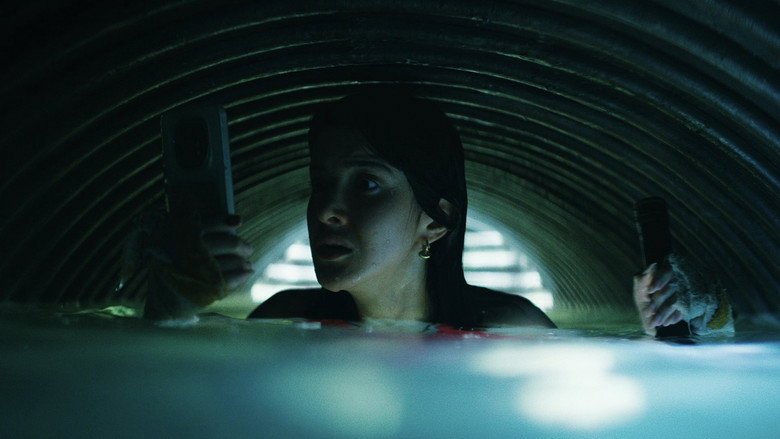
In the end, Tu Yaa Main is a film of contradictions. It’s visually stunning but narratively messy. It has two great performances but a script that can’t decide what it wants to be.
It’s a survival thriller that takes forever to get to the survival, a romance that forgets to be romantic, a social commentary that doesn’t trust its audience to read between the lines. And yet, for all its flaws, I can’t stop thinking about it. Maybe it’s Gourav’s face in that pool, or the way the camera lingers on the cracks in the tiles, or the fact that, for all its missteps, the film feels like something new—even if it’s not entirely sure what that something is.
I don’t know if Tu Yaa Main is a good movie. But I do know it’s the kind of movie that makes you want to argue about it afterward, the kind that lingers in your head like the echo of a half-remembered dream. And in an industry that too often plays it safe, that’s not nothing. It’s just not quite enough.
"A tense, well-acted survival romance with striking visuals whose draggy setup, uneven tone, and clichéd beats keep it from fully landing."
Strong chemistry between Adarsh Gourav and Shanaya Kapoor, stylish cinematography and an increasingly gripping survival stretch in the pool make the second half work. A long, sometimes boring first half, familiar rich-girl–poor-boy and pregnancy tropes, patchy writing and occasionally unconvincing CGI crocodiles make it an average one-time watch for others rather than a must‑see.
Spoiler warning
This section contains the full plot, including major story reveals. Overview above stays spoiler-free.
You came for the crocodile romance-thriller; you stayed wondering what on earth was going on off camera. From a real reptile on set to paycheque drama and a heartbreakingly bad box office, latestnetflix.com maintains, Tu Yaa Main’s behind-the-scenes story is as tense as that drained pool.
Entertainment rumors and trivia aggregated from public reporting. Treat speculation as unverified unless a cited source confirms it.
More titles in the same genres and with the same cast.